| Fuji Kindergarten, Building, Architects, Picture, Proposals, Project, Design, Photos Japanese Kindergarten : Roof House e-architect |
World Architecture : index Architecture News World Buildings |
||
| Fuji Kindergarten : Architecture Information + Images | |||
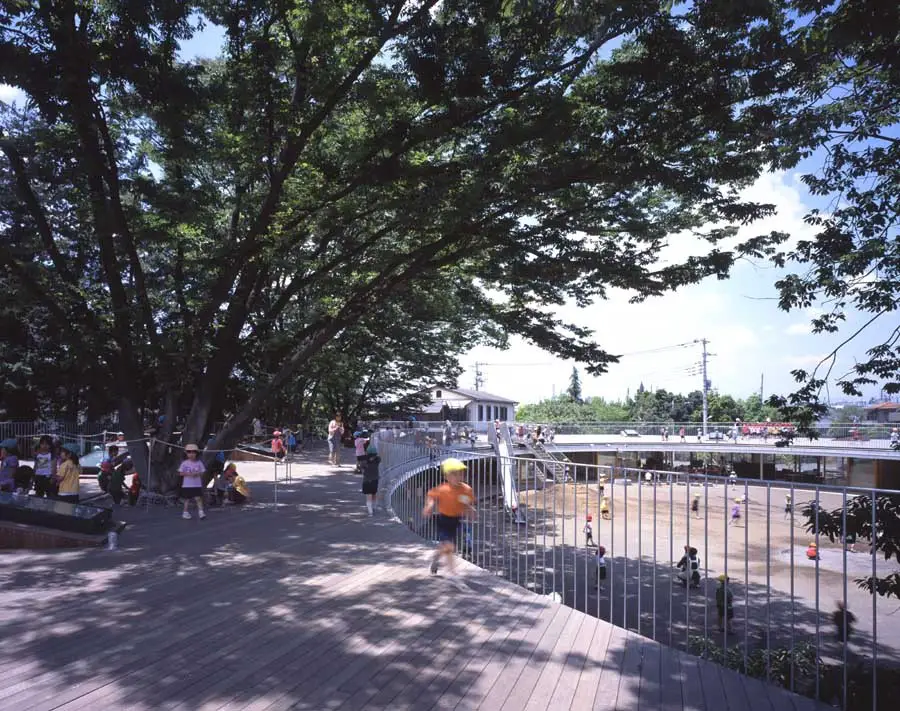
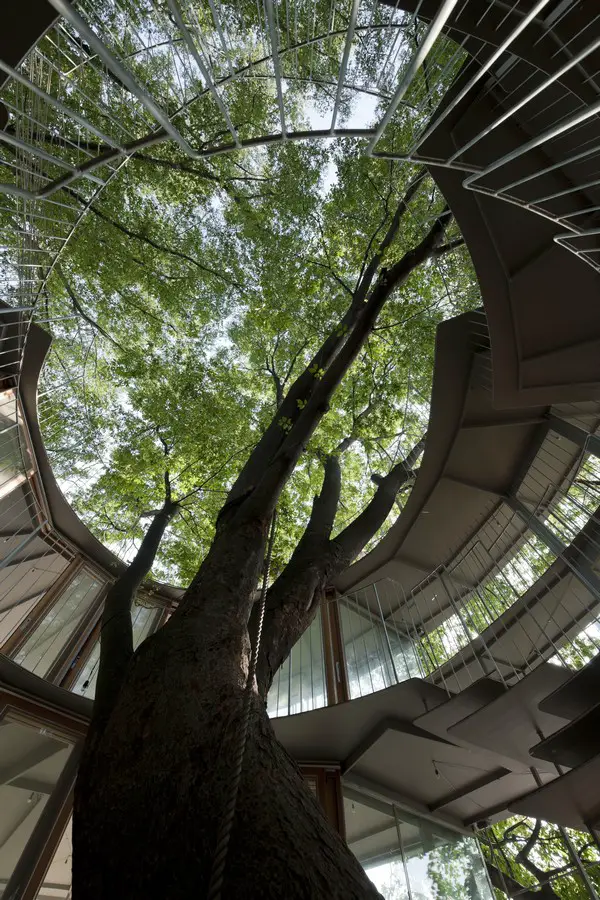
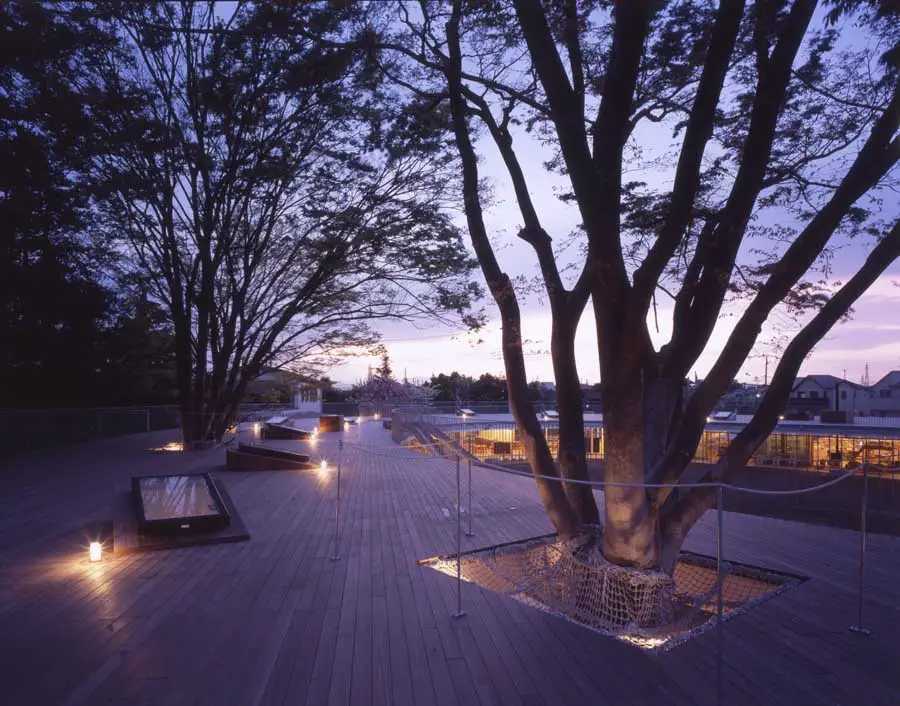
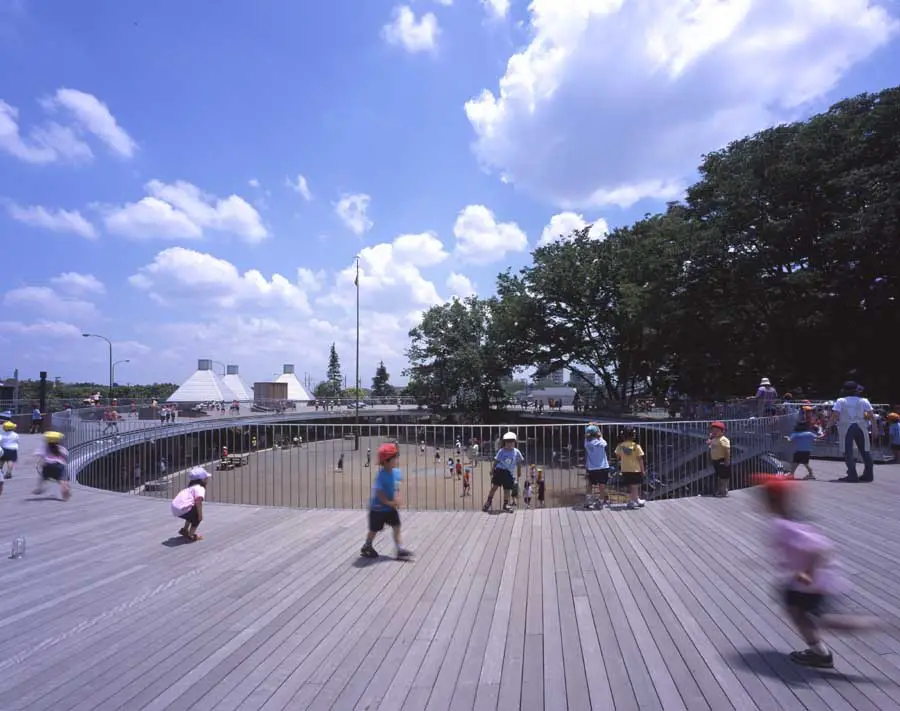
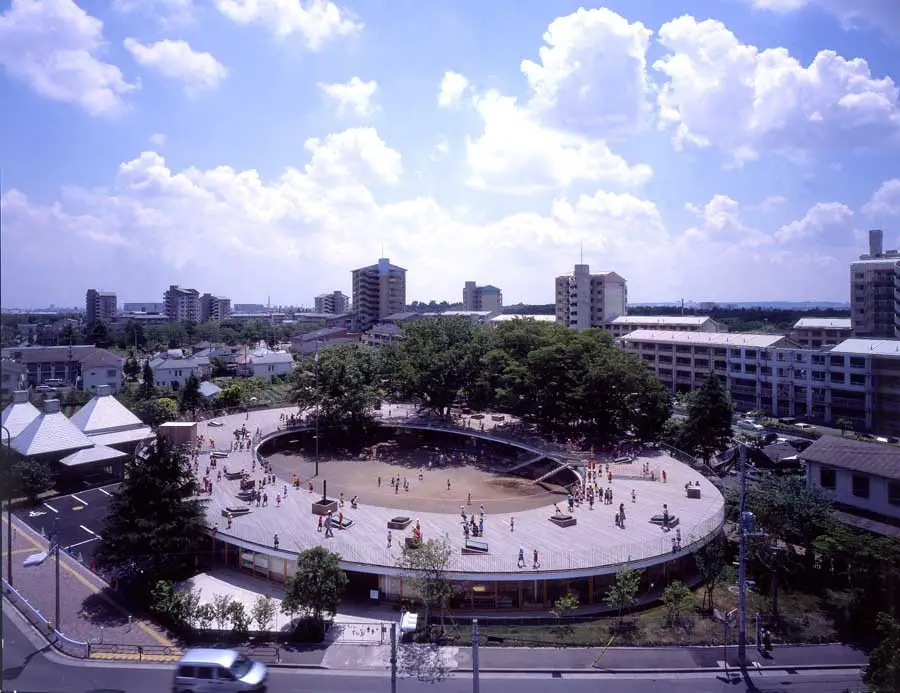
The Roof House 2007 Tezuka Architects Photographs : Katsuhisa Kida The request from the kindergarten directors was extremely simple in content: "we want you to make a Roof House for five hundred kindergarten pupils." We had been introduced by Kashiwa Sato, a creative director who loves the Roof House. The Roof House is a work we completed in 2001. Even now, the family eats together up on the roof. The Roof House has caused debate on its pros and cons. Has the roof been really used during hot summers and cold winters? The answer is YES. The husband and wife team that run the Fuji Kindergarten understood this roof without a single word of explanation. Nor was it necessary to explain the power of understanding of Kashiwa Sato, who had introduced us to the kindergarten directors. At the climax of the initial meeting, we conferred at the Roof House. Although it was originally just an inspection visit, having gone up onto the roof, somehow no one wanted to go home. Whether Mr. and Mrs. Takahashi (the owners of the Roof House) became involved, or whether the other couple involved them, unconsciously there was a deepening feeling of familial solidarity, however slight. We dont think this is due to it being a gathering of people with similar hobbies and preferences. Discussion was unnecessary. The Roof House told us everything. In summer the roof is hot, so we go out in the morning and evening. In winter the roof is cold, so the afternoon is good. These comments from Mr. and Mrs. Takahashi, owners of the Roof House, penetrated to the essence of the architecture. This time, our team understood perfectly. The Roof House is the mother of the kindergarten. ![]() The appeal of the existing kindergarten building Visiting the kindergarten together with Kashiwa Sato, we found a continuously meandering, long and narrow kindergarten building, along with a wide garden filled with large zelkova trees. The kindergarten building was somehow reminiscent of a bungalow. Looked at as a nursery, the kindergarten directors are not buried in the directors office, but constantly walking through long corridors and popping into each successive nursery room. Any room you enter is noisy, so all of the rooms are the kindergarten directors classrooms. Because this atmosphere was so good, we commented, its best to rebuild it just as it is. The kindergarten directors then became worried that if it were to be the same as it is now, these architects wouldnt take on the job of reconstructing it, and so they politely began to inform us about places where the roof leaked. Finally, they told us, "the children in this kindergarten are good at putting buckets under the leaks in the roof." We loved this kindergarten building that we had to destroy. The wide garden was also good. The shadows of the large zelkova trees were also good. If it were to be reconstructed, we vowed to not lose this goodness. Spaces without dead ends That doesnt mean that the oval shape emerged easily. It was a shame that the existing kindergarten building was not connected in a loop. We absolutely wanted to make a space without dead ends, but as we were obstructed by three large zelkova trees, it just couldnt become circular. Riding the train on the Chuo Line one day, we suddenly drew an oval that avoided the trees, and seeing how much better it was, we used it unchanged as the shape. Voices of concern were raised by the team with regard to building while preserving the large trees, all three of them inside the building, but they were overcome by the allure of a space without dead ends. ![]() Colleagues are spaces with unobstructed views and no distinctions In this kindergarten, there are no distinctions between the colleagues. For better or worse, rooms at the ends of a building unavoidably tend to be segregated from the others, but in this kindergarten building there are no hidden places. The place designated as the directors office is a corner at one side of the entry hall. Rather than a directors office, it is merely a directors corner. The directors are also the security guards. Basically, the problems that have been occurring in schools over recent years, including bullying, are created by the presence of hidden rooms. What occurs in closed spaces is unknown. The children have no refuge. Teachers and pupils in closed spaces dont know what is occurring in the adjacent spaces. The spaces in this kindergarten building are in full view of each other. Playrooms without walls There are no walls in this kindergarten. There are just piles of paulownia wood blocks to indicate the area of each class. Because there are no walls, sounds are also transmitted between spaces. The sounds are not blocked by the acoustic absorption material on the ceiling. The rooms are only divided by casually stacked-up furniture, like building blocks. If you scramble up onto this furniture, the neighboring classes can be seen. The problem of inaccessible rooms does not arise here. If a problem occurs in a classroom somewhere, help will soon come from a nearby room. With no hidden rooms, children will automatically adopt socially acceptable behavior patterns. Its also no problem to go to an adjacent classroom for a moment. According to the directors, spaces with a lot of noise are better for raising children who have the ability to concentrate. If you think about it, children don't study in their rooms. Children study in noisy kitchens. Junior high school students go to the library to study, but the library is by no means a tranquil space. People can recognize the voices of others even in the bustle of Shibuya. A peaceful, sympathetic space is perhaps an abnormal condition that doesnt originally exist in society. ![]() Furniture that softly partitions rooms The original boxes that partition the interior of the building were invented by "Jyo Gakkai," a student organization at the Musashi Institute of Technology. Three years ago, over a period of only three days and nights, they produced five hundred boxes for a campus festival. There was no money, so they made really crude constructions using MDF that still had a strong smell of headache-inducing adhesive, but it was a great success. Although these are merely boxes, they allow innumerable children to gather. The children like the fact that there are no requirements. Even if we offer to help, these children running about will very diligently pile up the boxes. Even with no requirements, they will try to get into the narrow spaces. If you give orders, children wont work, but in reality they like to work. With luck, most of the standout pupils here will one day belong to our studio at the university. Based on our impressions of the effectiveness of this idea, we decided to collaborate with the students even more than before. Paulownia wood was used as the material. It was Mr. Hirano that introduced Kashiwa Sato to the kindergarten directors. That was, so to speak, the starting point of this project. Although paulownia has an expensive image, we were told that this could be done at a low price. Because we used soft paulownia, even if the kindergarten pupils bang their heads slightly, it will be the paulownia that gets dented. The corners were given a 5mm radius. The basic module of the box is 300×300×300. This was developed into variations of 300×450×300, 300×600×300, and 600×600×600. Thats because fitting all of the kindergartens teaching materials into the same-sized box would be inconvenient. The outer forms of the boxes are arranged with these modules. The basic idea of the box is a building block. The paulownia can be easily lifted, even by a light kindergarten pupil. The thickness of the boards has been increased in accordance with the span, and even if the children jump on them or hit them, they are sufficiently strong to prevent problems. Basically, even if an adult gets on, they will be safe. Having completed the boxes, the children were gathered into what we labeled a workshop, in which we were told that it would be good if the boxes remained free. The empty boxes were divided into two classrooms and handed over to the kindergarten pupils. The result was like piranha fish in the Amazon River. The kindergarten pupils crammed themselves into the stacked boxes, piling up in an immense uproar. The result was a success, but these boxes were intended for the use of the teachers, and essentially shouldnt be used by the kindergarten pupils. In places where the excessively vigorous kindergarten pupils dragged them out, the door hinges were pulled off. The boxes themselves were robust, but the doors needed further study. Holes were inserted in the centers of the box faces, and places for bolts to be installed were etched on the inner faces. If this was all left entirely free, it would still be unstable during an earthquake, so consideration was given to stiffening braces where necessary. Boards of pure paulownia have been used for those walls that are unavoidable in the kindergarten rooms. These are interposed between the paulownia boxes and stabilized with bolts. It is possible for even the kindergarten teachers to easily demount the bolts. ![]() Water wells in the nursery rooms The image of the washroom in a nursery room is that of an outdoor well. We want the kindergarten pupils to casually chat around these wells. Even having installed so-called walled washbasins, there are no walls in this kindergarten. Besides, rather than washing one's hands while facing a wall, we decided it was more fun for everyone to gather together, cheering and shouting. The waterspout faucet is a molded flexible tube. Inside as well as outside the sink, you can freely turn to your friends, and we were worried about disasters, but unexpectedly the children understand. At present, it is being happily used without any trouble. Naked bulb lighting The lighting is naked light bulbs. Although naked light bulbs do not provide the brightness of fluorescent lamps, this teaches children the way light is made. Strings for turning on the lights hang inside the rooms. However, even if one is pulled, it is only attached to the few lights surrounding the string. To turn on all the lights in a room, it is necessary to go to each place and pull the strings. There are no partitions in the rooms, so naturally there are no walls in which to place the switches, and no walls to divide the lighting areas. Children gather in the places where the lights are turned on, creating a local place. A light dimmer function is included in the switch for each light. Although the purpose is to extend the longevity of each lamp, another purpose is to allow the children to visually check the filaments of the light bulbs that have become extinguished. Children who graduate from Fuji Kindergarten will know why lamps shine. They will also know the relationship between a lamp and a switch. ![]() Eaves There are no balustrades in the Roof House. The kindergarten directors said that it would be good if this kindergarten building also had no balustrades. When we made the Roof House, the husband eliminated the balustrades by merely saying, "there were no balustrades on the roof deck of our previous house, and looking around the neighborhood there are no other houses with balustrades on the roof." Yet a kindergarten without a balustrade is impossible. The married couple that run the kindergarten made a proposal for a device in which children who fall could be caught by a net projecting out from the eaves, but this was no good. We had no answer to the question of what the children who were so caught would then do. The allure of having no balustrades lay in the eaves. The eaves are not just a problem of appearance. Sitting on the eaves is comfortable. Finally, after a period of trial and error, we were able to keep the eaves seating by encircling the roof with slender balusters at a maximum spacing of 11cm, too small for a childs head to enter. Feet can pass through an 11cm gap, unless they are especially big ones, and most adults can also hang their legs over the eaves. On the day the building was handed over, four hundred and fifty kindergarten pupils sat on the eaves. A thousand pairs of socks danced on the eaves. All the people involved couldnt stop their tears of gratitude. The eaves have been lowered to the legally permitted limit. The height of the ceiling facing the courtyard is only 2.1m. A man of normal height can easily reach the eaves with his hand. 2.1m is sufficient for a child. The lowness of the roof means that the top of the roof is near to the underside of the roof. Looking at the roof on the other side of the courtyard, events on the roof can simultaneously be seen. The roof deck slopes toward the courtyard, so even if a person goes further back on the roof, their whole body is visible, right down to their feet. If you jump a little from the garden, you can touch the hanging feet of the children. To cope with falling dead leaves, a wide-open horizontal gutter was specified at the eaves. The collected rainwater falls from gargoyles in four places into four large rain drain pans in the courtyard. When it rains, the children gather around the waterfalls from these gargoyles. The children love this flowing water. Nets around the trees Around the trees, we made use of the ideas of the married couple that run the kindergarten. Holes have been inserted in the roof for trees to project through. We initially tried surrounding them with a 1.1m-high handrail, but the children could pass through it without any trouble, so the final result was a net specifically designed to surround the trees. Although it is difficult to climb a zelkova tree from ground level, it is easy to do so from roof height. Even today, the surroundings of the zelkova trees swarm with children. Directionality of the roof The roof deck is roughly aligned in a single direction. With an oval, the structural lines would probably be applied radially, but the shape of this building is not an oval. There is also no center to be aimed at, nor an index for its transformation. Trying to apply radial boards to the model was really uncomfortable. The building was originally defined with distortions, leading to a condition in which an accurate deck would have to bend the rules. While the building seems to have a center, it is a space without a center. In this kindergarten, neither the desks nor the furniture are aligned in rows. Rather than altering it, furniture that does not lend itself to alignment in rows was chosen. The kindergarten pupils sit in randomly dispersed directions, only turning their heads toward the teachers when necessary. The places under the roof are entirely equal, including those of the kindergarten directors. ![]() Distorted oval The oval has been distorted. This is the result of scanning in a hand-drawn sketch, and linking it with spline curves. It indeed caused trouble for our staff and on site. There is no regularity to the variations in the curve, and there are also parts that are close to being straight lines. Inaccurate construction is not responsible for the swaying of the eaves when you stand on them on site. Although the roof is sloped to follow the water drainage slope, the eaves on the outer perimeter and inner perimeter are each fixed. On the other hand, the width of the building expands and shrinks in accordance with the sketched lines. As a result, the roof appears smooth but is actually the three-dimensional curved surface of a delicately changing hyperbolic shell. A hand can instantaneously give answers that cannot be achieved on a computer. When solving delicate site relationships, such as preventing the trees from protruding, a mouse is only a hindrance. Entirely openable kindergarten building This kindergarten building is used entirely open for two thirds of the seasons throughout the year. This has already been tested, because the building was built in two phases and so half of it has been in use since summer. Therefore, the basic state of this building is with the windows open. The sliding doors directly follow the distorted oval shape. With the ground surface and room interiors at almost the same level, there is no sense of having to take off your shoes, and the distinction between where outside stops and where inside starts doesnt apply. This kindergarten is an outdoor corridor. Going to each place is like taking off your shoes to visit a house. There are no slippers. Thinking about it, putting on slippers when indoors is a strange custom that only exists in the Japanese educational environment. Even in a residence or a workplace, there are no slippers for the general public. Put strongly, even in the cold of midwinter, your bare feet wont be cold if Korean stove-type air-conditioning has been installed throughout the building. Nor does it have the unnatural heat of floor heating that uses electricity or warm water. It is a microclimate that envelops the entire building. Mountain under the stairs To reach the slide, you ascend a stair to ascend a mountain of soil about one meter in height. Because the stairs are low, we considered that there would be no injuries even if someone fell, but to be honest, it was also because we were aware that children would enjoy the heap of earth. The shape of the mountain was prepared by our students from the university. If we used a power shovel, it would unavoidably become an unpleasant crew-cut shape. The mountain was difficult to make, but as we expected, the children love it. No children fall from the stairs and get injured, either. There is a problem, however. The children noticed that the soil of the mountain is softer than the ground surface, and so every day they scrape some off to make mud pies. It has now become a very steep slope. We must again go and pile it up with our students. Play equipment without requirements The play equipment that we made here comprises just one slide. There is not a single piece of play equipment on the roof. The truth is, we gave it up because there was no money, but we think the result of having no play equipment is really good. The rooftop itself becomes the play equipment. What was needed here was a roof. During construction, we went to see Gaudi's Casa Mila. Our purpose was to go to see the roof, which is full of strange, irregular chimneys and windows. Actually, we had visited it seventeen years previously. There is no play equipment at Casa Mila. Thats obvious, because its not a kindergarten, but neither our four-year-old child nor our one-year-old child could stop running around and shouting. No matter how many times they fell down and grazed themselves and started crying, they were soon running around again. It is not only the children that were enjoying it. The adults were also cheerful. Incidentally, not a single item of play equipment appears in the movies of Hayao Miyazaki, which are so beloved by children. Adults as well as children enjoy Hayao Miyazaki's movies. "The house of Satsuki and Mei" that appears in My Neighbor Totoro is a designer's muddled combination of Japanese and Western-style house extensions. In one scene, they search for a concealed stair to the second floor. They are alarmed by a head that projects from a round shoji screen. However, what we both enjoyed was that it was a very ordinary architectural element. It wasnt an invented device. What is important is that it is not given, but found. If it is made to fit a child, an adult cant enjoy it. After all, adults and children have different sightlines. At the same time, a child's sightline is not the same for each person. Their backs also differ in physical strength. Their preferences are also different. If everything is given, we cant choose sightlines for ourselves. Play equipment comprises tools devised by adults to give children ways of playing. Playgrounds are given, and ways of playing are restricted. Children are experts at finding locations by themselves. Children can find locations on the rooftop of the Fuji Kindergarten by relying on the skylights. On the first day the roof was joined in a loop, the teachers guided each class around the rooftop, but the children never stayed with their teachers. They gathered around the skylights and didnt move. While making a full revolution, only a few people remained behind the teachers. From the nursery rooms below, the heads of friends peeping from above seem interesting. The roof is sloping. Just because of this slope, running becomes fun. Even the children who usually dont run will race around this roof. There are said to be children who do thirty laps in the mornings, but thirty laps is 5500 meters, and there is nowhere in Tokyo where kindergarten pupils would run this distance without compulsion. ![]() Tree roots and foundations To preserve a tree is to preserve its roots. With regard to zelkova trees, the spread of the roots is only the span of the branches. Therefore, there are no foundations around the tree roots. The roots extend from the courtyard across the width of the building to the exterior face of the oval. At least the parts under the building do not cause an increase in weight, so flat slabs can span from foundation to foundation. To prevent the areas around the roots being infiltrated by the alkali compounds in concrete, a sheet underlay was installed prior to the leveling concrete. The digging and soil stabilization proceeded while avoiding the roots, and it was more like an excavation site than a construction site. Outdoor faucets Faucets for outdoor use are indispensable for the garden of a kindergarten. Before we made basins for outdoor use, our students investigated various kindergartens, including the nursery schools our own children attend, and discovered not a single one of their basins was unblocked. Of course, there are probably no problems at prestigious schools, where they have people who clean very often as well as a selection of well-behaved children, but this is usually impossible. At Fuji Kindergarten, we observed why they become blocked, and saw that the children get together and use shovels to jam mud pies into the squares of the grille. Thats why they get blocked. Depending on the kindergarten, only the faucets stand high, and the drain holes do not appear unless they are excavated. For ordinary concrete drain pans to be visible in this kindergarten would be unsightly. The image of the exterior faucets is like grass growing up from the ground. The freely curved faucets grow from the ground, and pour water onto the ground. Round slices of tree trunks are arranged on the ground, and water enters their crevices from below ground. Large water drain pans have been installed underneath. In conclusion Our scheme is the "end of an era." The end of an era is a treasure house of "joys" that have now been abandoned. Modern conveniences have deprived children of sensation. They dont know that when it rains, the soil gets wet. They dont know that if a person is hit, they get injured. They don't know the reason why a light bulb glows. What we want to teach through this building is "common sense. Common sense comprises those values of human society that are unchanging, even across eras. Yesterday, we spent the whole day visiting the family of the Roof House. When we first met them, the sisters were in the second grade and fourth grade of elementary school, and they are now in the first grade and third grade of high school. Still, the atmosphere flows unchanged from those days. We think the Roof House will probably still be unchanged when this married couple reaches the end of their lives. And we think that the Fuji Kindergarten will be the same even after fifty years have passed. Fuji Kindergarten images / information from Tezuka Architects 310708 Japanese Architecture - key projects School Buildings Photographs © Tezuka Architects World Architecture Festival Awards 2008 : Learning Category Shortlist Montessori School Fuji Kindergarten Location: Tachikawa, Tokyo, Japan SITE AREA: 4791.69m2 FOOT PRINT AREA: 1699.10m2 TOTAL FLOOR SPACE 1094.83m2 CEILING HEIGHTS (VARIES): 2.172m TOTAL HEIGHTS (VARIES): 2.785m FLOORS: 1 LEVEL Master planning: Feb 2005-March 2006 Phase 1 construction (50%): March 2006 - Sep2006 Phase 2 construction (100%): July 2006 - Jan 2007 Owner: Montesoli School Fuji Kindergarten Creative Director: Kashiwa Sato Architect's firm name, address, phone, and fax number: TAKAHARU+YUI TEZUKA ARCHITECTS 1-19-9-3F, Todoroki, Setagaya, Tokyo, JAPAN Phone: 81(0)3 3703 7056 Fax : 81(0)3 3703 7038 Building Construction Takaharu+Yui TEZUKA/ TAKAHARU+YUI TEZUKA ARCHITECTS Masahiro Ikeda/MASAHIRO IKEDA co.,ltd Original Design Takaharu+Yui TEZUKA/ TAKAHARU+YUI TEZUKA ARCHITECTS Takaharu Tezuka, Yui Tezuka, Chie Nabeshima*, Ryuya Maio, Asako Kompal Kousuke Suzuki Naoto Murakaji Shigefumi Araki Shuichi Sakuma Masahiro Ikeda/MASAHIRO IKEDA co.,ltd Construction/Maintenance Takaharu+Yui TEZUKA/ TAKAHARU+YUI TEZUKA ARCHITECTS Takaharu Tezuka, Yui Tezuka Chie Nabeshima *Asako Kompal Kousuke Suzuki Masahiro Ikeda/MASAHIRO IKEDA co.,ltd Associate architect(s),: if applicable: Takenaka Corporation Kenji Takeshima Masaaki Hiroshima Satoko Inoue Mitsuo Seki Tezuka Lab at Musashi Institute of Technology Takayuki Utsugi Yusuke Hujita Kanako Takeshita Momoko Yoshida Miki Ajioka Nao Otsuka Keiichi Kato Naoko Sato Noriko Tsujimura Megumi Nakamura Yusuke Tanaka Atuko Ota Engineer(s) Masahiro Ikeda/MASAHIRO IKEDA co.,ltd Lighting: Masahide Kakudate / Masahide Kakudate Lighting Architect&Associates Masahide Kakudate, Junko Watanabe * Mechanical,Electrical Engineering Takenaka Corporation Hiroshi Kanemaru *demolished [Ed. assume no longer there....] Tadao Ando World Architecture : e-architect - a guide to key buildings across the globe Tokyo Buildings Japanese architect : Toyo Ito Buildings / photos for the Fuji Kindergarten Architecture page welcome: info@e-architect.co.uk Fuji Kindergarten Japan Building : page - adrian welch / isabelle lomholt |
Buildings by this architect: n/a Key Links: Skyscrapers Architecture Studios New Houses Japanese Buildings |
||