
Bijlmer Station Amsterdam photo, Dutch rail architecture, Architect, Holland railway building picture
Bijlmer ArenA Station Amsterdam
Transport Building Extension in The Netherlands design by Grimshaw, London, UK
post updated 27 April 2024
Design: Grimshaw with Arcadis Architecten
The Amsterdam Bijlmer ArenA Station is situated on the southeast of the city on the line that links Amsterdam with Utrecht. To the west there is a commercial development area punctuated by the newly built Amsterdam Arena, a 50,000 seat football stadium.
photo © Ger Van Der Vlugt received from Grimshaws
post updated 4 Apr 2021 ; 9 Apr 2008
Amsterdam Bijlmer ArenA Station
To the east there is a large residential area with a high proportion of social housing which has become home for large sections of Amsterdam’s immigrant population. Prior to this project, there were four tracks running on a raised earth embankment that split the area in two. The only pedestrian connection was a narrow and dark tunnel within the old suburban station.
On behalf of the City of Amsterdam, Dutch architect Pi de Bruijn proposed a 70m wide pedestrian boulevard aligned diagonally to the railway tracks to connect the two districts. Although initially ProRail were just planning to add a pair of 200km/h tracks on the Amsterdam-Utrecht line alongside the existing ones, they agreed to rebuild a 2km stretch of existing railway with the sole aim of increasing the available height above the planned boulevard by almost 2m. Both clients then agreed to pool funds in respect of a new station, which was to be a transport hub in respect of the national train service, the Amsterdam Metro, buses and taxis, and which was to be sized to cope with Arena crowds on major match days.
Grimshaw worked with Arcadis Architecten on the redevelopment of the station, which had to remain open for the entire duration of construction. This had an important influence on the final design. A viaduct carrying the extra pair of tracks was constructed first and trains from an existing pair of tracks were then rerouted onto it, liberating the latter area as a construction site. This area of embankment was then excavated against temporary sheet piling installed to retain the adjacent “live” one. The process was repeated until there were eight new tracks running at the raised level. The roof enclosure followed sequentially.
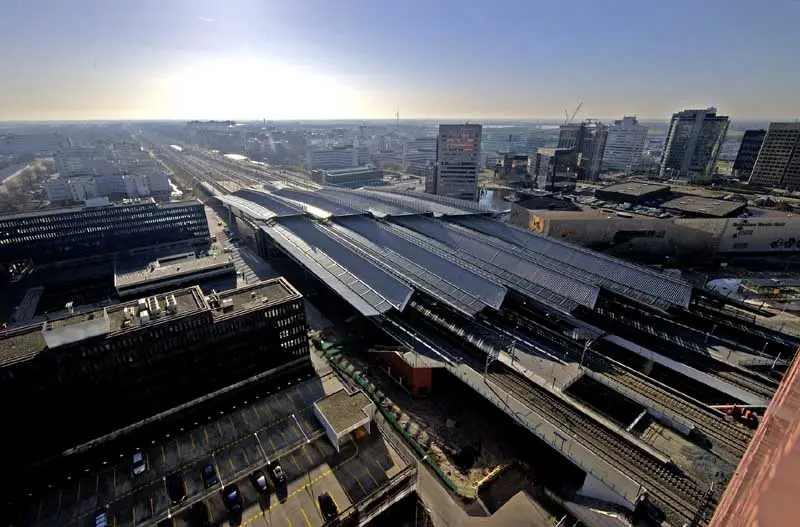
photo © Mark Humphreys received from Grimshaws
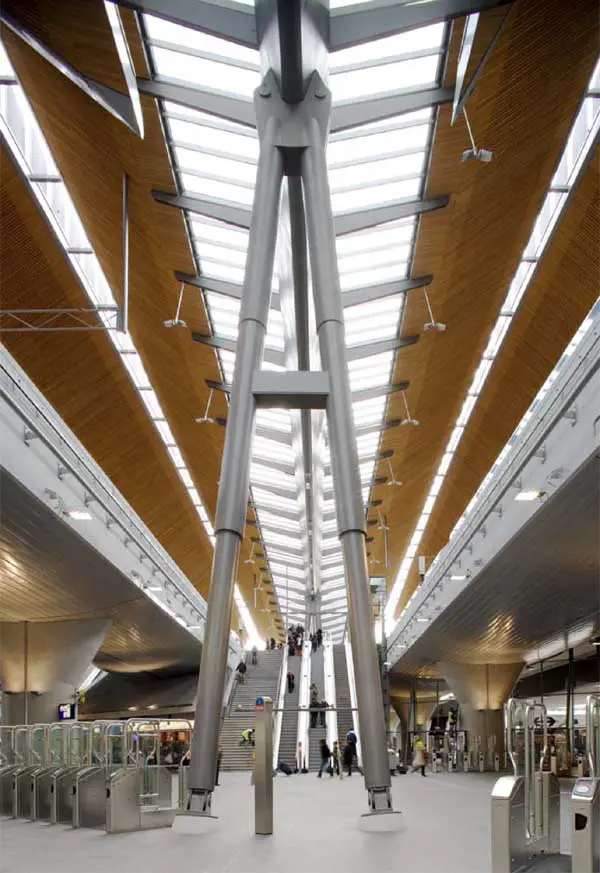
Every aspect of the design process was informed by the need to civilise these viaducts and to create a pleasant and safe ground level public space. To avoid a dark 100m long tunnel, the concrete structures were spaced apart. Each 20m span was supported at each end on just one column via an integrated cantilevered saddle. Arrays of columns were then aligned on axis with the boulevard to maximise visual connectivity from east to west. However, the most important decision concerned the roof design in general and its soffit treatment in particular. It is the modulation of this surface, its ribbons of roof glazing and its acoustically absorbent Oregon pine surfaces that convey civility from the perspective of the boulevard and the platforms below.
The base-element of the roof structure is a “V” shaped continuous hollow steel boom with steel arms cantilevered on either side to support all the roof glazing. The combined assembly is supported on a series of tubular “A” frames with only a single deep longitudinal stabiliser near the south end. Beyond their last supports these booms cantilever up to 18m thereby enhancing the sense of linearity and direction. The timber lined elements straddle each track-bed and are open at ridge level to assist natural ventilation and allow areas for pressure release in respect of 200k/h trains.
The lack of land to either side dictated a corresponding diagonal station hall facing the boulevard under the tracks. This diagonal slant dictated that the escalators, stair, lifts and roofs all be staggered.
To signal the presence of the buried station hall from the surrounding area it was decided to gently arch each boom structure and to split all roof planes above the primary vertical circulation. The station’s angular aesthetic is derived from this methodology. The station is designed to provide a high level of social security both during the day and at night. Long voids are cut into the platforms to break down the overshadowed sections of the 100m wide area below the viaducts. These voids improve the sense of safety through visual contact and improved transparency between the platform and ground level areas.
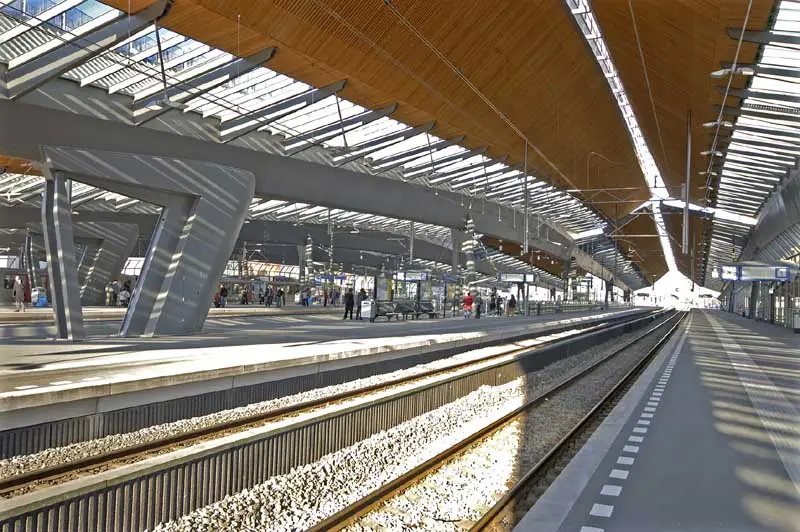
photo © Mark Humphreys received from Grimshaws
They also permit the boulevard and bus station areas to be flooded with natural light. The station hall and platforms are also designed for maximum transparency to improve the orientation of travellers within the building. Escalators, stairs and glazed lifts lead the public from the central ticket hall up to the platforms.
The building has been warmly received in Amsterdam and is generally perceived as a catalyst for the development of the area on both sides of the tracks. Several related projects are already under way, including a parade of shops facing the station hall on the boulevard’s north side and the complete overhaul of the square immediately to the east currently cluttered with a series of temporary buildings.
Bijlmer Arena Station Amsterdam info from Grimshaw 140408
Grimshaw’s Bijlmer station expansion in Amsterdam is ituated in the southeast of the city, the renovated station is one of the ten largest in the Netherlands.
Bijlmer is already a key transport junction, so a major challenge for the team was to design a station that could be constructed alongside the day-to-day operation of the existing facilities.
Bijlmer Arena Station Amsterdam – Building Information
Location: Amsterdam, The Netherlands
Contract Value: 130 million euro
Area: 6,500m2 ticket, retail & auxiliary space; platforms
Design Start Date: Sep 1997
Site Start Date: Jan 2002
Completion Date: Nov 2007
Address: Infraprojecten, Moreelsepark 2 3511 EP Utrecht Postbus 2038
Grimshaw Team:
Partner in Charge: Neven Sidor
Team: Simon Moore, Ingrid Bille, Florian Eckhardt, Nick Grimshaw, Ben Heath, Ewan Jones, John Ridgett, Carl Shenton, Tim Schoenburg; Shoaib Rawat; Benny O’Looney; Giles Omezi
Arcadis Team:
Project Manager: Jan Schouten
Project Architect: Jan Van Belkum
Team Luc Veeger, Harry Beertsen, Hans Van Weelden, Onur Buldac, Michael Van Der Kaaij, Arthur De Groot, Jos Delhez, Christiaan Schmid
Services & Structural Engineer + Rail Engineer + Quantity Surveyor: Arcadis
Shortlisted for Stirling Prize 2008
Bijlmer Station Extension design : Grimshaw
Bijlmer Station Amsterdam award : Stirling Prize 2008 Shortlist
Location: Bijlmer Arena Station, Amsterdam, The Netherlands, western Europe
Amsterdam Buildings
Major New Dutch Buildings
Amsterdam Architectural Designs : links
Amsterdam Architecture Designs – architectural selection below:
Amsterdam Architecture – contemporary building information
Amsterdam Buildings – historic building information
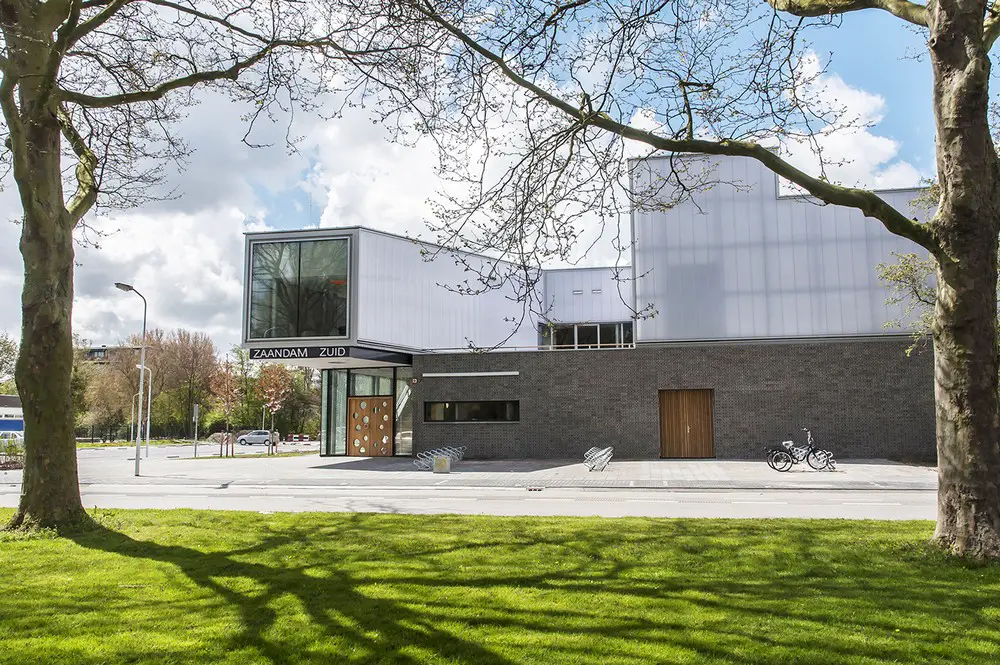
Zaanstad Sports Centre
Design: UArchitects
photograph : Daan Dijkmeijer
Zaanstad Sports Centre
Bijlmer Station Extension architect : Nick Grimshaw
Dutch Architectural Designs
Major New Dutch Buildings
Netherlands Architecture Designs – chronological list
Comments / photos for the Bijlmer Station Amsterdam Architecture design by Grimshaw, UK page welcome.

