
Sustainable Design, Opinion, News, Building, Progress, Climate Change Architecture
Sustainability in the Built Environment : Article
Sustainable Architecture Discussion by Trevor Tucker
Sustainable Design
Article for e-architect by Trevor Tucker, Editor and sessional professor of English literature at the University of Ottawa.
“Never saw a miracle of science that didn’t turn from a blessing to a curse,” sings Sting in the song “If I Ever Lose My Faith In You”. Wendell Berry, Kentucky novelist, one of America’s greatest essayists, and a member of the American agrarian movement puts it slightly differently: “We can’t solve the problems using the same tools that created those problems.”
I have to admit, my lot is with them. I have not the enthusiastic passion of those who feel that science can solve everything, that we’ve had the dawning of the Age of Aquarius, and that humanity is headed for its next great evolutionary leap. In things architectural, I, admittedly, am drawn to the traditionalists. As William Hazlitt wrote in his essay on reading hard books, “I have more faith in the dead than in the living.”

Trevor Tucker
At the old farm a couple years back, I rescued my grandfather’s wheelbarrow from the rust heap. And, though decaying and brown with rust, the thing still works.
I’m using the wheelbarrow to grade a new portion of a blueberry field at the southern-most portion of our lot. So, it’s a day last month. I dump about 30 loads, every now and then thinking about my grandfather’s gigantic hands on these same handles. Among its various unique features, the wheelbarrow has eleven feet of wire, 10 bolts, and about eight square feet of sheet metal…all after-market, all add-ons. I wonder, what was it in my grandpa’s head that lead him to “jimmy it up” this way?
I come inside, and I’m flipping through an architecture magazine. On the first page is a slick ad for a hybrid luxury automobile: “For those in a hurry to change the world.” A few pages over there’s one for a new Hollywood-area way-up-scale neighbourhood that has made responsible use of the best of green materials, and obtained a platinum LEED certification.
Something clashes. Two very opposite faces of sustainability.
Being green is not a new thing. Southern exposure, trees, thermal mass, windmills, using local materials, re-using, recycling, and going to bed when it gets dark, these are things my grandparent’s knew. The average non-corporatized farmer living on the same land his family had owned for generations knew that he had to either take care of the earth or lose it. He composted. He let his land lie fallow. He respected his livestock as creations with their own place in the great chain of being.
And what of his barn? Great-grandfather built this one in 1908. Its entirely post and beam construction with trees felled on his own land. It’s a simple, straightforward, albeit mammoth, design, built by local hands, for whom such mortise and tenon construction would have been one of many skills. And it has barely shifted. The barn has two stories, the lower with a low ceiling, small windows, and stone walls almost three feet thick and of limestone quarried on his own land. This level housed the livestock (In many local barns, often this level was built into the side of a hill) and the upper level was the hayloft. Convection cooled the structure in the summer, and the hay above blanketed the animal’s body heat during the winter.
And they were curmudgeonly about their use of resources. In a time when you couldn’t pop down to the local hardware store and pick up a new, inexpensive wheelbarrow, you made do. You worked with what was on hand and there was just as much pleasure in making the thing last as in buying new. You took the existing, the created thing, with all of its embodied energy and craftsmanship, seriously.
Socks were darned, the water from the cistern was used sparingly, and rooms were heated and lit according to usage. People slept in the same bed for heat. Every milk bag, bottle and can was put to good use. Such cans, filled with unbent nails that my grandfather rescued himself, still line the shelves of the woodshed. My ancestors didn’t think of themselves as saving the planet or of being green. They were frugal, that’s all.
Today, we use cloth bags at the grocery and smile patronizingly at the unenlightened soul still toting plastic or paper. Smugly, we turn out the lights for an hour on Earth Day.
So what would my grandfather say about sustainable architecture? Truth be told, grandpa was a dreamer, and a little eccentric. The story goes that the woman next door once ran back home to tell her husband that she’d seen a bear out in our back pasture. Turns out it was just grandpa farming in the nude, one of his favourite pastimes. This is the man who one night dreamed that there was oil deep below his back fifty; he walked down the lane and planted a pipe to mark the spot.
I see something of him, this man who once had wanted to be a builder instead of a farmer, when I look at my wheelbarrow. I think he’d love the inventiveness and entrepreneurial mindset that’s grown out of our collective green consciousness, the kind of possibility-thinking where you can “mix your avocation and your vocation.” But I think he’d also be suspicious of gadgetry and anything trendy, say, like fake trees to capture CO2 instead of real ones, or the new array of geo-engineering projects that seek to wrest control our environment from the forces of the universe. He’d question the sanity of our local official who recently stated, “We have to act now so that in the future we get the temperatures that we want.” I think he’d loathe the constraints of buffer zones and organic certification rules. But Ewart Campsall would love the freedom to dream, to take the new technology and adapt it to his own environment. No doubt he’d be the first on the street to have built his own power-generating windmill. Probably ugly and made completely with spare parts, but functional and out of his own brain.
Perhaps not surprisingly, in my own search for understanding architecture, and particularly sustainable architecture, I’ve been drawn to what has lasted. Cross-ventilation, southern orientation, thermal mass, and convection, these all have resurfaced in architecture throughout time. They are all common-sense approaches that are easy for any homeowner to understand, incorporate and then enjoy with a little pride at one’s ingenuity.
“When you don’t have anything, everything is possible,” reads a line from an advert on Afrigadget.com quoted in Ethan Zuckerman’s November 2008 article on Worldchanging.com. Zuckerman aptly captures the spirit of the green entrepreneur in his feature that highlights the ingenuity coming out of the developing world. He offers some key “principles of innovation from constraint”:
– innovation often comes from constraint
– don’t fight culture
– embrace market mechanisms
– innovate on existing platforms
– realize that problems aren’t obvious from afar
– understand that what you have is more important than what you lack
– build infrastructure on infrastructure
Now this is the kind of stuff my grandfather, and his forefathers, would understand – the latest master plans for tightly regulated and technologically-dependent green cities and hybrid cars being far from their ken. And it’s this holistic respect for both what’s come before and what’s possible with a little imagination that I feel drawn to in my admittedly early education in sustainable architecture. I’ve started to formulate my own list of what sustainable architecture should be about. Here are a few ideas:
1. Does it have psychological and physical resonance with the past?
2. Is it built to last forever?
3. Could it give adequate shelter without mechanical systems?
4. Does it facilitate the easy changeover of mechanical systems?
5. Does it merge with and support the local ecosystem?
6. Does it merge with and support the local community?
7. Does it connect us to the natural environment and make us want to live in a “green” way?
8. Can it be fixed by the owner (ideally) or at least by a local means?
Idealistic, yes, but doable. Read about the developing world ushering in innovations such as agricultural co-operatives, solar-powered stoves and micro-generation plants, all from locales devoid of big corporate money and government R&D grants, where people have to make due with what they have. They’ve got something to teach those of us on the other side of industrialism. Something about our once pioneering spirit. Perhaps the lesson is as simple as remembering that money is a resource, too.
Trevor Tucker
Editor and sessional professor of English literature at the University of Ottawa
Trevor Tucker
Architectural Designs
Sustainable Buildings – Building Issues : Article by Adrian Welch
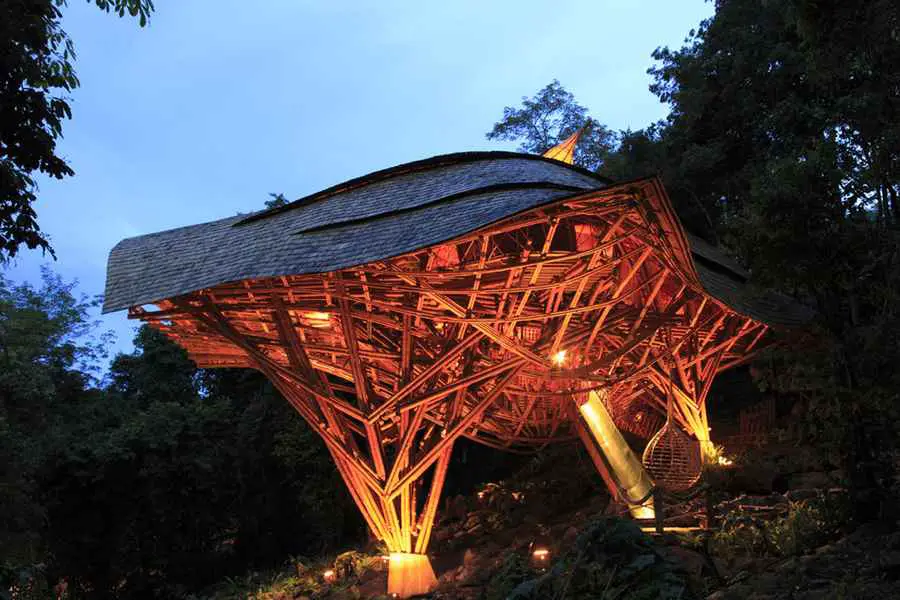
photo from architects
Sustainable Building Design : article by Trevor Tucker. 18 Aug 2009
Sustainable Home Architecture : Lotte Glob House
Sustainable Architecture : main page

image from architects
Sustainable Architecture News Scotland : Scotland
Comments for the Sustainable Architecture Design page welcome

