
Rotterdam City Tower, Images, Architecture, Dutch Skyscraper Design, Building Proposal
Rotterdam City Tower, Netherlands : Dutch Skyscraper
Dutch Skyscraper, The Netherlands – design by Monolab, Architects
19 Jan 2009
Rotterdam Tower
2009-
Design: Monolab
A TRUE HIGH RISE FOR ROTTERDAM © 2009. Monolab initiative
Clients: call for investors – project developers
design: Monolab
ROTTERDAM CITY TOWER
…Rotterdam is considered the architecture and high-rise city of the Netherlands.
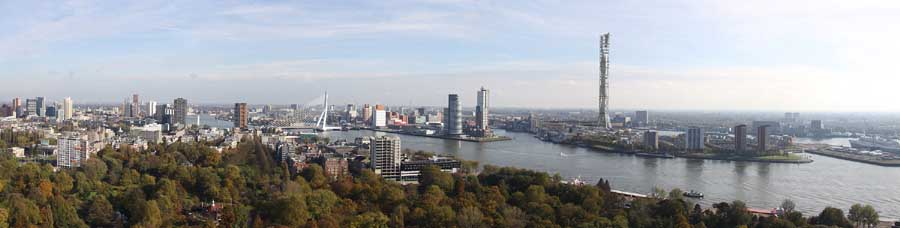
MONOLAB architects is not convinced and delivers a recommendation to address this in reality. These Rotterdam-based architects project a distinct tower, the ROTTERDAM CITY TOWER, on a unusual location: right in the Maas Harbour…

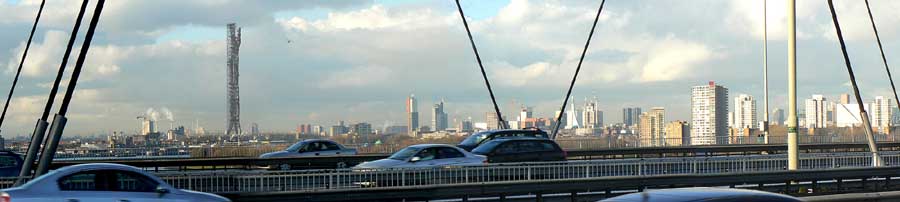
Jan Willem van Kuilenburg, principal of Monolab Architects: ‘Rotterdam is too hesitant, too defensive and too much like an underdog. After the Erasmus bridge we are in need of a real skyscraper of European scale of which Rotterdam can be proud. All currently realised towers in Rotterdam are of mediocre quality and very primitive. As we should save in prosperous periods, it makes the current economic crisis the right time to invest. This new 450-m tall Rotterdam skyscraper is ambitious and at the same time pragmatic:
1. For Rotterdam it re-opens the window to ambitious architecture. Rotterdam always was an urban experimental field, since it’s center was bombed out during the second World War, but since the eighties Rotterdam lost its courage.
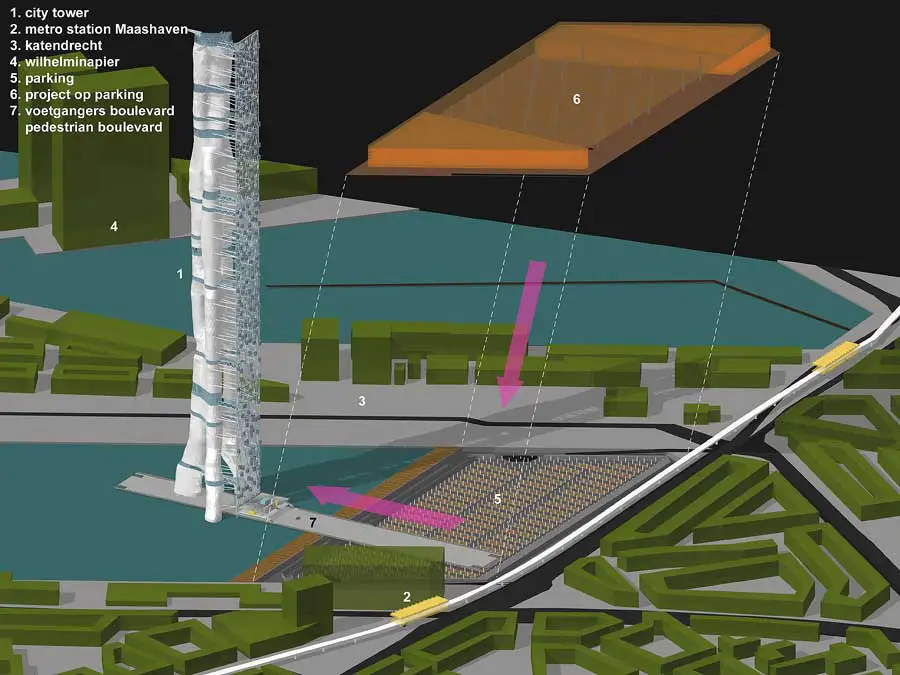
2. It stands in the water. Conventional towers are on top of massive parking lots. We shifted the Rotterdam City Tower into the harbour and realised a second project on the vacant site on top of this parking lot for 1000 vehicles. This second project has scenografic qualities with its huge urban window and plaza towards the Maas harbour and the daily sunsets. It mediates between the big scale of the tower and the surrounding city. The Rotterdam City Tower is connected with a steel pier as pedestrian boulevard to the parking and to the quay plus metro station.
3. The skin of the tower is finished in Photovoll glass, it delivers all necessary energy.
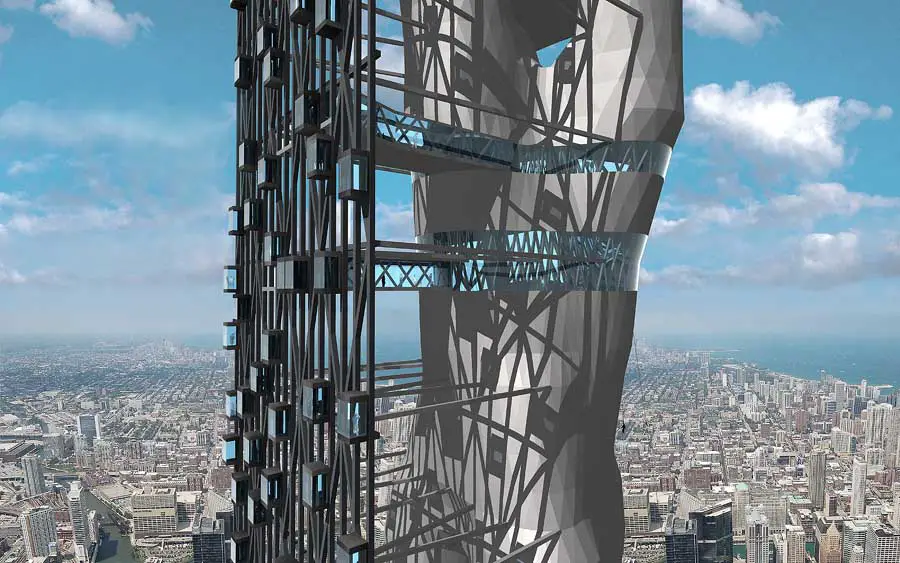
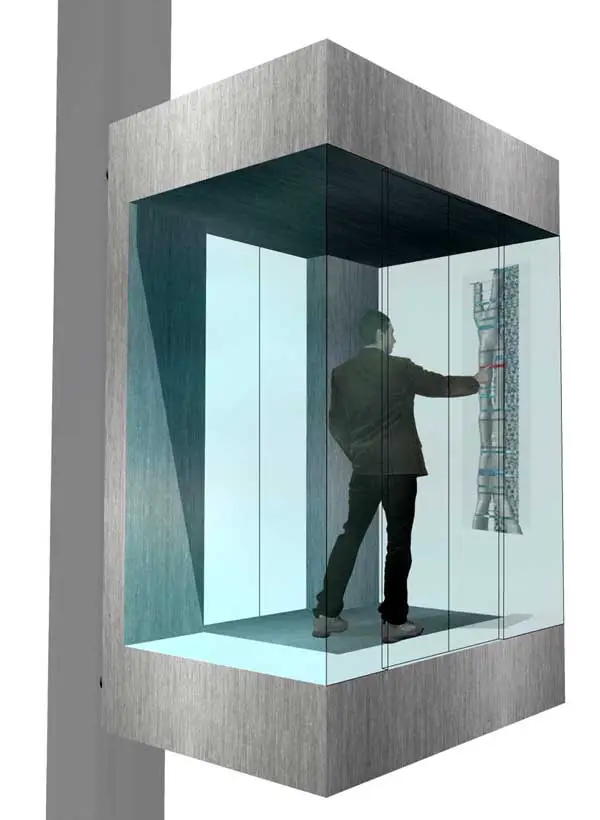
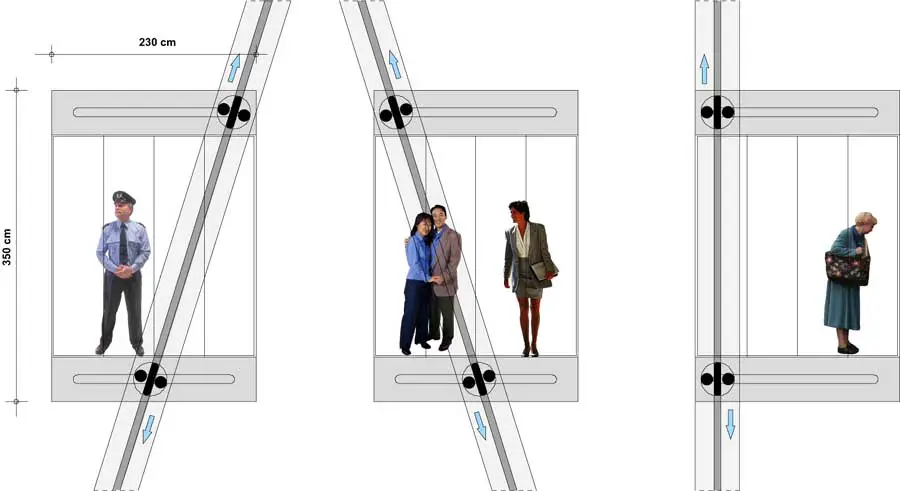
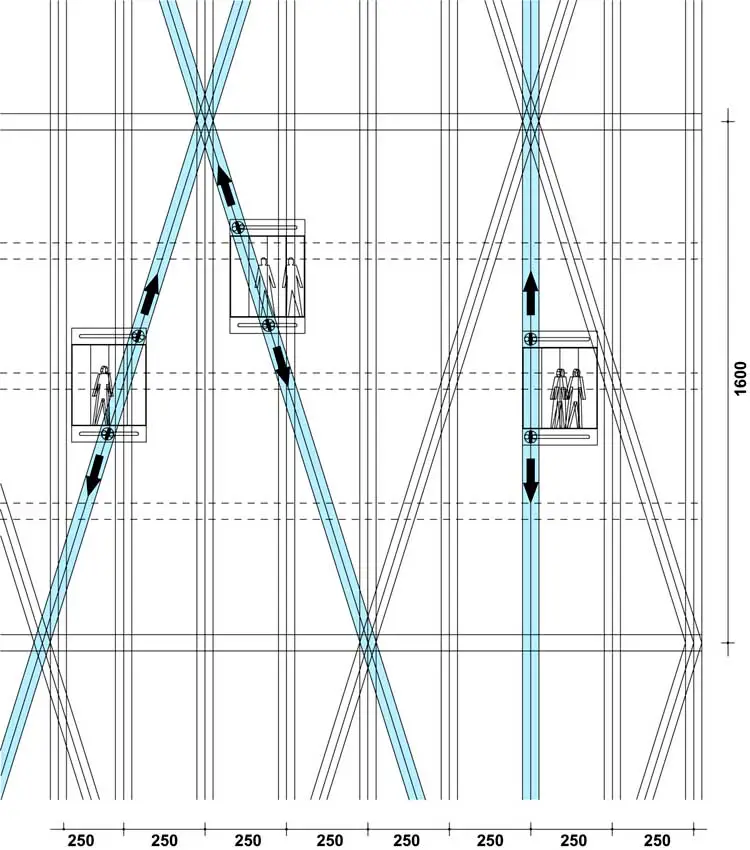
4. Traditional towers need internal transport cores for elevators and emergency stairs. These cores destroy the tower floorspace and every single elevators occupies a vertical core. In this project we placed the core outside, as a grid, holding the elevators. As the grid allows many trajectories we made a cloud of elevators or better: gondolas, strategically moving up, down and diagonally for passing. Placing the vertical transport system outside, its appearance displays a building ‘under construction, something very common to the Rotterdam people. You could say we designed a true Rotterdam high-rise…at last’.
The high-rise zone, planned by the DS+V urban planning office, is extended southwards by MONOLAB as a facilitating spine for the complete city. It stretches from the Central Station District via the Kop van Zuid to the Zuidplein public transport hub and Ahoy multifunctional venue. In this zone, the Rotterdam City Tower is the first of a series of towers, slowly walking Southward…
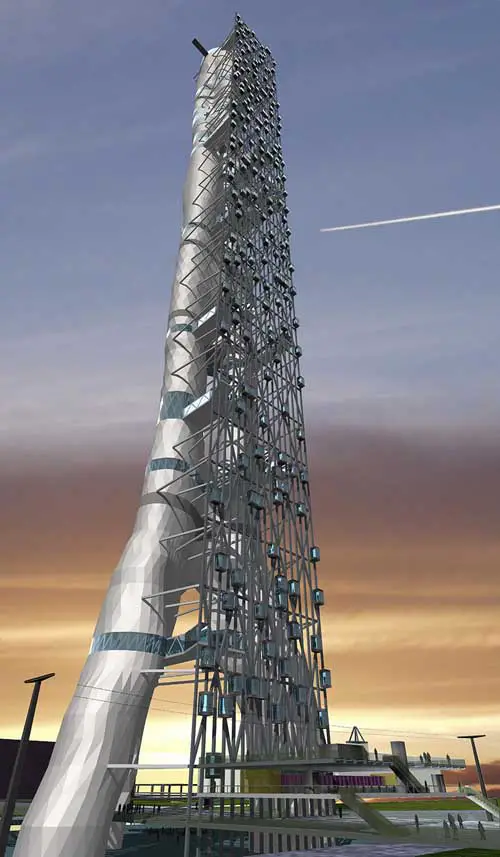
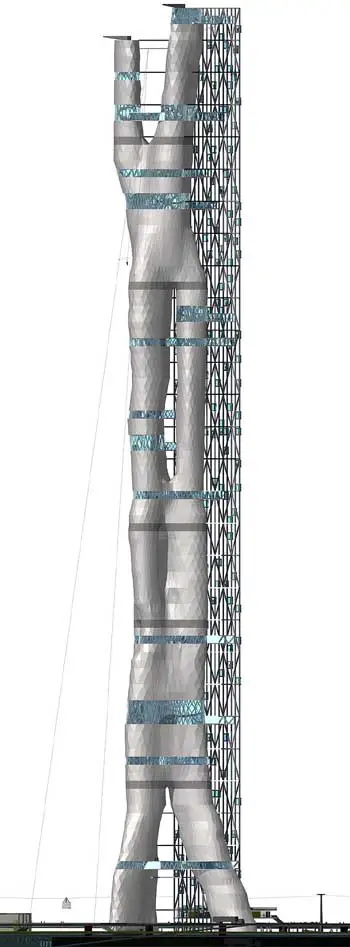
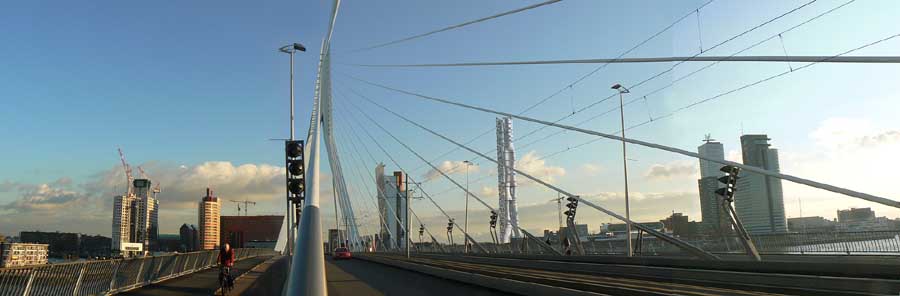
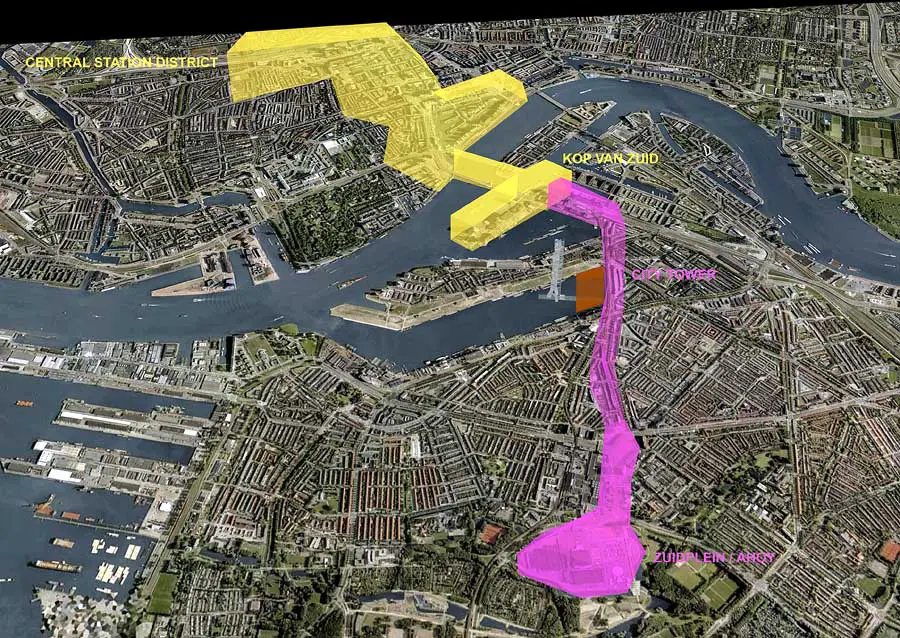
The Rotterdam City Tower project consists of four co-operating parts:
1. the tower (sculptural, pure, free and heroic)
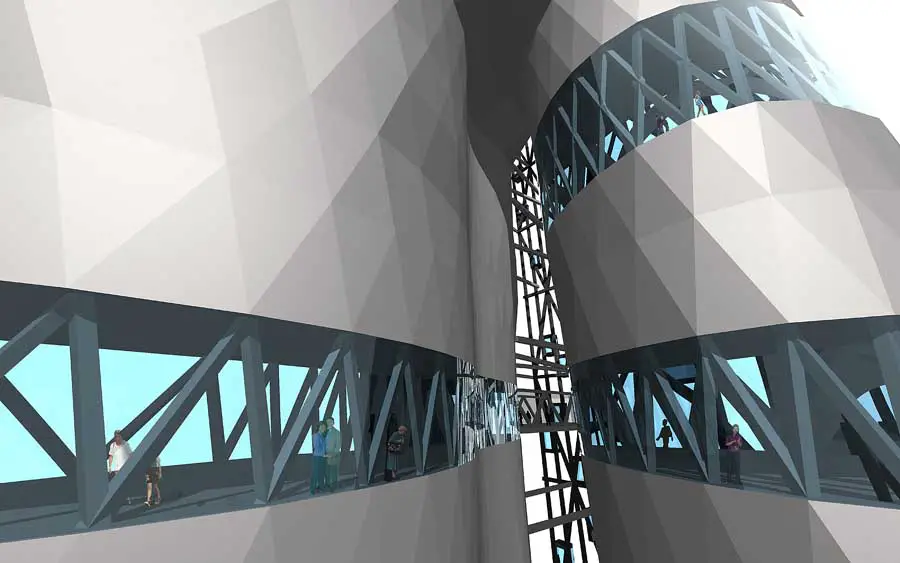
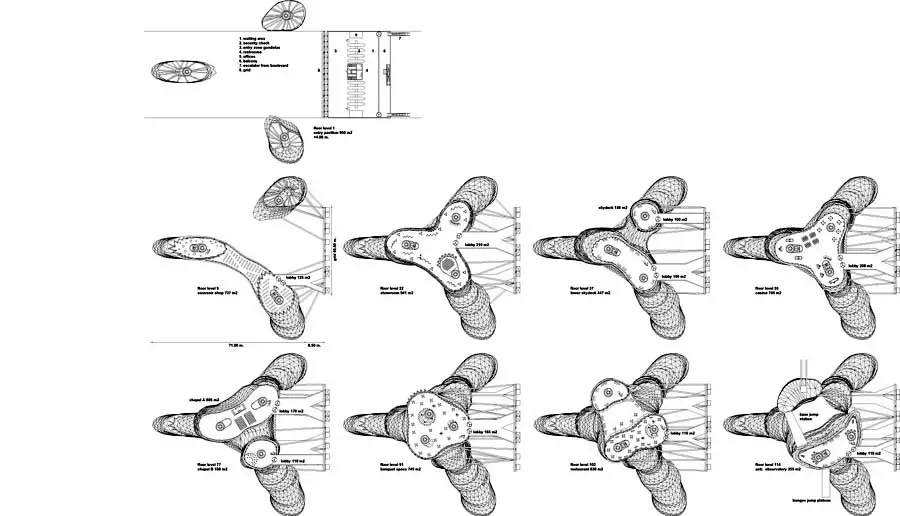
The tower stands in the water of the Maas harbour to minimise wind and shadow effects and to provide another project on top of the parking lot. The Rotterdam City Tower functions through the intense co-operation with the grid. It is a sculpture, a liberated tower, communicating through emphatic design. From the surrounding context it looks different from all sides. The Rotterdam City Tower has a full potential of 83.400 m2 floorspace. It is programmed with apartments, offices and special entertainment/commercial programs like three observation decks and eleven locations for facilities like sport clubs, cafe’s, restaurants, bars, office spaces, recreation space and extreme sports facilities. The special programs are finished in very transparent glass, the apartments and office floors are finished in Photovoll glass, which is almost not transparent, seen from the outside.
2. the grid (a vertical highway, holding a cloud of gondolas)
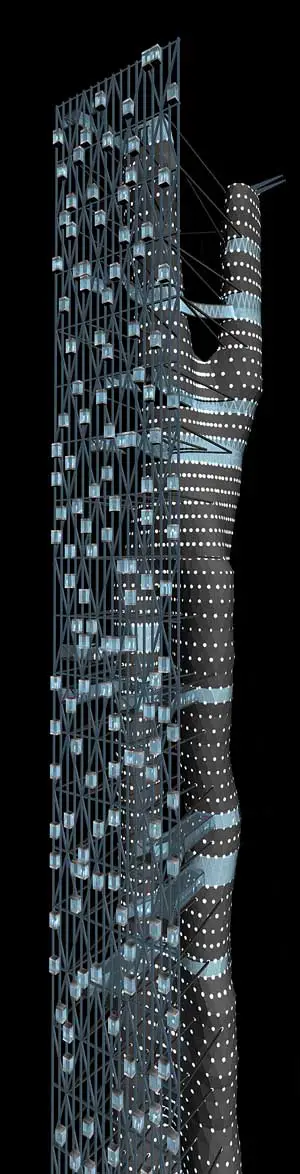
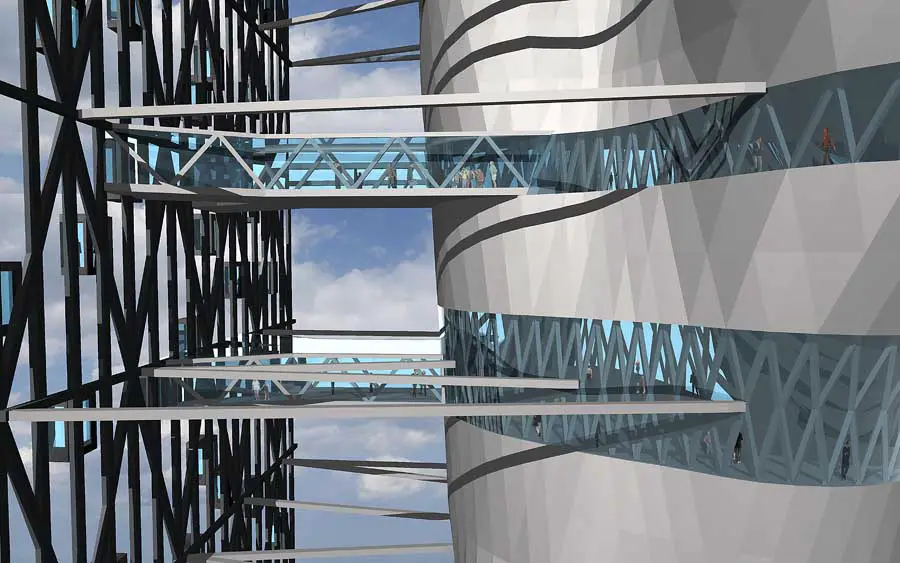
The grid is a vertical highway, a dedicated logistical matrix. It services the Rotterdam City Tower as a carrier through continuous transport of gondolas that travel individually along the structural supports. The grid goes far beyond traditional elevator systems because of velocity, efficiency and capacity of passengers and addresses. It defines an exponential urban user-density by holding a maximum of 200 gondolas (max. 12 passengers each), which makes a theoretical 2400 passengers travelling at the same moment. All the Rotterdam City Tower gondolas move individually through their own energy cells and electric engines. All gondolas together have continuous intercommunication. In this way they avoid congestion and collision by strategically moving up, down and diagonally for passing, all supported by the grid. The grid is structurally stabilised with a steel forest of spacers connected to the tower. Sky lobbies make connections, suspended between grid and tower, serving parts of the tower via short internal elevators and escalators.
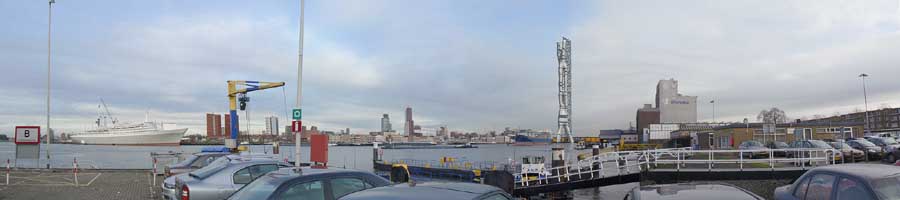
3. the boulevard (a pedestrian bridge, crossing the water and giving access to the complete Rotterdam City Tower project)
The urban pedestrian boulevard is a pier, an interface connecting to the nearby Maashaven metro station. It crosses the parking and the harbour and gives access to the grid and tower. It is a steel grid structure covered with profiled glass planks, like a ‘shadow’ of the grid.
4. the parking lot (along the quay of the harbour)
The concrete parking lot has a capacity of 1000 parking places in a 15.00×15.00-m. layout. The roof makes a location for the second –scenografic- project with its huge urban window and plaza towards the Maas harbour.
circulation
The pedestrian boulevard brings people via escalators into the tower through the check-in pavilion with security facilities. The grid is the transport medium for a cloud of gondolas. Through the entry pavilion visitors and personnel travel via gondolas to co-ordinates, dedicated addresses on the grid. Denser clusters of gondolas will appear if programs in the tower are more demanding at certain moments. The gondolas bring people to sky lobbies that make connections between the grid and the Rotterdam City Tower.
lighting design
The Rotterdam City Tower project has various options for lighting:
1. the tower is lighted in full height from the grid and displays its sculptural qualities,
2. the tower is in the dark, while its LED covered skin displays a 3D galaxy,
3. the grid displays the intense activity of the gondolas through a perpetual changing pattern of moving light particles,
4. the pedestrian boulevard is uplighted as a floating strip over the water.
STRUCTURAL STUDY
The Rotterdam City Tower has no traditional core and has a steel structural envelope which is made of triangular elements. Horizontal structures handle forces on the facade every 12-m. and support the structural envelope sideways. These structures can be floors or, if these are not available, ‘spider structures’: beams radiating from a center ring. The rings are connected vertically, providing tubes that hold the emergency stairs. The Rotterdam City Tower facade is made of approximately 7.500 prefabricated unique triangular panels of Photovoll glass that deliver the tower’s electric energy needs. The tower foundations reach very deep to take vertical tension forces and lateral wind forces. The tower has 5 technical floors to handle fire fighting, evacuation, and climatic services.
The grid consists of vertical steel profiles with horizontal members every 16-m. Diagonals in the grid serve as passing lanes for gondolas and for lateral stability. The grid is stabilised towards the tower through a forest of steel spacers. To handle possible deflections, hydraulic devices below each vertical member are tuning the verticality of the grid. Sky lobbies connect the grid and the Rotterdam City Tower, suspended in space.

The boulevard is spanning the complete site like a bridge. It has a structural layout, supported every 15 m., which fits the parking grid. The pedestrian boulevard measures 380 by 40 m. and has a maximum capacity of 7.000 pedestrians. Its steel members are 50×50-cm. Glass planks with a profiled anti slipping topside make a semitransparent walking surface.
The parking lot has one layer with a standard grid of 15.00×15.00 m. concrete columns.
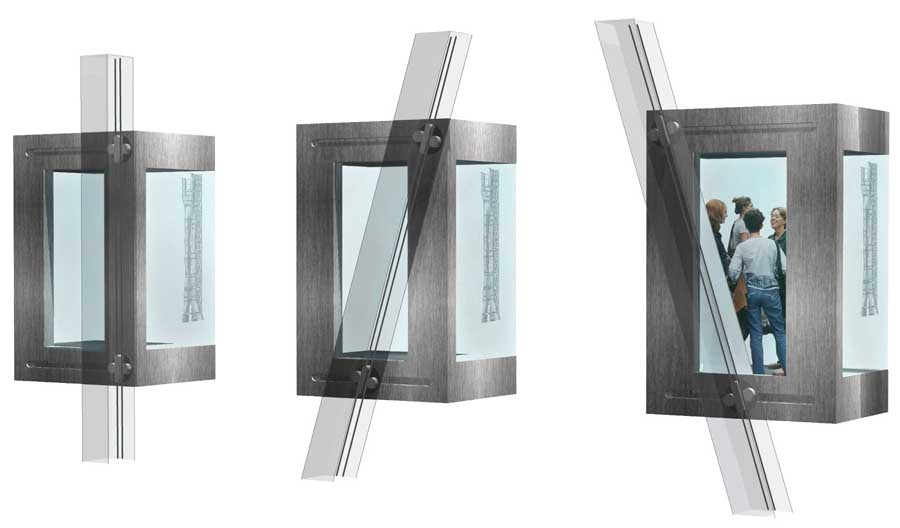
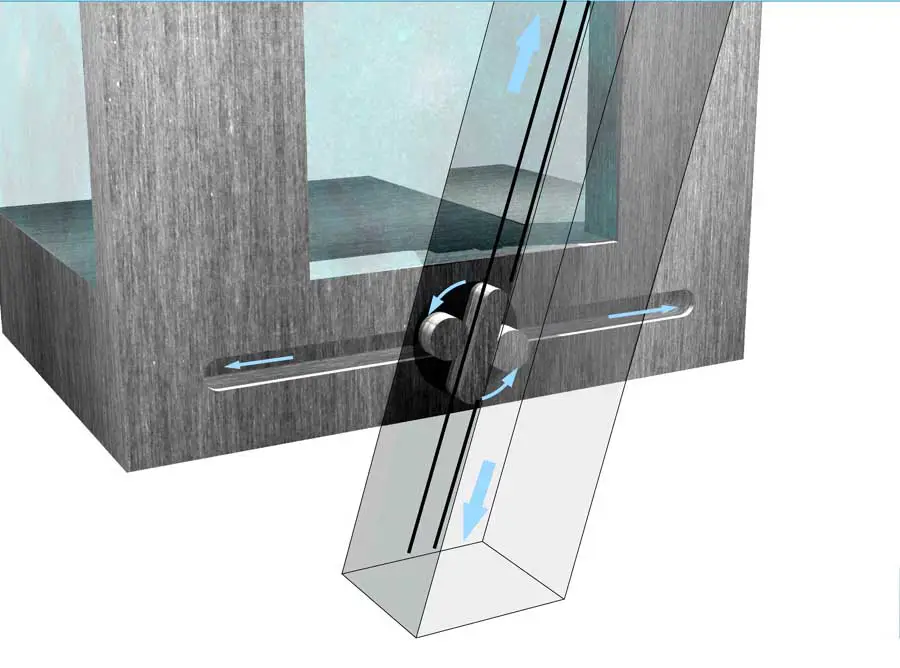
All gondolas move individually by their own energy cells and two electric engines, one in the top and one in the bottom. Each engine drives a heads that locks into the steel grid, driving the gondola along the grid vertically and diagonally. The heads can rotate to change the direction of the gondola. The cloud of gondolas inter-communicates to avoid congestion and cueing. Through variations in speed and change of directions vertically and diagonally, each gondola finds its own critical path to a requested address. In the side window of each gondola an interactive touch screen is embedded in the glass to command the address. Rotterdam City Tower gondolas have two sets of doors: in the front passengers step in from the entry pavilion, and the back gives access to the sky lobbies and the tower. The gondolas are glazed to give panoramic views while travelling. Each gondola can hold a maximum of 16 passengers. Maintenance of gondolas takes place in dedicated parking locations on the grid.
© MONOLAB ARCHITECTS
Rotterdam City Tower images / information from Monolab 190109
Rotterdam City Tower architects : Monolab
Location: Kop van Zuid, Rotterdam, The Netherlands
Architecture in Rotterdam
Rotterdam Architecture Designs – chronological list
Rotterdam Architecture Walking Tours
Rotterdam Architecture Studios
Rotterdam Architecture – Tower Selection
De Rotterdam
OMA
De Rotterdam Towers
Montevideo – tower
Mecanoo architecten
Rotterdam tower
Key Tower designs around the globe:
Russia Tower
Singapore Tower
Burj Dubai Tower
Key Dutch architects:
UN Studio
Mecanoo
Rem Koolhaas
Rotterdam bridge
Rotterdam station
Coolsingel Rotterdam
Dutch Architect Office : MONOLAB urbanism-architecture, Rotterdam, Netherlands
Comments / photos for the Rotterdam City Tower Design page welcome
