|

Photograph © Robin Hill
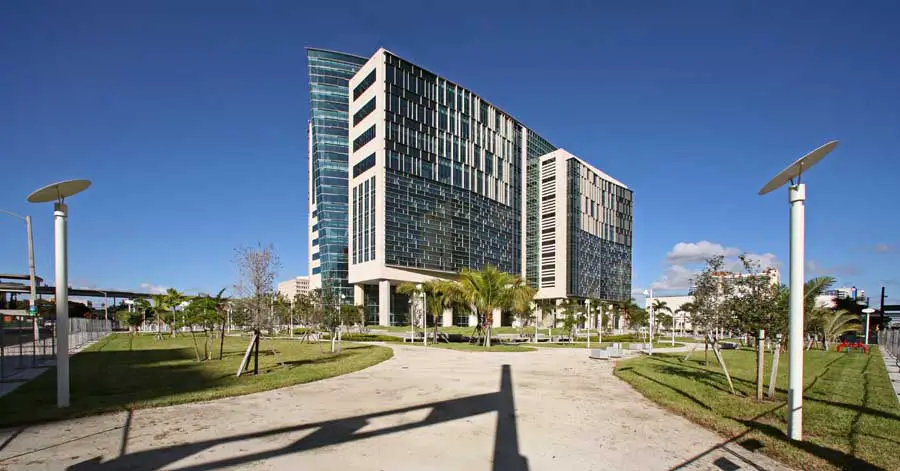
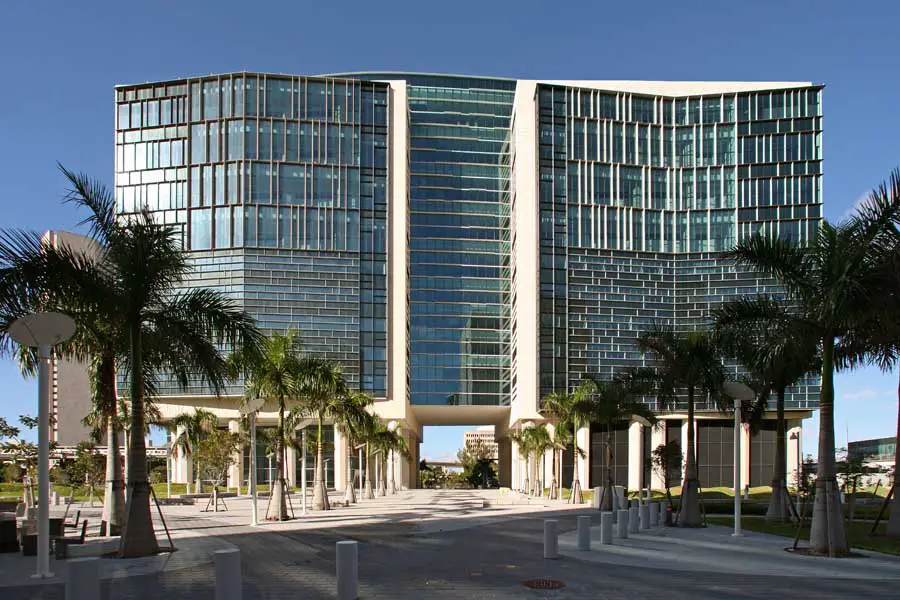
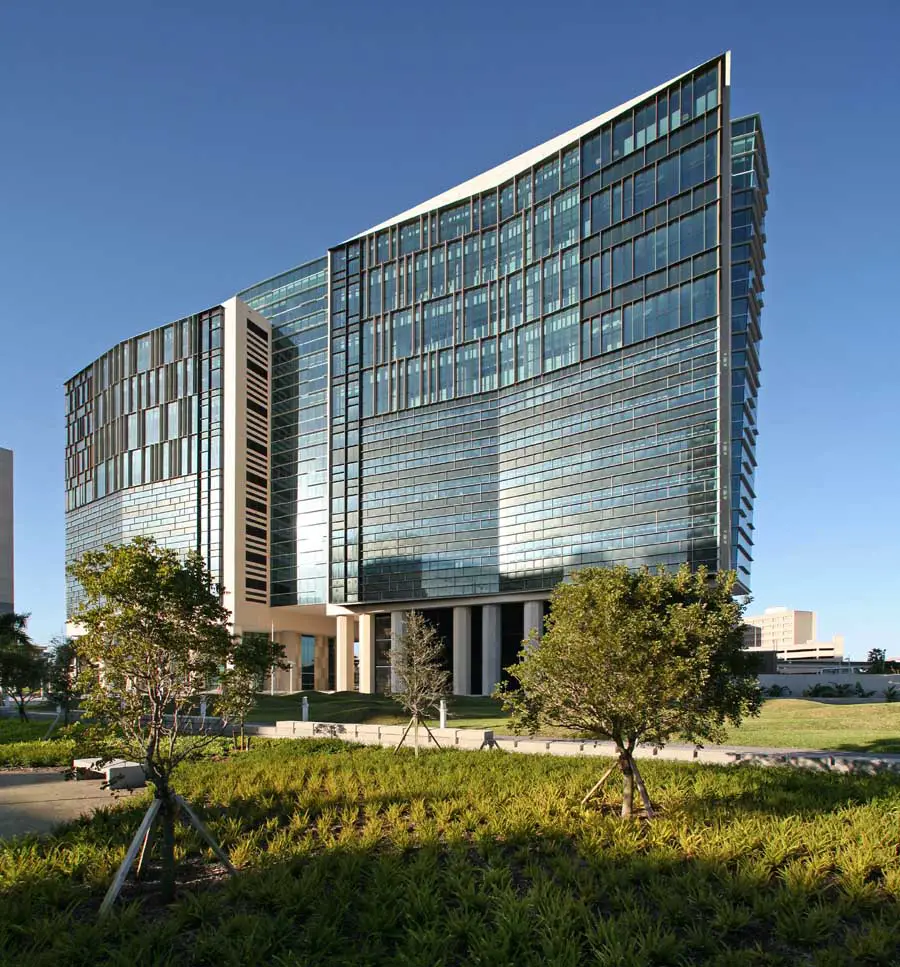
This $129,000,000.000 courthouse of 77,784 SF stands at the end of the
axis created by an urban promenade. Located on what were once separate
blocks, the towers face east and west. Each is dramatically lifted three
stories off the ground by massive free-standing and engaged limestone
columns. The center atrium is elevated above the plaza to maintain the
physical and visual axis through the building. The façades are
scored with a pattern of mullions suggesting the different functions within
from tall, broadly spaced lines that announce public spaces to shorter,
more densely packed divisions that delineate the offices on lower levels.

Image © Norman McGrath
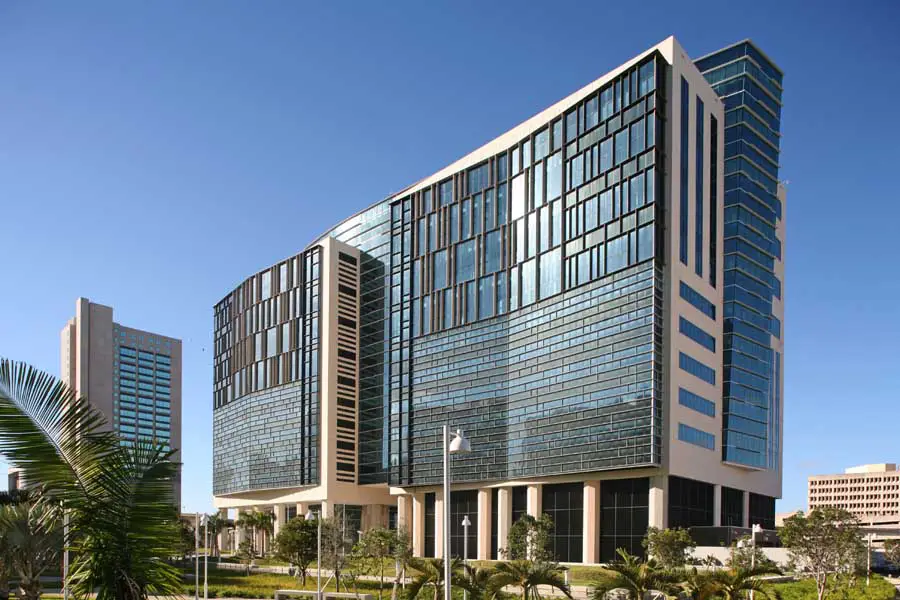
The profile is characterized by the layering of different forms and details.
Courtrooms, judges chambers, and court-related office space are
defined as two glazed towers edged in sand-colored precast concrete. Joining
the two towers is an 8-story curved glass form that appears as the hull
of a great ship held inside and rising above the framework of the towers.
With its prow pointed south, this volume is defined by an expansive blue-green
curtain-wall highlighted with slender horizontal sunscreens in various
lengths and locations. In the paired east and west tower façades,
the precast concrete frame is thicker at the bottom edge of one and the
top edge of the other. In the same elevations, the wall of one building
moves out while the other is pulled back.
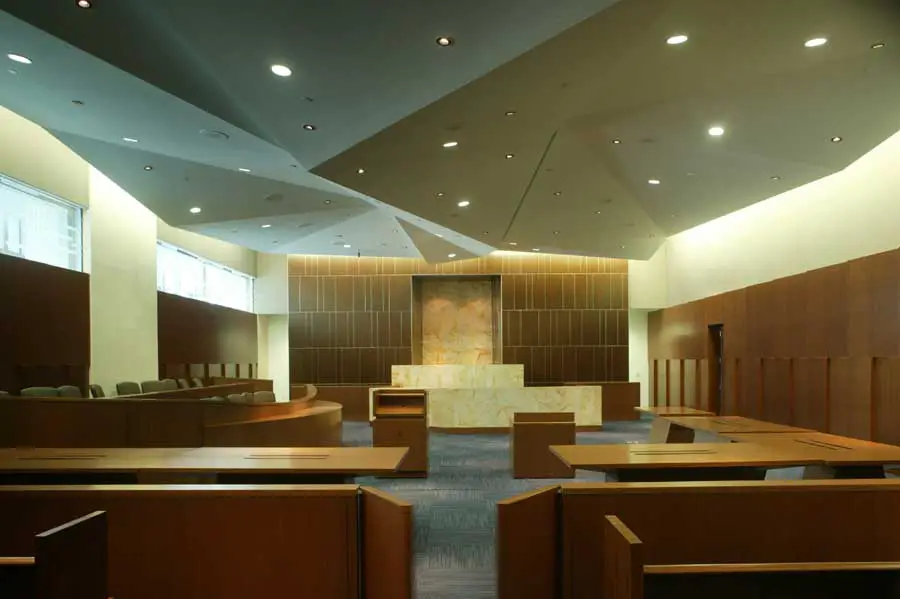
Image : Julio Espana, © Arquitectonica
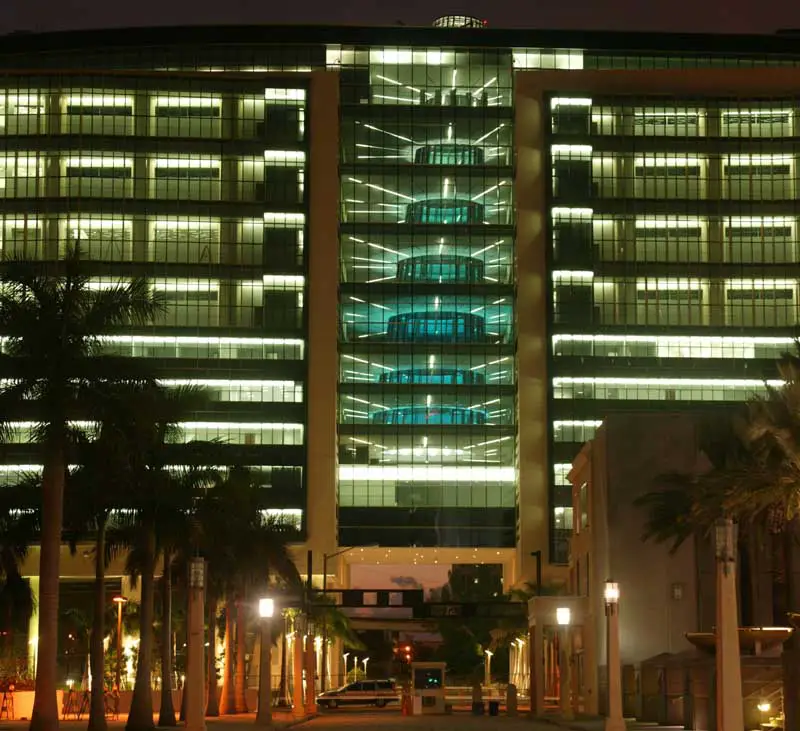
The building is about openness, with exterior and interior engaging each
other as if in dialogue. The planimetric design is based on four-courtrooms
per floor. The two court towers are connected by a generous circulation
lobby, occurring on every floor, and rising dramatically throughout the
entire height. The courtrooms themselves are designed with clerestories
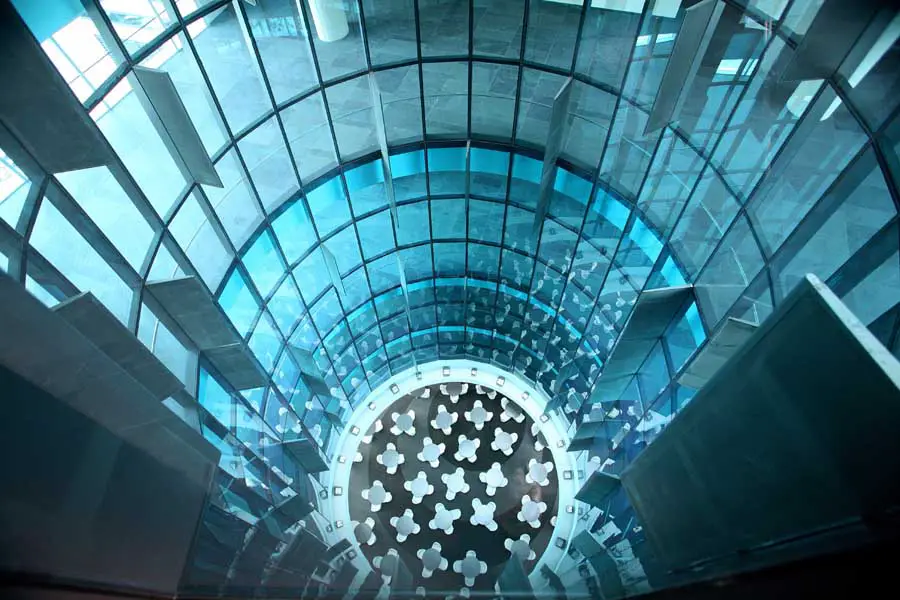
for natural light. The transparency is most evident in the central section
where floors seven through 14 are a multistory atrium penetrated by an
expanding cone of colored glass piercing through the lobbies and decreasing
in size as it rises through the building, terminating in a skylight. At
night, the cone is illuminated and can be seen through the façade.

Photographs © Robin Hill
A contemporary colonnade surrounds the south tower entrance alluding in
its mass and scale to classical porticoes. These columns are the threshold
to a five-story glass walled lobby. The floor is slate, and interior walls
are covered in irregularly staggered vertical limestone panels. At the
north end elevators rise to upper floors; to the south, an escalator dramatically
crisscrosses the lobby to the fifth floor jury assembly area.
Photograph © Robin Hill
Levels five and six span the entire length of the building but on levels
seven and higher the light-filled atrium divides each floor. On the courtroom
levels, ten through 13, the walls are lined with the same limestone found
in the lobby. On these floors, elevators open into waiting areas with
expansive views. Courtroom plans in the east and west towers are mirror
images of each other. These spaces have clerestory windows that bring
in natural light. Finishes include fabric acoustical panels and overlapping,
multidirectional cherry wood paneling. The furnishings and fixtures are
walnut. In the rear center of each courtroom, the judges bench is
faced with teak and limestone in front of a backdrop of wenge wood panels.
Of particular visual interest are the folded, origami-like courtroom ceilings.
These provide acoustical benefits and reinterpret a signature detail of
the building that visitors first encounter in the water wall under the
open portal.
Award:
2007, American Institute of Architects Academy of Architecture for Justice,
Design Certificate of Citation

Photo © Norman McGrath
Miami buildings

Wilkie D. Ferguson, Jr. United States Federal Courthouse
Location
400 North Miami Avenue, Miami, Florida 33128
Owner
General Services Administration
Region 4
401 West Peachtree Street
Atlanta, Georgia 30365
Terry Fuquea, Senior Project Manager, Real Estate, Design and Construction
terry.fuquea@gsa.gov
Tel: 404 331-1305
Fax: 404 331-7063
Architects formal firm name, address, telephone and fax number
Design Architect
ARQUITECTONCIA
in joint venture association with
Hellmuth, Obata + Kassabaum
Arquitectonica
801 Brickell Avenue Suite 1100
Miami, Florida 33131
Telephone: 305.372.1812
Fax: 305.372.1175
Partners-in-Charge of Design
Bernardo Fort Brescia, FAIA; Laurinda Spear, FAIA
Architect of Record
Arquitectonica
Associate Architects
Hellmuth, Obata + Kassabaum
4040 NE 2nd Avenue, Suite 301
Miami, Florida 33137
305.573.5101
Interior Designer:
ARQUITECTONICA INTERIORS
Size: 577,784 GSF
Published Budget $129,000,000.00
AWARDS
2007 AIA Academy of Architecture for Justice, Certificates of Citation
Project Description
The Design
The building stands at the end of the axis created by the 4th Street Promenade.
However, because the center atrium space is approximately 20 meters above
the plaza, both the physical and visual axes are maintained through the
building. The design completes the judicial campus created by the old
courthouse, the courthouse annex tower, the Lawrence King Building and
the federal prison.
The planimetric design is based on a four-courtroom per floor layout.
The two court towers are connected by a generous circulation lobby, which
occurs on every floor, and rises dramatically throughout the entire height
of the building. A dramatic conical glass atrium connects the floors by
piercing through the lobbies and decreasing in size as it rises through
the building terminating in a skylight.
The site plan is divided into two distinct zones. The first, at street
level is comprised of densely planted native vegetation punctuated with
seating and meandering walks which can be used for local art fairs and
markets. The second zone is the lawn. It is raised approximately 1 meter
above the sidewalk forming a natural and secure perimeter around the building.
The walls of the plinth have seating. The two east quadrants of lawn areas
were designated as the sites in which the artist Maya Lin developed her
earthen installation, Flutter. The hard-scape is primarily
comprised of three-colored pre-cast pavers, which coordinate, with the
pre-cast panels of the building.
The building is composed of three individual elements: the opposing two
towers and the glass crystal that spans between them.
The east and west curtain-wall elevations of the two towers are a blueprint
for the interior functions within the building. The alternating rhythms,
depths and colors of the horizontal and vertical sunshades delineate the
primary office, circulation, chamber and courtroom functions located in
the tower.
The north and the south facades of the tower are solid pre-cast with punched
openings reinforcing the solidity of the envelope which then create the
asymmetrical frame on the east and west elevations.
The signage is located on all four elevations of the tower. At the base,
it welcomes pedestrian, at the top it acts as a banner for the vehicular
traveler. The exterior expression is primarily transparent and open reflecting
the integrity of the court while emphasizing equality before the law.
A monumental three color stone colonnade recalling the richness of traditional
courthouses supports the south tower. The north tower sits upon the building
garage clad in stone columns placed at irregular intervals and a metal
grille. The crystal curtain-wall spanning the two towers contains an atrium
that pierces through each floor.
Stacking
The lower basement level contains two separate yet secure tunnels to the
Courthouse Annex Tower. One for prisoner movement and the other for staff
circulation.
The upper basement level contains a vehicular access to the south tower
parking where there will be 16 secure spaces for the judiciary
The building lobby is located at the south tower. Entry is from underneath
the gateway, and in front of a multi color stone water feature of 40 m
wide by 10.60 m high. By passing through security the public is allowed
into the main elevator lobby. The main lobby, where the Great Seal is
located, and the elevator core are clad in a three color natural limestone.
Escalators to jury assembly are located in the southern most tip of the
south tower in an 18 m high space.
U.S. Marshal prisoner sally port, central plant, transformer vault, main
electrical room, loading and GSA support are located on the plaza level
of the north tower. Entry into secure parking is accessible from this
level via ramp.
Main mechanical, electrical, maintenance and storage rooms are located
in the ground level at the North Tower.
Parking in the north tower occurs on levels 2 to 4.
Mechanical room for the south tower is located on level 2 of the south
tower.
Public defender is located on the 3rd floor
Jury Assembly is located on the 5th floor and is accessed directly by
escalators located at the southern-most tip of the building.
The U.S. Marshal Service and central holding facility is located on the
6th floor. It is the first full floor that spans over the plaza and connects
the two towers. The Marshals have direct access to both secure elevators
on each side of the building, which link all the courtrooms above.
The Grand Jury and USAO are located on the 7th floor, while the Clerk
of Court is split between the 7th and 8th floors. The cafeteria and servery
are located in the 7th floor public space that spans across the Pedestrian
Promenade and looks out over onto the judicial campus and the bay to the
east.
Clerk of Court is located on the 8th floor.
U.S. Probation offices are located on the 9th Floor
The District Courtrooms, judicial chambers, jury rooms, holding cells
and waiting areas are located on floors 10 to 12.
The 13th floor contains the two Special Proceedings courtrooms located
in the north tower.
The judicial library and conference rooms and private dining are located
on the 14th floor.
Air handlers for the courtrooms are located on mezzanine floors in between
the courtrooms on levels 10 to 13.
Cooling towers, emergency generator and elevator machine rooms are located
on the mechanical penthouse level.
Interior Finishes
The courtrooms are finished in a combination of wood veneer paneling,
acoustical fabric wrapped panels and custom design glass in the walls.
The ceiling is painted drywall in a custom designed origami
shape. All millwork for the courtrooms, including the judge's bench, clerk's
bench, jury box, witness stand, and gate are veneers of three different
species of wood. Wood pew seating matches the walnut millwork.
All Judges' benches are handicap adaptable. Jury boxes and witness stands
are handicap accessible.
Carpet tile is used over raised floor areas in the courtrooms.
Judicial chambers consist primarily of wood paneling; fabric wrapped wall
covering, wood base and carpet. A combination of drywall and acoustical
lay-in tiles are used for ceiling treatment.
All courtroom public waiting areas and the main public lobby area receive
drywall, wood panels, and limestone in three colors. Floors are in black
calibrated slate to ensure durability and ease of maintenance.
Office space and jury deliberation rooms, attorney/client conference rooms
have painted drywall, vinyl base on carpet with acoustical ceilings. Public
restrooms with ceramic tile floors and walls and drywall ceilings.
Secure holding areas and all prisoner movement corridors are constructed
in reinforced glazed ceramic tile in accordance to the U.S. Marshal' design
handbooks. Flooring in the secure areas is in epoxy terrazzo for ease
of maintenance. Stainless steel, security acoustical ceiling system is
used.
All mechanical, utility and electrical closets are constructed of painted
CMU. Acoustical considerations are given to those areas that are extremely
sensitive. This is achieved through wall treatment and sound attenuation.
Art-in-Architecture
Maya Lin was selected as the artist. Her work encompass the two east lawn
quadrants of the building plaza. Each quadrant contains sculpted dunes
and waves of earth and Bermuda grass reminiscent of the Florida coastline.
The gentle dunes are approximately 3-4 feet high, ergonomically designed
to allow children to play in them and adults to use them as seating areas.
The dunes are deep enough to enhance the building's perimeter security.
Highlights of the Design
The architect has fully designed a building that both meets the strict
requirements of the United Sates Courts Design Guide and incorporates
client, tenant and city requests, which include the following:
Natural light in all the courtrooms, chambers and jury rooms
Perimeter Security
Avoid relocation of underground utilities along NW 4th Street
Preservation of the 4th street promenade
Unified Landscape Design
Underground subway considerations
Dramatic interior space
Public Plaza/Community space
Tunnel connector
Building image and scale
30 year Expansion
The team achieved a significant reduction in the amount of impermeable
surface area. Increase landscaping means less contaminated runoff into
ecosystem.
Native and draught-tolerant plantings will conserve water and reduce maintenance.
An efficient drip irrigation system will deliver water to plants with
minimal evaporation.
The design goal is to provide 50 percent shading of glazed areas, which
provides significant reduction in the cooling load.
The building envelope uses 9/16 inch laminated glazing for the curtain
wall system and punched windows, which removes over 99 percent of ultraviolet
(UV) radiation. Low-E glazing proved to be less effective; energy modeling
showed that it trapped solar heat gain in the building.
Since microbial growth is the leading indoor contaminant, no internal
insulation will be utilized for HVAC ductwork or sound attenuators. Commissioning
before occupancy will also reduce the risk of microbe-related indoor air
quality problems.
Materials include locally manufactured precast concrete; low-VOC paints,
adhesives and finishes; low-toxicity waterproofing and damp-proofing compounds;
and non-endangered wood species.
Specifications require construction waste recycling during demolition
of existing television station on the site and during construction of
the new facility.
ten museum park miami
Florida
Property
World Architecture : e-architect
- a guide to key buildings across the globe
Miami Condominium
: COR tower, Miami
American Architects
Comments / photos for the Wilkie D. Ferguson Jr. United States Federal
Courthouse page welcome: info@e-architect.co.uk
Wilkie D. Ferguson Jr. Courthouse
Miami page - adrian welch / isabelle lomholt
|