
Bird Island Home, Kuala Lumpur, Building, Malaysia Architecture Images
Bird Island : Zero Energy Home, Malaysia
Contemporary Malaysian Residence – design by Zoka Zola Architects
6 Feb 2009
Zero-Energy Home – Rafflesia House
at Bird Island at Sentul Park in Kuala Lumpur, Malaysia
International Invited Competition – Winning scheme
The Competition
Zoka Zola Architects have been selected to participate in an international competition for Zero Energy Housing, on six sites in the middle of Sentul Park in Kuala Lumpur. Eight designers were asked to submit two designs. From sixteen designs, six designs were chosen to be constructed.
The project is envisaged as the first showcase of Sustainable Zero Energy Housing in the world. The competition brief called for houses that work in harmony with the environment, are made from renewable materials, create their own energy, and recycle water.
“This project will become as important of a permanent exhibition for sustainable contemporary architecture as the Weissenhofsiedlung Exhibition of 1927 was for the modern movement in architecture last century.” (South China Morning Post 11.16.2007).
Beside requirements that the houses are zero energy, the competition called for innovative and extraordinary designs that contribute to the legacy of contemporary architecture.
Rafflesia Flower
Our wining design (unintentionally) looks like the Rafflesia, the largest flower in the world and a native to the rainforests of Malaysia. (Rafflesia used to be Malaysian national symbol, but it is now replaced by Petronas Towers.) The Rafflesia develops from the bud into a flower over a period of nine months. The blossom is pollinated by flies attracted by its scent, which resembles that of the carcass. The flower lasts for only a few days. Rafflesia challenges traditional definitions of what a plant is because
it lacks chlorophyll and is therefore incapable of photosynthesis. Rafflesia is a parasite. It did not begin its life as a parasite, but evolved this lifestyle. Biologists do not know what the Rafflesia’s function is in its ecosystem.
This mystery incites one of the most elementary questions: What is the function of the humans in the world’s ecosystem?
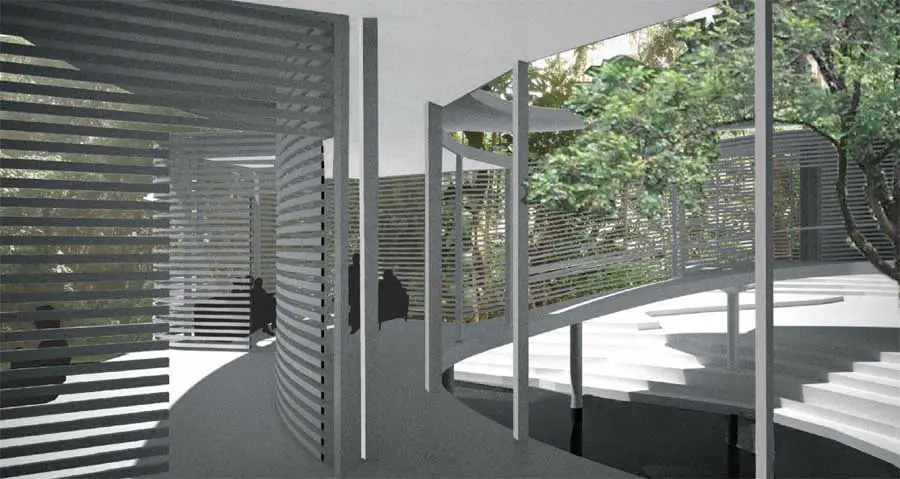
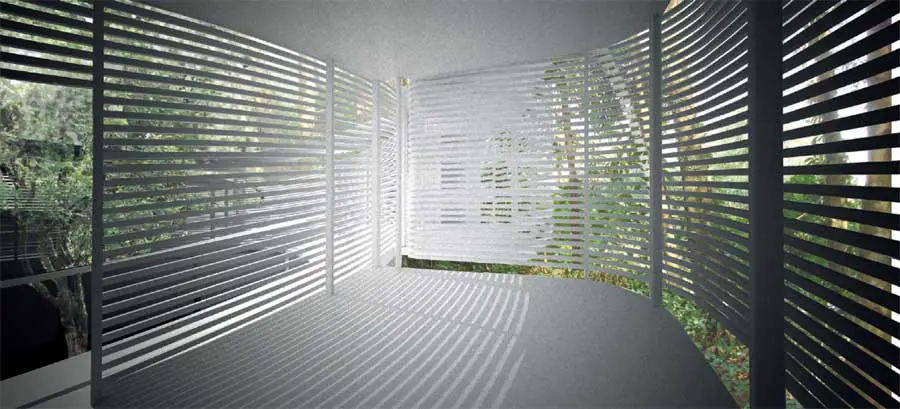

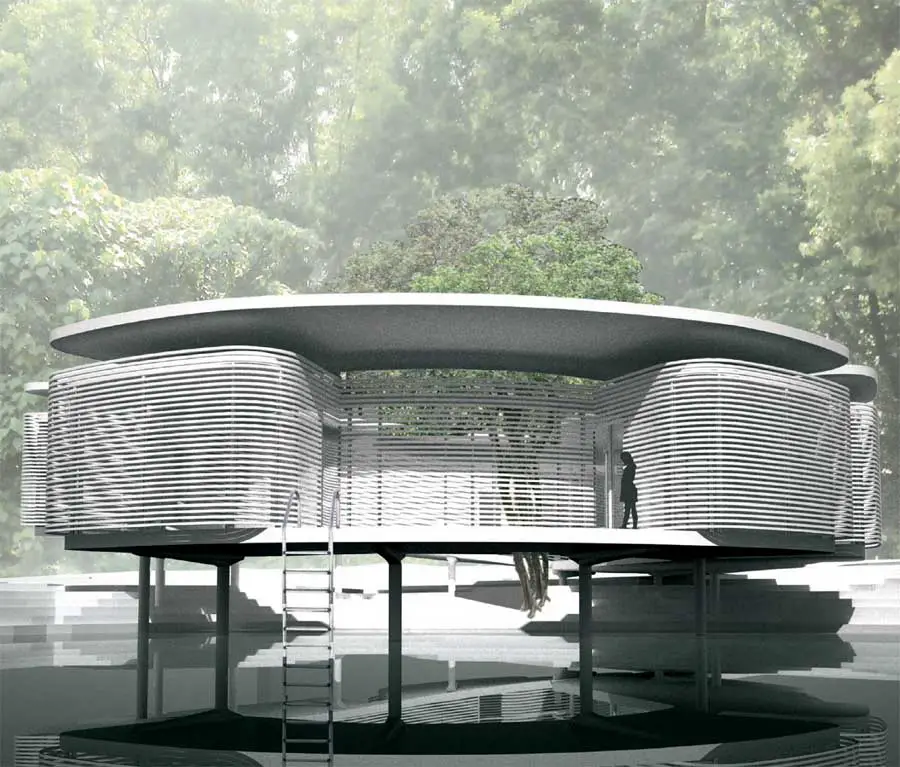
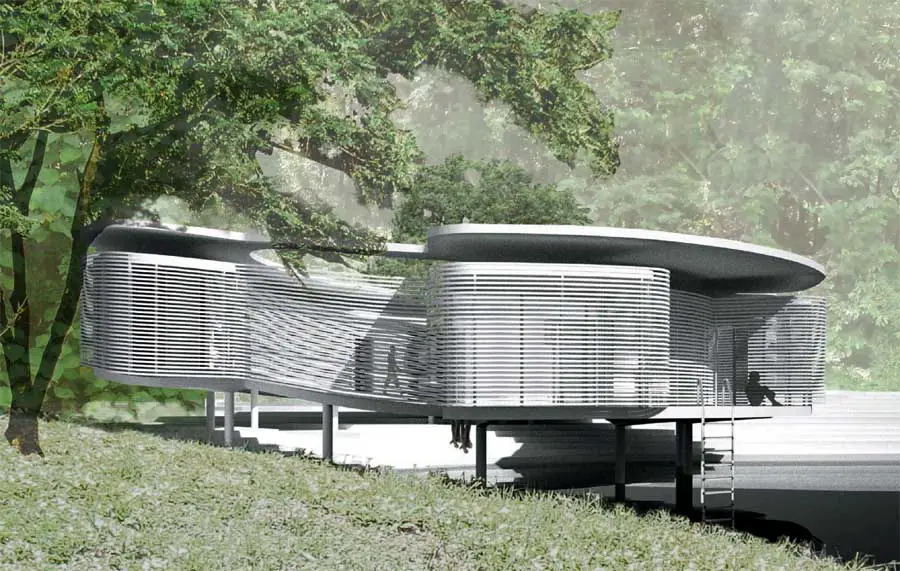
Winning design : Rafflesia House
Rafflesia House is a study of the human habitat that is an integrated part of its tropical, urban, and site-specific ecosystem.
We searched and re-examined the ideas of the right balance between the connection of the building to the outside and the shelter the building provides from the outside elements: plants, creatures, rain, sun, wind, or heat. We designed this house with an interest to understand real human needs relieved from burdens of preassumptions,
but with an intent to house the whole human complexity. The building sits on 12 columns to allow other species to develop around it.
Ventilation
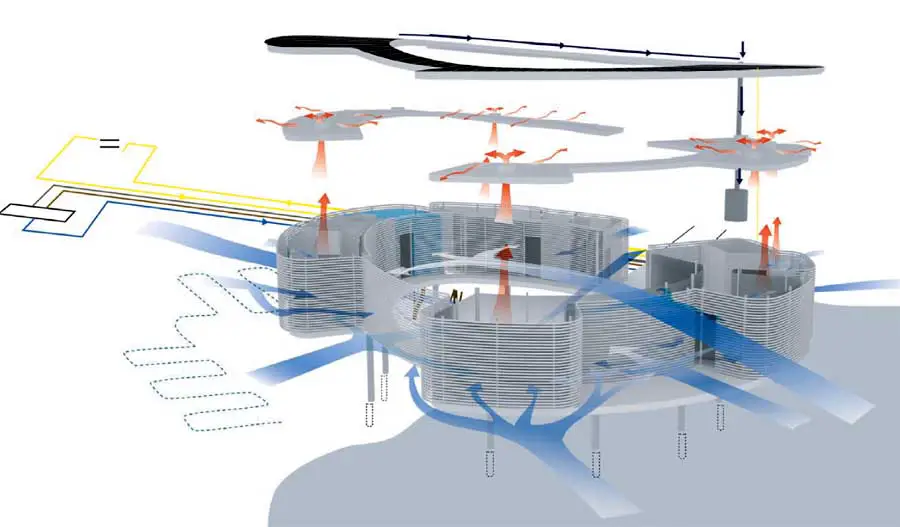
The design of the house responds to the local wind patterns. The winds in Kuala Lumpur are on average of low speeds, while the prevailing wind direction changes from month to month. Concave and convex walls enclose the house. The convex parts of the building envelope accelerate the existing air movement and direct
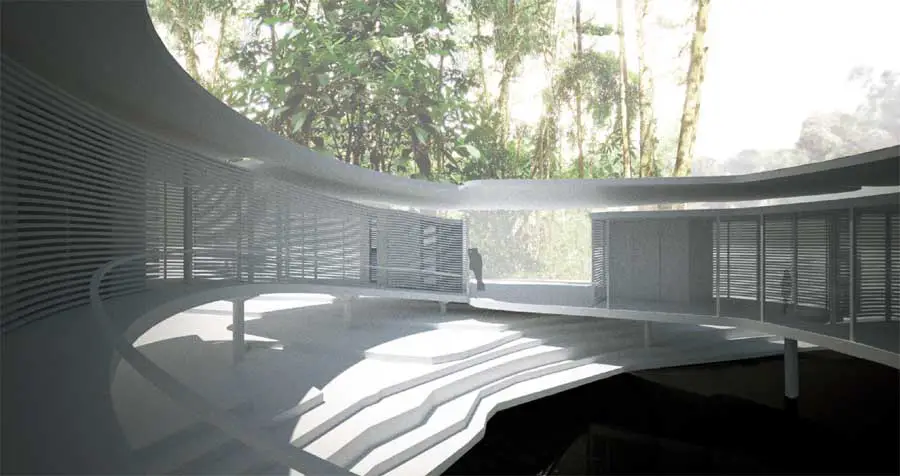
it to the concave parts of the building enclosure. The concave walls catch the wind and thus prevent it to simply circumvent the house. At the concave parts of exterior walls the wind penetrates into the interior of the house through its open windows and doors. By the same principle, at the house’s courtyard the concave exterior walls direct the wind towards the interiors of the building.
The wide courtyard is well ventilated because the building is raised up from the ground, and additionally it is permanently open to winds on two opposite sides.
To minimize the shielding of air movement by the building itself, one half of the house is higher up than the other half.
Air space between the top and the lower roof insulates the interior of the building from heat generated by the sun. Its height is 0.5 m tall and < 6 m deep, and therefore it is a well naturally ventilated space. It is also used for the discharge of interior air with fans in the interior ceilings, thus freeing the roof for the installation of solar panels.
Exhaust Fans
Ten large, silent fans above ceiling grills in each and every room can be individually turned on to increase the air-movement-velocity. These fans push the air out of the room, thus pulling the fresher outside air into the room, and allow an increase of the air circulation and speed of air movement. It is worth mentioning that fans are low energy consumers, and therefore they can provide desired thermal comfort consuming much less energy than air-conditioning.
Air-conditioning
Rafflesia house can be air-conditioned at seven independent zones. Each zone is air-conditioned when needed to a temperature desired by its users.
Here follows a scenario how the seven zones might be used at a particular time: A pregnant woman cools her bedroom to 18°C, another person prefers to sleep in their bedroom with open windows and fan assisted ventilation, while the third bedroom is not used but naturally ventilated. Kitchen /living /dining spaces are not used and therefore the air-conditioning and fans in those areas are turned off. The house is designed to be the most enjoyable when breezes from all directions fill up its interior. Therefore we predict that inhabitants will not use the air-conditioning routinely.
A Zero – Energy House is achieved.
All the energy needed for living in this house will be provided by photovoltaic panels on 92% of the roof’s surface. (The calculations by engineers are available.) This amount of solar panels would provide USA comfort levels of 23.8°C and 60% of humidity for 60% hours in a year. This energy demand is likely to be considerably
smaller, but at this point incalculable, because it depends on the number and lifestyle of users and their individual cooling needs. Main competition project requirements
zero-energy-house; minimal footprint on its environment; extraordinary and innovative architecture
Bird Island Zero-Energy Home – Rafflesia House images/ information from Zoka Zola Architecture + Urban Design 060209
Bird Island Zero-Energy Home – Building Information
Space requirements for the Bird Island houses: 150-180 m2 houses with 3 bedrooms
Areas of winning scheme: Interior space: 145 m2; exterior space: 60 m2
Communal facilities: security facilities; parking and charging stations for electrical buggies from local renewable energy source; back water treatment plant
Time schedule: to be determined
Budget: $250,000
Developer: YTL Developer
Winning Designers: Zoka Zola Architecture + Urban Design (Chicago),
Atelier Ten (London), Grant (Bath), KplusK
(Hong Kong), MAD (Beijing) and Graft (Berlin)
Jury Members
Paul Sloman of ARUP; David Nelson of Foster + Partners’ Paul Tange of Tange Associates; Stephen Pimbley of SMC Alsop; Tan Eng Keong president of PAM; Ng Sek San of Seksan Design; Dato Yeoh of YTL; Tan Sri Dr. Yeoh of YTL
Bird Island Zero-Energy Home Project Team
Architects: Zoka Zola Architecture + Urban Design; MEP Engineers: IBC Engineering
Zoka Zola, AIA, RIBA, LEED AP
Zoka Zola Architecture + Urban Design based in Chicago, USA
Location: Malaysia, Southeast Asia
Malaysia Buildings
Contemporary Malaysian Architecture
Malaysian Architecture Designs – chronological list
Bird Island Project designers : GRAFT
3×3 House, Kuala Lumpur
Design: CL3 Architects Limited, openUU Limited, Lim + Lu Design Limited
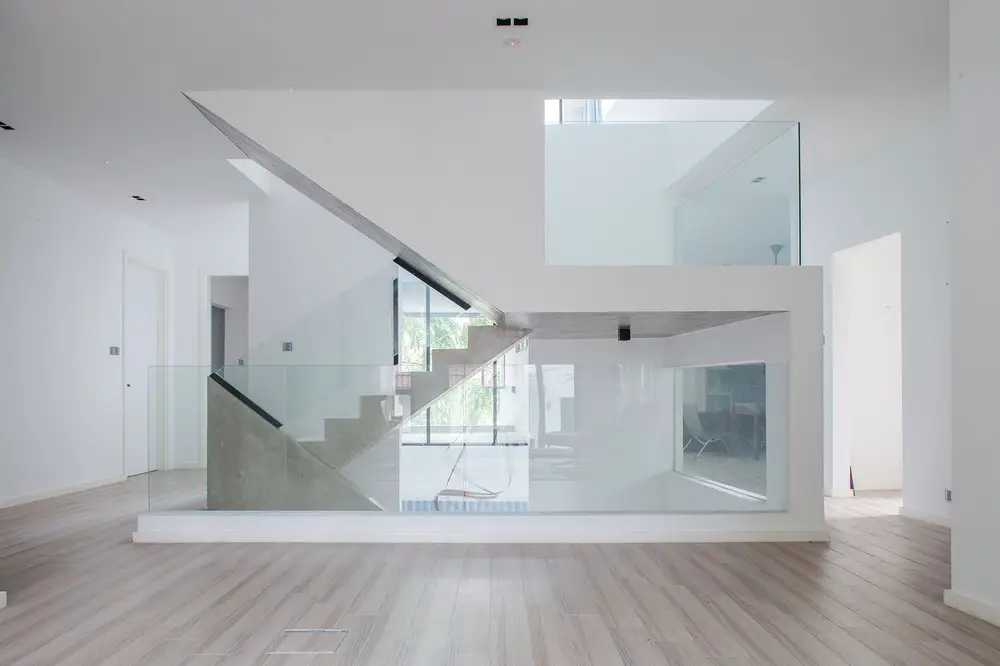
photograph : Nirut Benjabanpot
3×3 House in Kuala Lumpur
Bird Island Project, Kuala Lumpur, Malaysia by GRAFT
Singapore Architecture Designs
Singapore Tower by OMA
The Troika Kuala Lumpur by Foster + Partners
Kuala Lumpur development : Putrajaya Waterfront
Malaysian University of Technology by Foster + Partners
Malaysian Skyscraper : Penang Global City Center
Website: Visit Malaysia
Comments / photos for Zero energy Home Malaysia – The Troika Kuala Lumpur Architecture page welcome

