
Expo 2012 Yeosu, Korean Building, Thematic Pavilion Design, Image
Yeosu Expo Pavilion Contest in Korea
Yeosu Expo 2012 thematic pavilion competition – design by Studio Nicoletti Associati
19 Oct 2009
Yeosu Expo 2012
Entry by Manfredi Nicoeltti – Studio Nicoletti Associati, awarded third prize
YEOSU EXPO 2012 – KOREA
THE GREAT BLUE WHALE – THEMATIC PAVILION
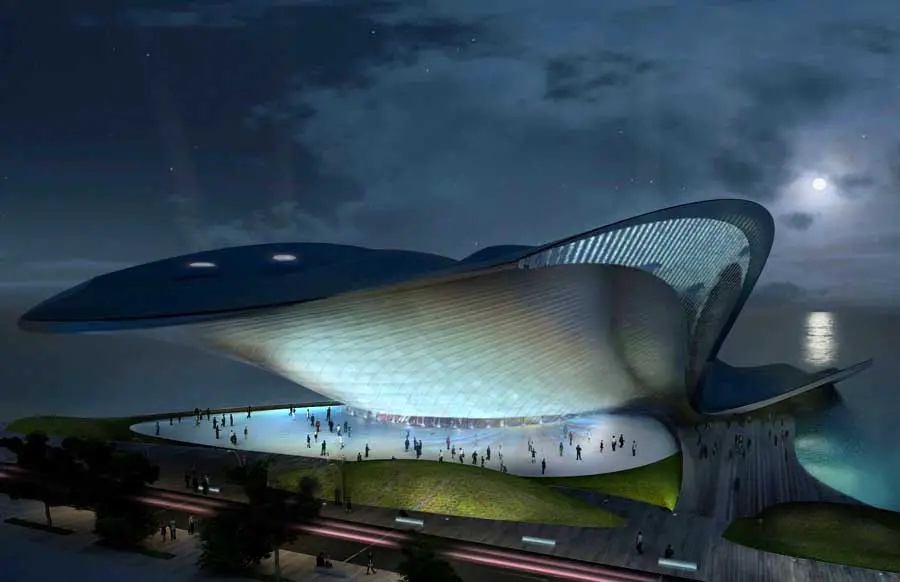
The Thematic Pavilion emerges from Yeosu’s waters as a Great Blue Whale hurling itself out of the port becoming the Messenger and the Symbol of Yeosu Expo 2012 – The Living Ocean and Coast. Its Iconic and Symbolic Design holds the messages that Yeosu Expo 2012 wants to transmit to the world:
OCEANS ARE THE ORIGIN OF LIFE ON EARTH – WE HAVE THE RESPONSIBILITY TO PROTECT THEM
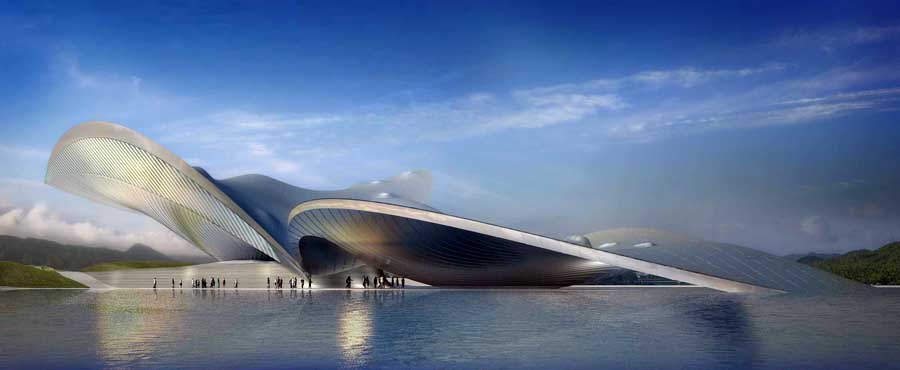
The metaphor spreading from the Thematic Pavilion wants to draw the attention to how fundamental are to the planet’s oceans and coasts resources, and how dangerous it is, for such a fragile ecosystem, an irresponsible behaviour. It is significant that such a message is entrusted by the largest living mammal on earth and which is, because of men, in danger of extinction.
In Yeosu, Nature itself will make its voice heard through its most mysterious and majestic representative, for the protection and the survival of the fragile planetary ecosystems. The Great Blue Whale will thus become the symbol not only of Yeosu Expo 2012 but the symbol of the movement for the preservation of Oceans and Coasts and their treasures.
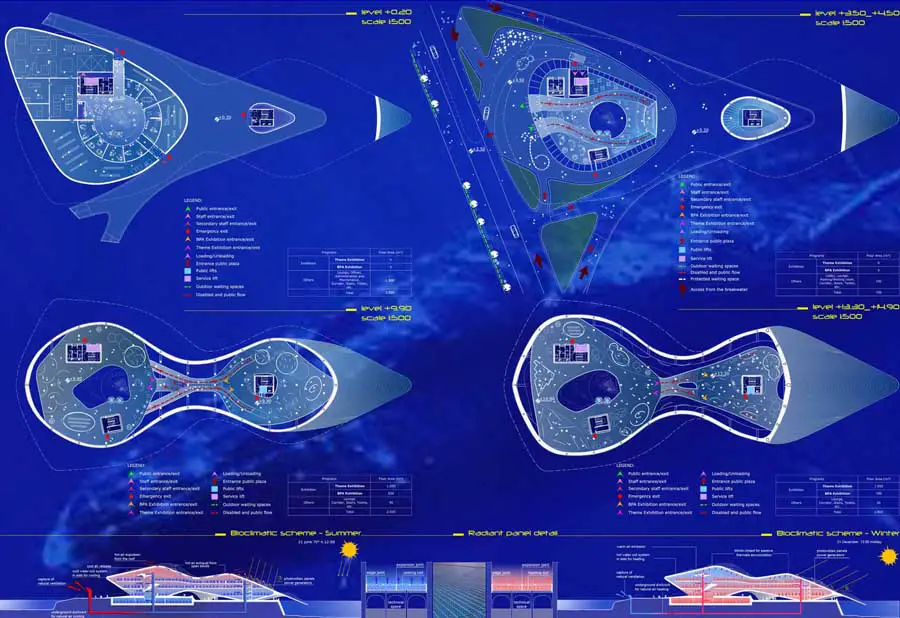
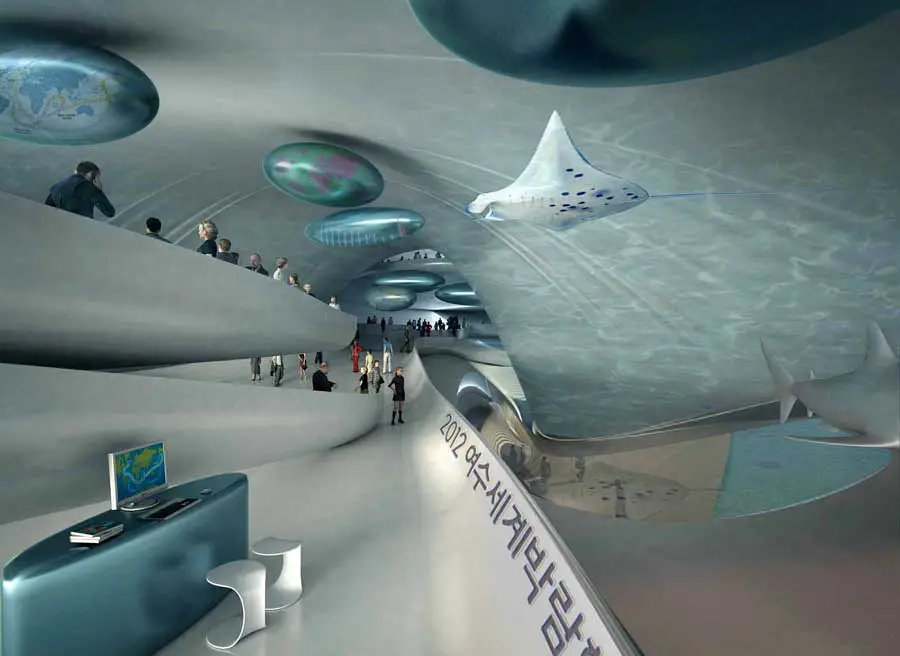
The Great Blue Whale – Thematic Pavilion contains two large separate but interconnected volumes hosting the Theme Exhibition Area and the Best Practice Area (BPA) Exhibition respectfully. The Great Blue Whale will reveal in its interior to the Expo’s visitors the deepest and mysterious secrets of the globe’s oceans becoming the architectural metaphor of a fairy tale that combines the biblical narrative to that of Pinocchio.
The Great Blue Whale is thus in the centre of the System-Expo, formed by the Expo Area, the Big “O” and the Port becoming an absolute iconic and attractive landmark. In addition, the Zoomorphic Design inspired by the marine harmonious geometries of whales perfectly complement and enrich the area of the new project called Metaphorical Archipelago.
THE THEMATIC PAVILION
The Great Blue Whale – Thematic Pavilion can be reached by two routes: from the breakwaters of the southern pier, which descends directly from the central area of national pavilions and from the breakwaters of the northern pier, which will link the tower to the area of the Expo. These paths have no architectural barriers: They allow everyone to easily reach the Thematic Pavilion offering evocative places to rest and directing visitors to the nearby large open space.
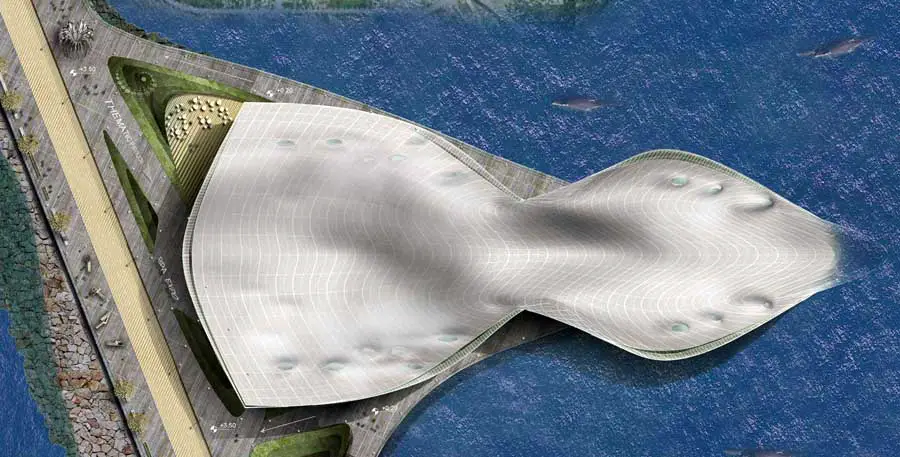
The Great Blue Whale extends over an area of about 5000m2 reclaimed entirely off-shore and it is surrounded by two large Public Squares placed at different levels. The lowest is close to the sea wilst the highest, that acts as a reception area for visitors to the Thematic Pavilion, assures maximum fluidity to visitors flows in and out of the Pavilion. In both Squares, visitors waiting to enter, will be protected from sun and rain from the very structure of the Great Blue Whale.
Inside the Pavilion, visitors will be directed through the two exhibition areas by guided paths, that is ramps, suspended levels, panoramic lifts, slopes and intricate double and triple height perspective views. The whole is supported by spectacular Zoomorphic structures that evoke the complex geometry of the bones and tendons of the whales.
SUSTAINABILITY STRATEGY
Our Sustainable Design Concept represents an opportunity to ensure that the Thematic Pavilion can be operated in a sustainable way by reducing operating costs (energy, water), minimizing environmental impacts (e.g. materials, waste) and by positively contributing to the environmental quality of the area (biodiversity, transport).
The Thematic Pavilion has the opportunity to become a world-class facility in terms of sustainable design and operation and become a landmark in South Korea and Asia.
Summary of Relevant Sustainability Measures
Daily energy conservation index
In order to minimise the Thematic Pavilion energy requirements, operating costs and CO2 emissions, a close collaboration has taken place between the architects, the structural engineers, the M&E engineers and the sustainability engineers. The concept has been to focus on Passive Design and Energy Efficiency first and then to investigate Low Energy/Carbon Technologies and then the Renewable Energy Resources.
– Passive Design and Energy Efficiency
Based on the comfort and health requirements of the Thematic Pavilion, and on Yeosu’s climate, a passive design strategy has been developed. The key objective is to minimise cooling/heating requirements as much as possible. This will be achieved by a very efficient natural interior cooling system that will exploit natural ventilation. Cool air will be entering the Thematic Pavilion from underground level and expelled through upper adjustable openings on building roof’s skin. When these openings are closed, during cold season, the Thematic Pavilion will naturally preserve its interior generated heat.
Paving materials on the site will also be light-coloured and have a Solar Reflectance Index (SRI)2 of at least 29. Lighting energy will also be minimised through the use of light colours for interior walls and ceilings in order to maximise daylight and light reflectivity and highly efficient fluorescent lighting and dimmable electronic ballasts should be used and be controlled according to occupancy or daylight.
– Low Energy/Low Carbon Energy Generation
A number of mature and energy/carbon efficient technologies are being considered for the Thematic Pavilion.
A gas-fired tri-generation system (i.e. gas-fired co-generation plant associated with absorption chillers), which will be used to provide baseline electrical, hot water and cooling requirements. As this system is using heat to create cooling (through the absorption chillers), it displaces a significant amount of electricity and therefore saves a significant amount of carbon.
A desiccant cooling system (DEC) can also be considered as a potentially very interesting option.
Traditional means of energy generation (i.e. gas-fired boilers and staged electric chillers) will be chosen among the most efficient (e.g. water-cooled chillers, potentially fed from recycled water) and be based on a multi-unit control basis. They will be controlled by a Building Management System (BMS). An auto-power factor correction equipment will also be installed to stabilize power factor and achieve a higher efficiency.
– Renewable Energy Resources
Renewable energy sources can help to reduce energy requirements / CO2 emissions even further. The Thematic Pavilion has its roof skin covered by Photo Voltaic Panels for a total area of 6500m2. Solar thermal panels could provide a proportion of the hot water load and a PV installation is integrated to generate electricity. This electricity could be used on site and/or be sold to Yeosu Power Company, which is obliged to buy surplus electricity generated by PV systems. This would provide a source of revenue for the Thematic Pavilion. It should also be noted that the government can subsidize up to half the installation cost for these renewable energy systems.
Yeosu Expo 2012 Entry images / information from Studio Nicoletti Associati
Location: Yeosu, South Korea, East Asia
South Korea Architecture
Contemporary South Korean Architectural Selection
South Korean Architecture Designs – chronological list
South Korean Architecture News
Expo Yeosu Pavilion, Korea – winning design
soma architecture
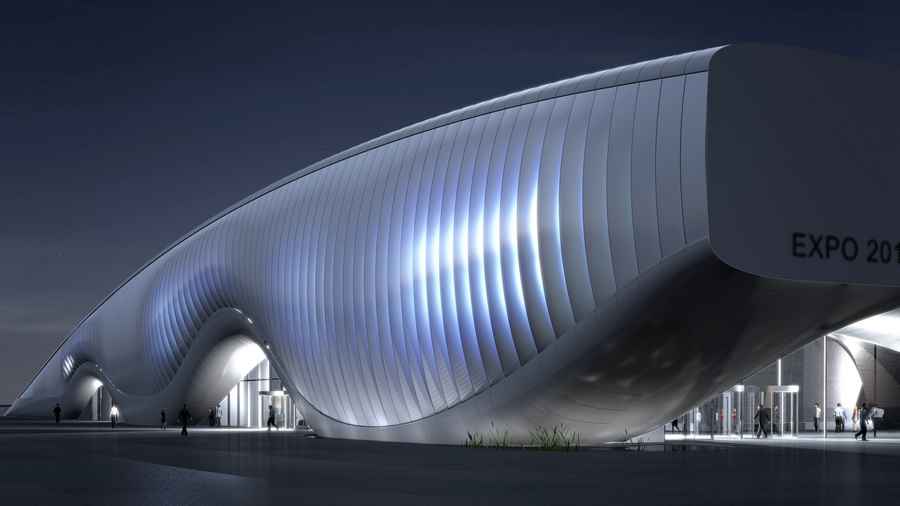
image from architect
Another Yeosu expo 2012 thematic pavilion competition design:
Expo Yeosu Pavilion by Antoine Damery
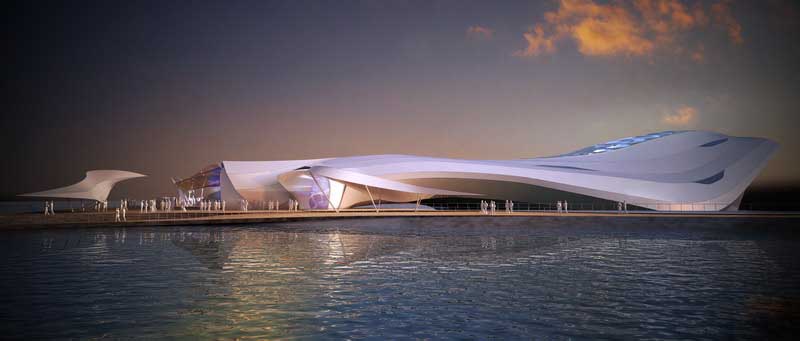
image from architect
HyunDai Pavilion Yeosu Expo
Design: UnSangDong Architects
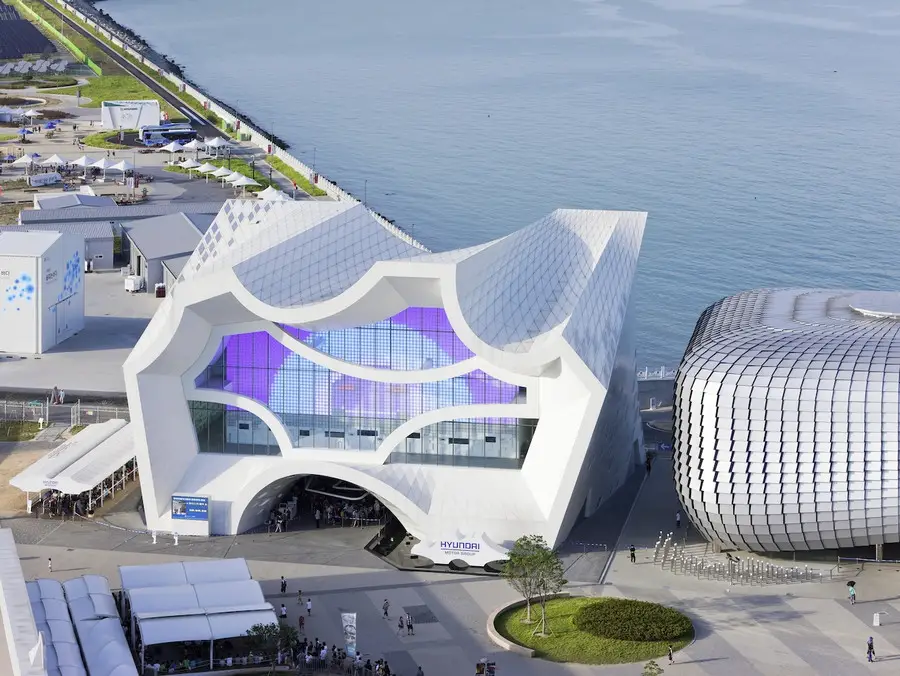
photo : Sergio Hyunsangyeosu
Digital Media City Landmark Tower
Busan Cinema Center : Architecture competition winner
Yeosu 2012 Expo : Further Information
Comments / photos for the Expo 2012 Yeosu Korean Architecture page welcome
