
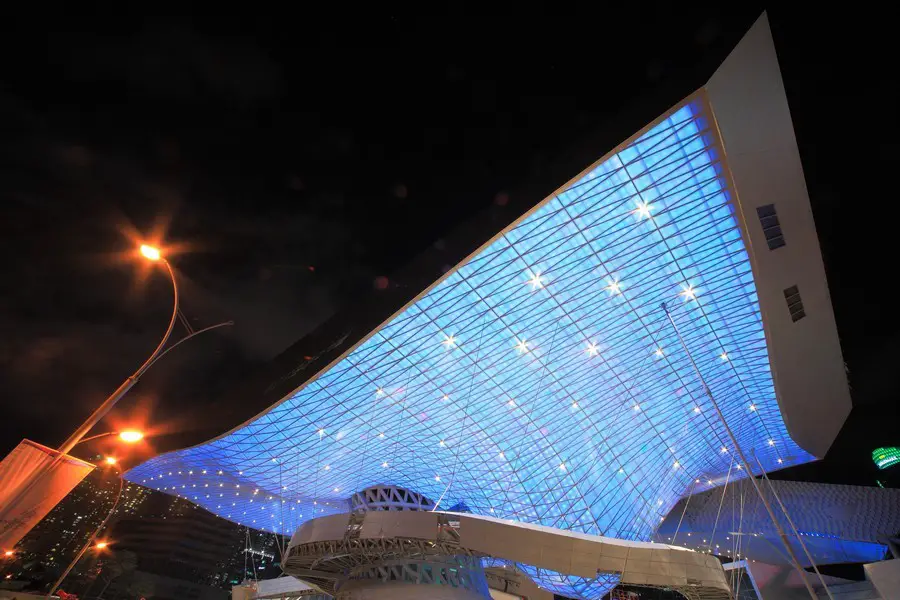
Busan Cinema Center, BIFF, Pusan Film Festival, COOP HIMMELB(L)AU Korea, Design
Busan Cinema Center, Korea : BIFF Building
Busan Cinema building design by COOP HIMMELB(L)AU, Architects
30 Sep 2011
Busan Cinema Centre
Busan International Film Festival
Location: Busan, South Korea
Dates built: 2005-11
Design: COOP HIMMELB(L)AU
The Cinema Center in Busan, South Korea, designed by Wolf D. Prix/COOP HIMMELB(L)AU, the new home of the Busan Film Festival (BIFF), was inaugurated with a grand opening on 29 September 2011 in the presence of the president of South Korea. The innovative building combines open space, cultural program, entertainment, technology and architecture in a novel way. Over 800 guests, among them the Mayor of Busan, the cultural minister, the sports minister as well as film celebrities attended the ceremony.
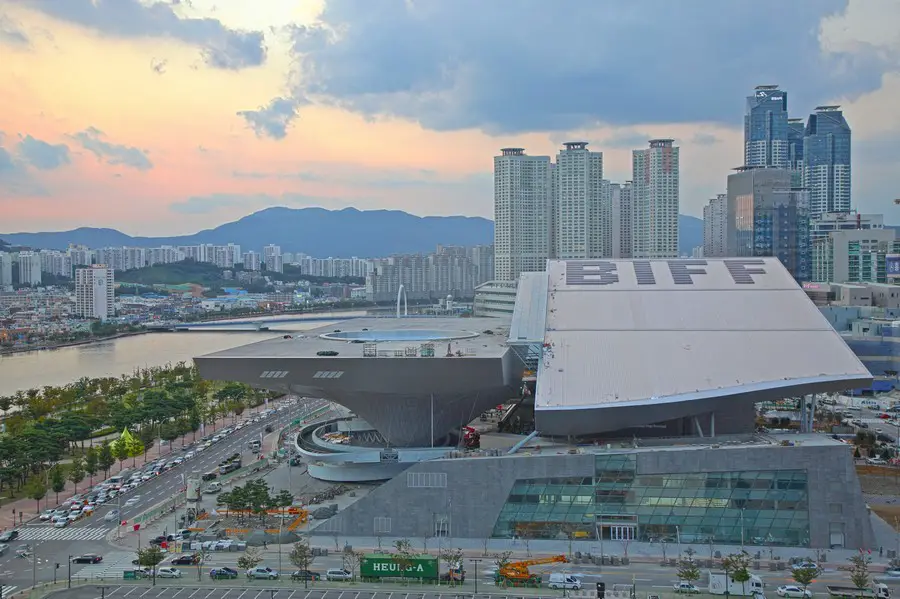
photograph © Woochang Choi Korea
The president of South Korea Lee Myung-bak emphasized in his opening speech the architectural achievement accomplished with the special feature of the Busan Cinema Center – the worldwide largest cantilivered roof. “Since the Busan Cinema Center is the greatest and the most beautiful one for exclusive cinema use, the Busan International Film festival will be top 3 film festival in the world”, he added.
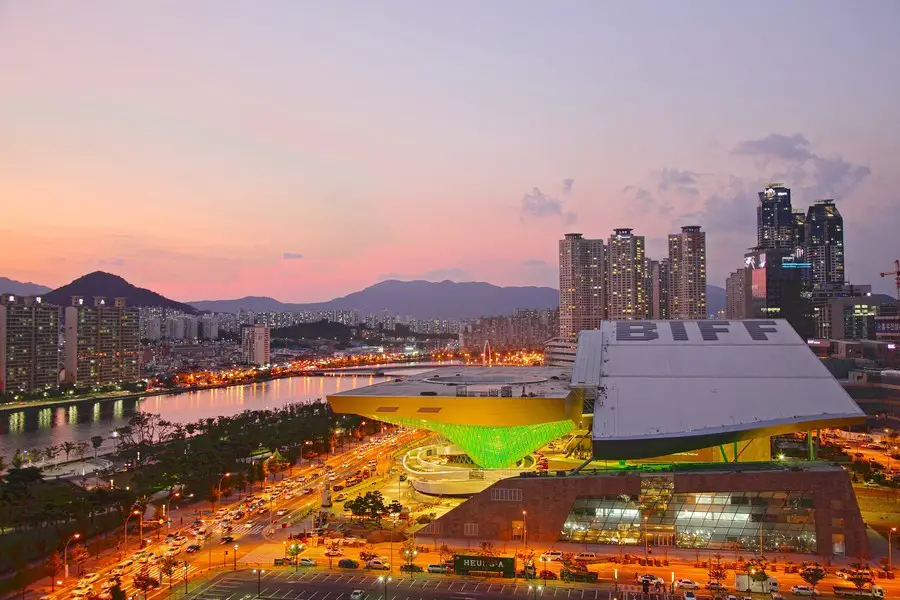
photo © Woochang Choi Korea
As part of the festivities Wolf D. Prix, the co-founder of the Austrian architecture office COOP HIMMELB(L)AU received as the first architect in South Korea the honorary citizenship of the city of Busan from the hands of Mayor Hur Nam-sik. The award is the highest recognition conferred by the city to personalities who have promoted Busan’s standing in Korea or abroad.
Just a few days ahead of the start of the 16th Busan International Film Festival Wolf D. Prix in company with Hur Nam-sik will inaugurate the COOP HIMMELB(L)AU exhibition “Architecture is the Media and the Media is the Message” and give a lecture on “The Possibility of the Impossible”.
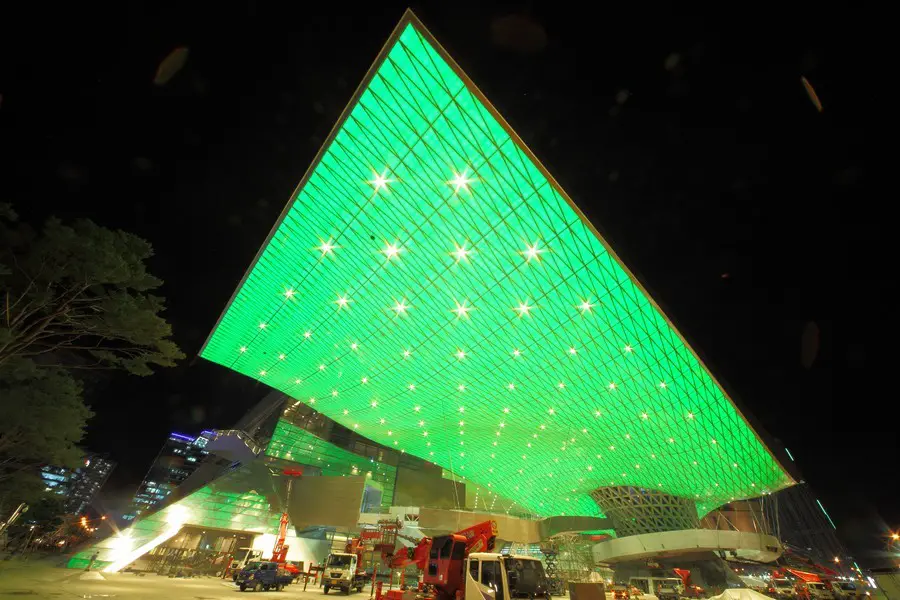
photo © Woochang Choi Korea
After winning the competition for this project in 2005 construction started the same year. The roof’s ceiling surface is completely equipped with LED projectors which allows for unique visual spectacles highlighting the Busan Cinema Center.
The dynamically illuminated ceiling will serve as the center’s platform of communication with visitors and passers-by. A free span of 85 meters and a roof surface of 60 x 120 meters makes the roof the worldwide largest cantilevered roof. The complex comprises about 60,000 m2 of performance, event, gastronomy and administrative spaces and has a capacity of up to 6,800 visitors.
Plans – Level 1 ; 3 ; 4 ; 6 ; 8
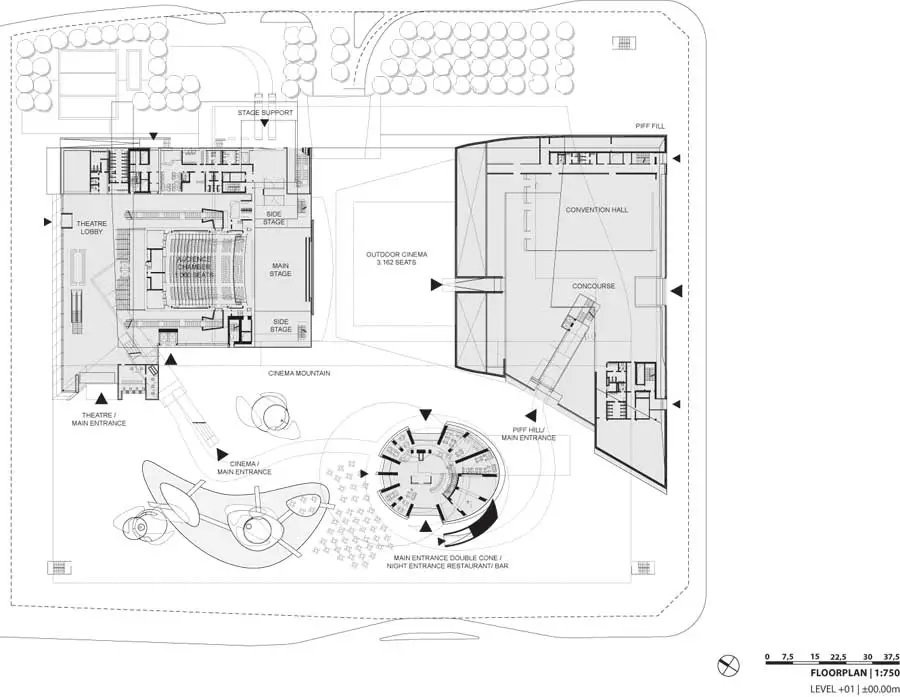

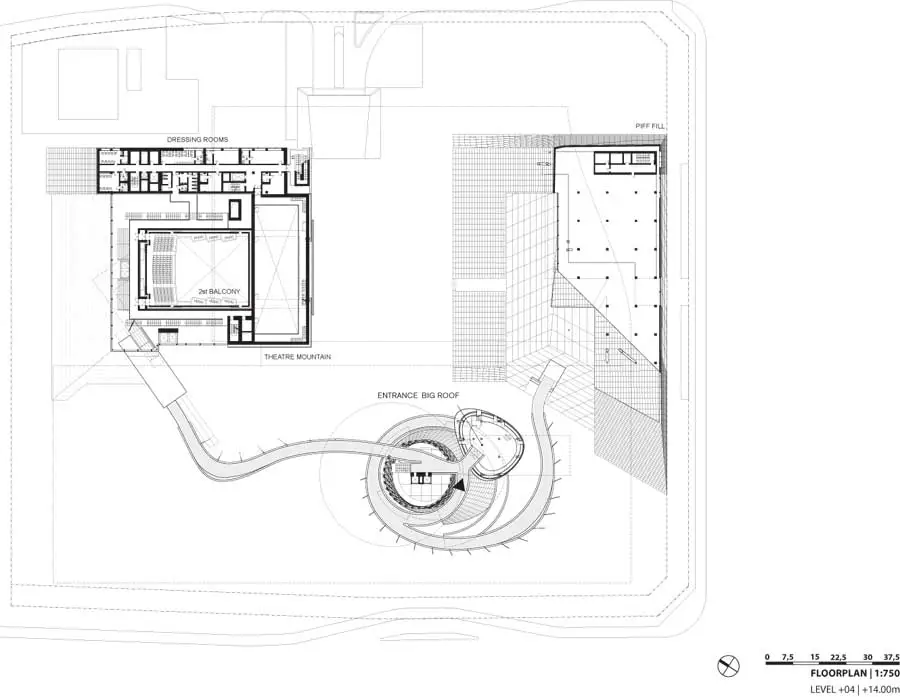
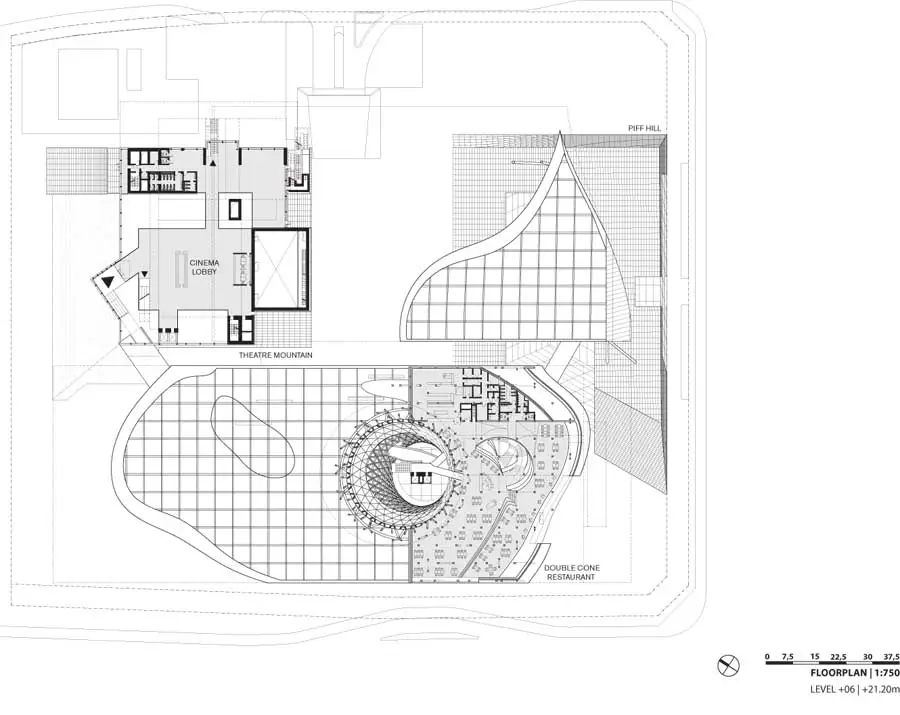
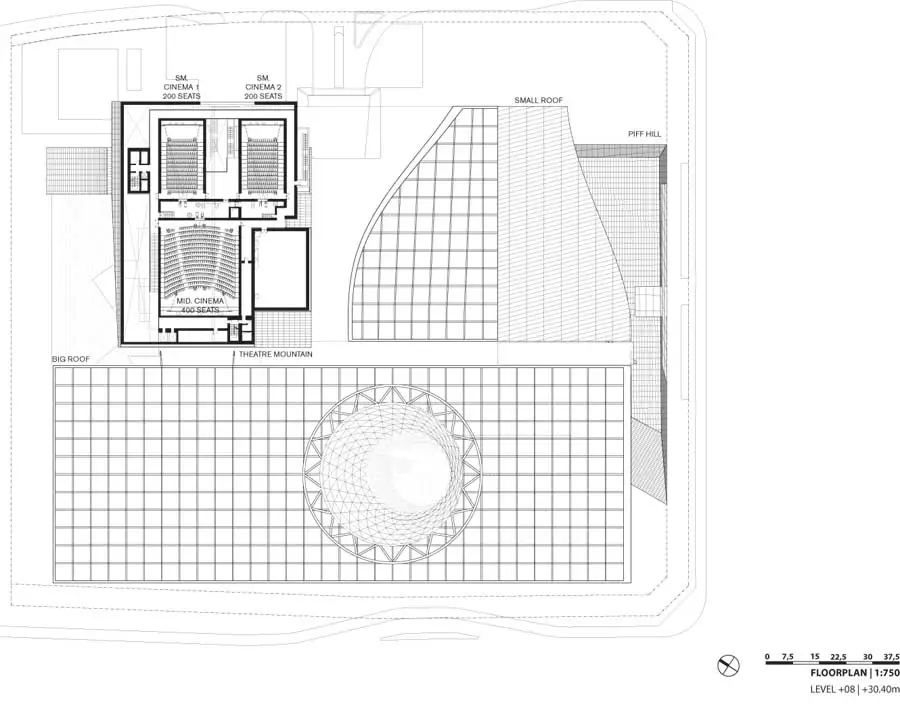
drawings © COOP HIMMELB(L)AU
The upcoming events of the opening festivities:
4 Oct 2011: Opening of the COOP HIMMELB(L)AU exhibition “Architecture is the Media and the Media is the Message” at the Busan Design Center
5 Oct 2011: “The Possibility of the Impossible”, lecture by Wolf D. Prix at the Busan Design Center
6 Oct 2011: Opening of the 16th Busan International Film Festivals BIFF
photo © Woochang Choi Korea
Busan Cinema Centre Building
Busan International Film Festival
Busan, South Korea
2005-11
Design: COOP HIMMELB(L)AU
Press Release, Vienna, September 13 2011
After the largest cantilever roof in the world at the Busan Cinema Center in Busan, South Korea, has been raised at the end of March, the building is now about to be completed. The COOP HIMMELB(L)AU designed project is the new home of the Busan International Film Festival (BIFF) and will house a multifunctional theater, cinemas, restaurants, cafés and other public spaces.
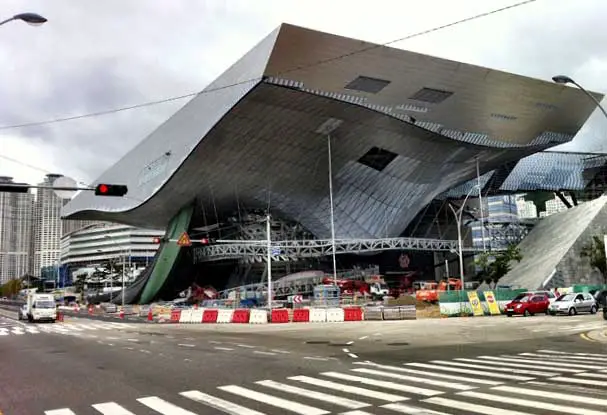
photo : Nathan Willock
Construction on the Busan Cinema Center site is proceeding at a furious pace in order to complete the building in time. As part of the opening festivities, scheduled to begin on 29 September 2011, a few days ahead of the start of the Busan International Film Festival, Wolf D. Prix will be conferred the Honorary Citizenship of Busan, as well as open an exhibition on COOP HIMMELB(L)AU in the Busan Design Center, and also give a lecture there.
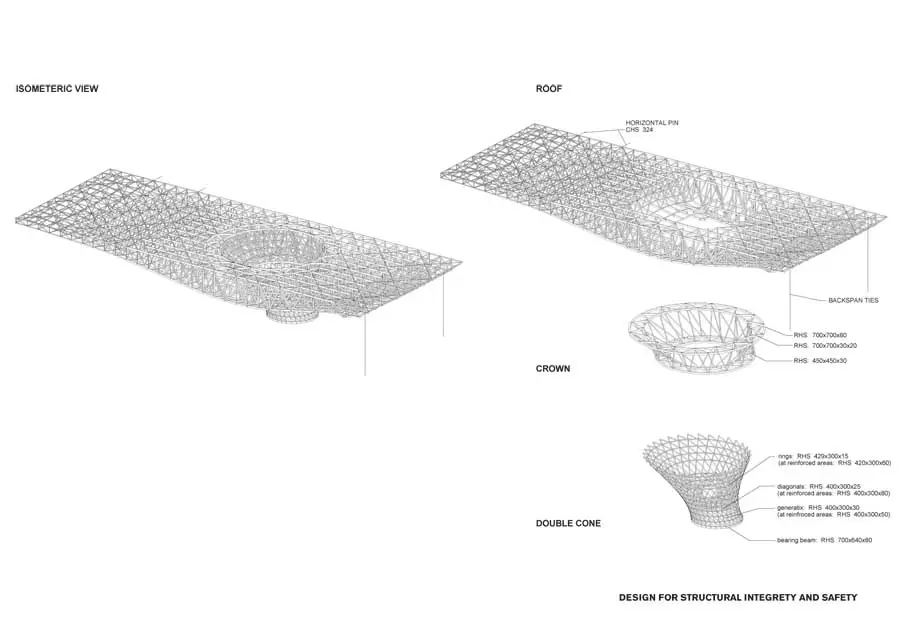
Being the longest free cantilever in the world with a span of 85 meters for a roof surface of 60 x 160 meters, the three-dimensional steel space frame is connected to a single large cone-shaped column which also houses a café and entrance. The dynamic LED lighting surface which covers the entire undulating ceiling of the cantilevered roof has been installed and tested.
Light show programs in full motion graphics produced and tailored to events of the Film Festival by visual artists can be displayed across the whole ceiling, visible during the day but creating a lively urban atmosphere particularly at night.
The Busan Cinema Center with its outdoor and indoor performance spaces will accommodate up to 6,800 visitors in several venues including cinemas and a 1000 seat multifunctional theater, all specially designed for the Busan International Film Festival (BIFF). In total the center includes around 60,000 square meters of public performance, event, entertainment, dining and administrative space.
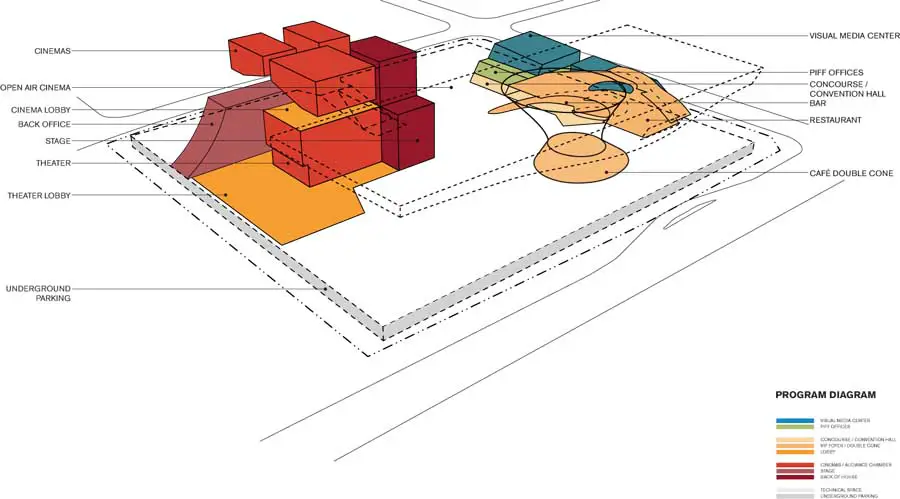

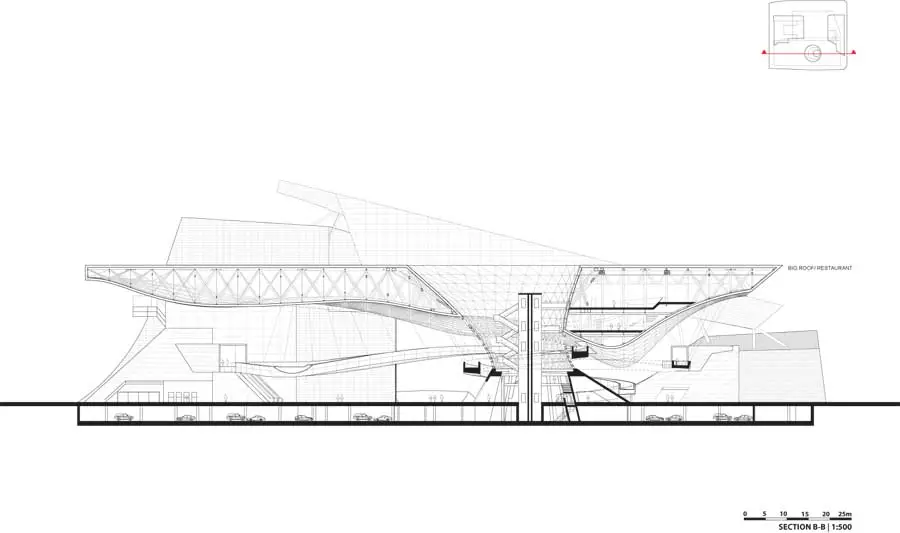
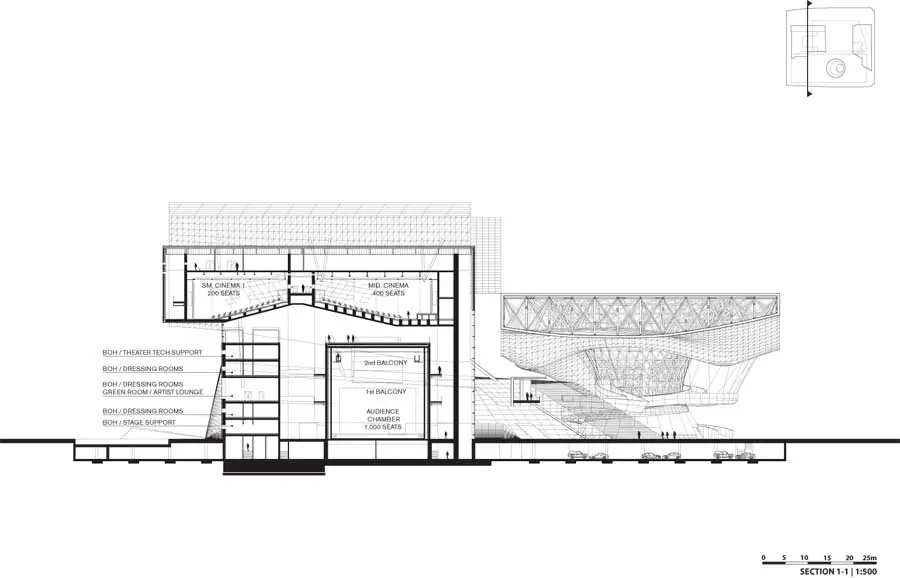
drawings © COOP HIMMELB(L)AU
Key Dates
29 Sep 2011: Opening Ceremony of the Busan Cinema Center and Award of Honorary Citizenship to Wolf D. Prix
4 Oct 2011: Opening of COOP HIMMELB(L)AU exhibition at Busan Design Center
5 Oct 2011: Lecture Wolf D.Prix at the Busan Design Center
6 Oct 2011: Inauguration of Busan International Film Festival
Busan Cinema Center images / information from COOP HIMMELB(L)AU 130911
Busan Cinema Centre Building, Korea
Pusan International Film Festival
Busan, South Korea
2005-11
Images © ISOCHROM.com, Vienna
Concept
The Busan Cinema Center – A multifunctional urban plaza
COOP HIMMELB(L)AU’s design for the Busan Cinema Center and home of the Pusan International Film Festival (PIFF) provides a new intersection between public space, cultural programs, entertainment, technology and architecture creating vibrant landmarks within the urban landscape.
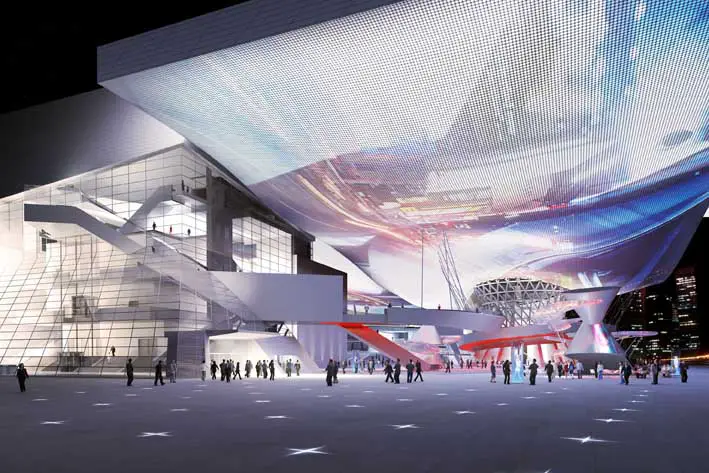
LED saturated outdoor roof elements acting as a virtual sky connect building-objects and plaza-zones into a continuous, multifunctional public urban space.
Media, technology, entertainment and leisure are merged in an open-architecture of changeable and tailored event experiences. The result is a responsive and changing space of flows acting as an urban catalyst for cultural exchange and transformation.

Busan Cinema Center – Project Description
The concept envisions an urban plaza of overlapping zones including an Urban Valley, a Red Carpet Zone, a Walk of Fame and the PIFF Canal Park. The urban plaza is formed by building and plaza elements sheltered by two large roofs that are enabled with computer programmed LED outdoor ceiling surfaces. The larger of the roofs includes a column-free cantilever of 85 meters over a multifunctional Memorial Court event plaza.
The urban zones of the complex are formed by individual and recognizable building objects placed below the outdoor roofs. The building objects contain theater, indoor and outdoor cinemas, convention halls, office spaces, creative studios and dining areas in a mixture of sheltered and linked indoor and outdoor public spaces. The design of these spaces supports flexible, hybrid functionality that can be used both during the annual festival period and day-to-day use without interruption.
The urban zones defined by functional surfaces in plan are further articulated in a sectional dialogue between stone-clad “ground” forms of the CineMountain and PIFF Hill, and the metal and LED clad “sky” elements of the roofs. The materiality of the building objects differentiates the spaces and articulates the architectural concept. Through their shape, placement and materiality, the various parts create a dynamic and informal tension between the ground and the roof.
Main Roof
The dynamic LED lighting surface covering the undulating ceilings of the outdoor roof canopies gives the Busan Cinema Center its symbolic and representative iconographic feature. Artistic lighting programs tailored to events of the PIFF or the Municipality of Busan can be created by visual artists and displayed across the ceiling in full motion graphics, creating a lively urban situation at night, but also visible during the day.
Imbedded in the architecture the lighting surfaces serve as a communication platform for the content of the Busan Cinema Center.
Light as art, which is at the very nature of cinema, creates a unique and memorable atmosphere for the public urban plaza and architecture of the PIFF.
Double Cone, Café and Roof Restaurant
The Double Cone is the symbolic landmark entrance element to the Busan Cinema Center and serves as the connective element between the CineMountain and the PIFF Hill. Designed as a steel web drum on top of a series of radial concrete fin walls, the Double Cone also is the only vertical structural support for the large cantilever acting as a large, singular column.
During day-to-day use, the ground level of the Double Cone contains a public café with outdoor seating, and the upper level links to a world-class restaurant, bar and lounge within the roof volume with views overlooking the APEC park and river beyond.
During the festival the Double Cone marks the Red Carpet Zone and VIP entrance to the “Busan Cinema Center”, and can be used as a pre-event space for VIP’s on the ground level, or as a pre-staging area for transfer to the Red Carpet procession to the outdoor cinema stage, or to the upper levels of the CineMountain or PIFF Hill foyers via the red carpet spiralling ramp and bridges suspended from the roof.
CineMountain
The CineMountain is a multifunctional building containing both a 1,000 seat multifunctional theater with fly-tower and full backstage support, and a four-screen multiplex comprised of a 400-seat and two 200-seat auditoria. Separate entrances and foyers are provided for theater and cinema respectively, however the foyers and circulation are designed so that they can be combined depending on operational preferences.
Complete structural separation between the theater and the cinemas ensures optimal noise isolation for the theater space, which is designed as a first-class, flexible hall with seating on two levels and optimal sight lines and adjustable acoustics. A flexible proscenium type stage with side stages and fly-tower accommodates movable acoustical towers used to close down the stage volume for concerts and operatic theater, but can be easily moved for theater, musicals and other staged events.
The stage includes a fore-stage lift that can provide additional seating, an orchestra pit or stage extension as preferred. Horizontally tracking curtains along the walls of the audience chamber can be hidden or deployed to adjust the acoustics of the space.
Urban Valley / Outdoor Cinema
The Urban Valley combines a flexible flat ground surface and large stepped tribunes of the PIFF Hill as seating for a 4,000 seat Outdoor Cinema. The Valley is sheltered by a large sculpted outdoor roof with an LED ceiling surface and is oriented towards a flexible stage and screen area on the outside of the Eastern façade of the CineMountain.
Accommodation for purpose built projection screens, stages, loudspeaker and lighting arrays are provided, as well as a large guillotine door opening into the CineMountain allowing for exterior performances to share the interior theater’s backstage facilities.
PIFF Hill
The PIFF Hill is a ground surface formation creating the space of the outdoor cinema and accommodating the concourse, the convention hall, the PIFF-center, the PIFF-offices and the visual media center. Given the flexible organization of the ground plan, it can be easily adapted to the different requirements during festival and day-to-day usage.
Red Carpet Zone
During the PIFF festival, or for other special events, the Red Carpet Zone is created by a special drop-off and media-event processional entrance at the Double Cone entrance element. A red carpet can be extended from the Double Cone event space and photo position to the south through the park and along a pier. VIP’s can enter from limousines along the street edge, or arrive by boat from the pier.
Various options are provided for the red carpet circulation from the Double Cone to the different event and performance spaces depending on the scenario preferred, including a vibrant spiralling ramp from the staging level of the event space to the VIP restaurant lounge of the upper roof or to the PIFF Hill and CineMountain on upper levels of the foyers. During non-event times the Red Carpet Zone acts as the symbolic entryway into the Busan Cinema Center complex.
Memorial Court & Walk of Fame
The Walk of Fame contains the Memorial Court as a public plaza. Sources are imbedded in the ground surface projecting holographic images of the stars, directors, producers and the like who have been made a part of the Walk of Fame. Their avatars inhabit the memorial court as permanent residents; however their programs can be changed to show variable aspects of information over time or in relation to specific PIFF- events.
During non-event times the Memorial Court is used as a grand entryway to the CineMountain and contains an outdoor dining area of the Double Cone Café overlooking the park and water beyond.
Due to the column-free sheltered roof above, the public plaza of the Memorial Court is a multi-functional event space which can be utilized for PIFF- or Busan City- events without interrupting the day-to-day activities of the Busan Cinema Center, or simultaneously with other events in the additional spaces.

PIFF Canal Park
The PIFF Canal Park is proposed as an extension of the open network of public programs into the planned riverside park, and as a linking element between the river and the cinema complex. A new pedestrian footbridge will connect the Busan Cinema Center site with the park across the Boulevard to the South connecting the Double Cone with the APEC Park.
An additional outdoor event ‘bowl’ is proposed surrounded by canals that can provide public and private boat access to the project site. Space for a future extension of the Busan Cinema Center project is proposed as an island among the canals, further integrating the cultural functions of the Busan Cinema Center project with the surrounding public space and landscape environment.
Busan Cinema Center South Korea – Building Information
Planning: COOP HIMMELB(L)AU
Wolf D. Prix, Helmut Swiczinsky + Wolfdieter Dreibholz
Design Principal/ CEO: Wolf D. Prix
Partner in Charge: Michael Volk
Project Architect/Design Architect: Martin Oberascher, Günther Weber
Team: Sergio Gonzalez, Rob Henderson, Guthu Hallstein, Matt Kirkham, Veronica Janovska, Dieter Segerer, Markus Baumann, Jasmin Dieterle, Anja Sorger, Jana Kucerova, Jan Brosch
3D Design: Renate Weissenböck, Jan-Ruben Fischer
Model: Paul Hoszowski, Ernst Stockinger, Ivana Jug, Vincenzo Del Monaco, Johannes Spiesberger, Markus Erhardt, Hyoung Sub, Marc Werner
Photographs: Markus Pillhofer
Competition Team: Victoria Coaloa, Rob Henderson, Paul Hossowski, Joerg Hugo, Irakli Itoni Alex Jackson, Matt Kirkham, Shannon Loew, Mona Marbach, Jens Mehlan, Tom Wiscombe, Burcu Bicer, Etienne Chanpenios, Monika Heliosch, Akvile Rimantaite
Renderings: Armin Hess
Client: Municipality of Busan
Kim, Byung-Heui; Cho, Seung-Ho; Chai, Young-Eeon; Seo, Myoung Seok
User: Pusan International Film Festival
Choi, Yoonna; Oh, Seok-Geun; Kim, Dong-Ho
Organizer: Busan International Architectural Culture Festival Organizing Committee, Yeonjegu Jungangro, Korea
Local partner: Heerim Architects & Planners, Seoul / Korea
Jeong, Young Kyoon; Eu, Sung Mo; Lee, Mog Woon; Kang, In Soo; Kim, SeoniI; Shin, Dong Young; Chang, Hyo Sup
Structural Engineering: B+G Ingenieure, Bollinger und Grohmann GmbH, Frankfurt / Vienna, Germany/ Austria
Klaus Bollinger, Jan Lüdders, Daniel Pfanner, Astrid Münzinger, Jürgen Asmussen
Mechanical, electrical Engineering: Arup, Berlin, Germany
Bryan Cody, Till Pasquai, Tobias Burkhart, Akif Berkyuerek
Lighting design: Har Hollands, Eindhoven
Wind studies: Wacker Ingenieure, Birkenfeld / Germany
Jürgen Wacker, Michael Buselmeier
Façade Engineering: Face of Building, Oberpullendorf / Austria
Johannes Stimakovits, Harald Weidinger
Theater consultant: Artec
Tadeo Nakajima, Ed Arenius, Ted Pyper
Busan Cinema Center Images © ISOCHROM.com, Vienna
Project Data: May 2008
Site Area: 32,100 m²
Net Floor Area (interior spaces): 51,067 m²
Gross Floor Area(interior spaces): 57,981 m²
Built-up Area: 10,005 m² (E00 without roofs)
Cubage: 349,708 m³
Competition: (1st Prize) 11/2005
Start of Planning: 01/2007
Start of Construction: 10/2008 (estimated)
Completion: 10/2011 (estimated)
Scheduled Opening: 11/2011
Building Costs: 100.000.000 Euro (budget)
Costs per m²: 1.725 Euro/m² (excl. exterior spaces)
Busan Cinema Center Korea design : Coop Himmelb(l)au, Architects
Busan Cinema Center images / information from COOP HIMMELB(L)AU 091008
Location: Busan, South Korea, East Asia
South Korea Architecture
Contemporary South Korean Architectural Selection
South Korean Architecture Designs – chronological list
South Korean Architecture News
Korean Architecture – Selection:
Hyundai Motorstudi, Goyang
Design: ATELIER BRÜCKNER
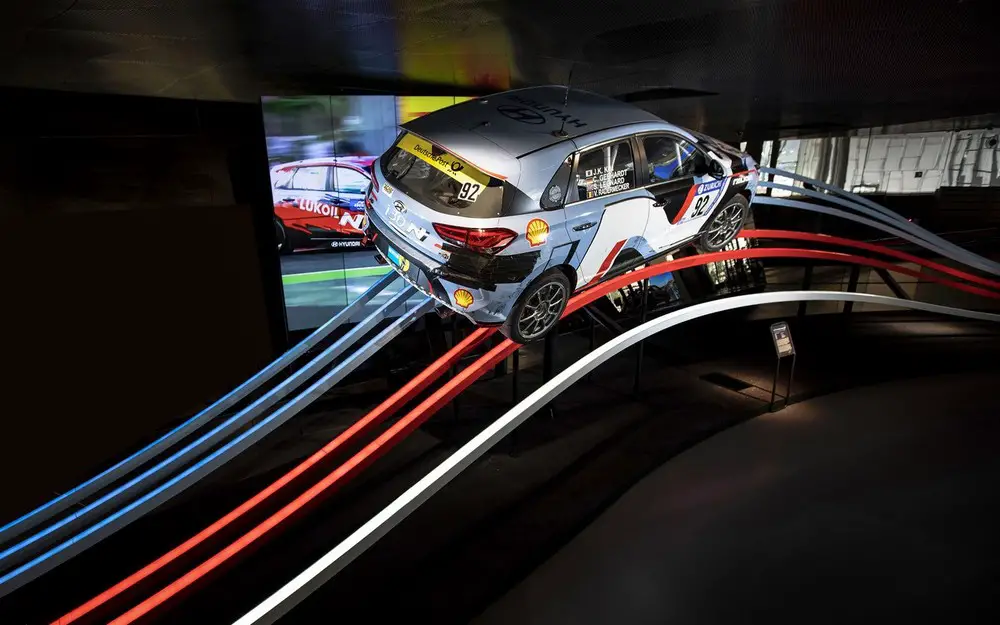
image courtesy of architects office
Hyundai Motorstudio in Goyang Korea
Digital Media City Landmark Tower, Seoul
SOM
Digital Media City Landmark Tower
Prada Transformer
OMA – Office for Metropolitan Architecture
Prada Transformer Korea
Busan Opera House – Competition design
Kubota & Bachmann Architects
Busan Opera House
Comments / photos for the Busan Cinema Center page welcome
