
Shenzhen Museum of Contemporary Art Building, Images, Chinese Museum, EMERGENT Architects, Design, Picture
Shenzhen Museum of Contemporary Art
Urban Proposal for MoCA/PE, China design by EMERGENT / Tom Wiscombe
Shenzhen Museum of Contemporary Art, Shenzhen
Date: 2007-
Design: EMERGENT
Shenzhen Museum of Contemporary Art Building
Urban Concept
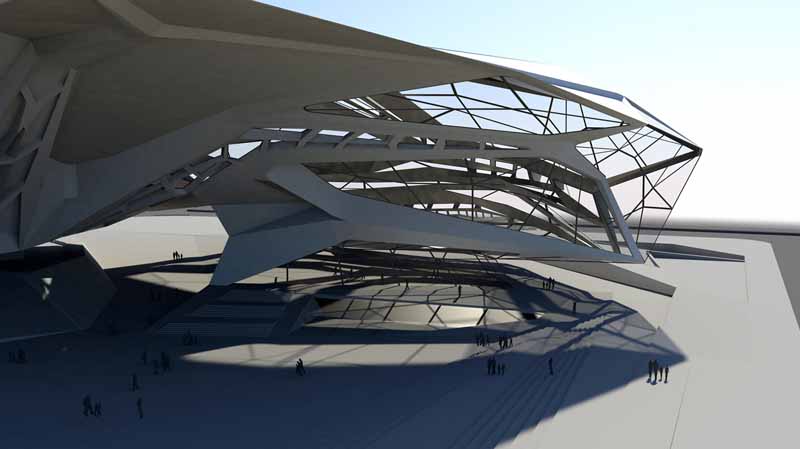
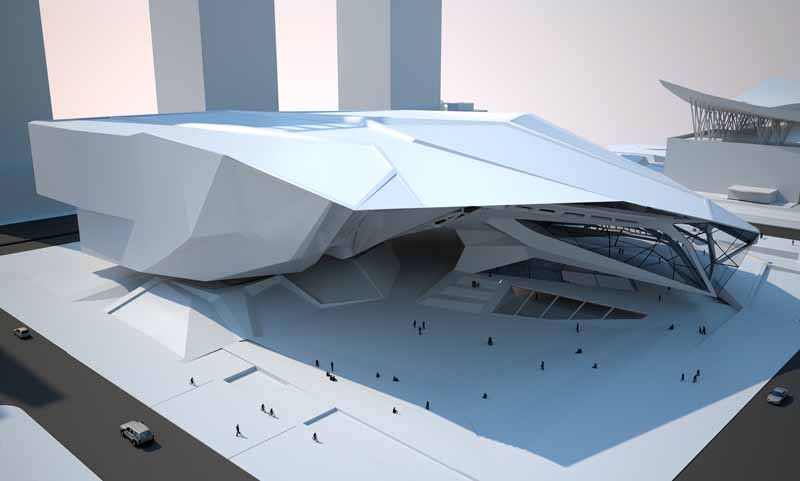
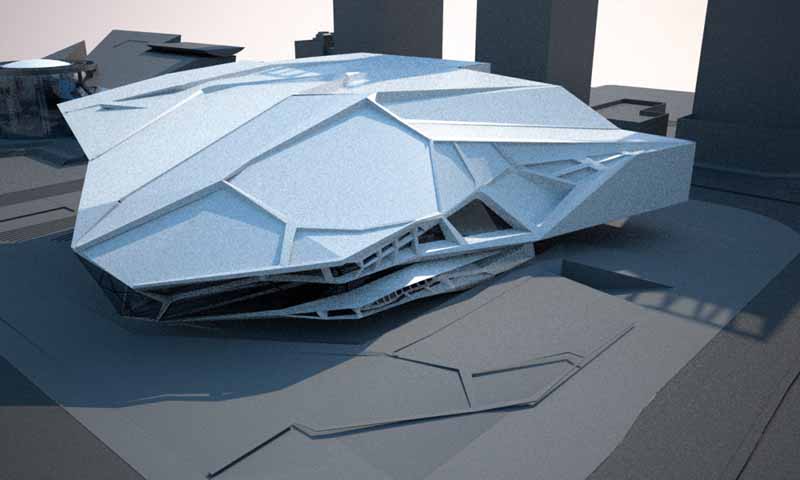
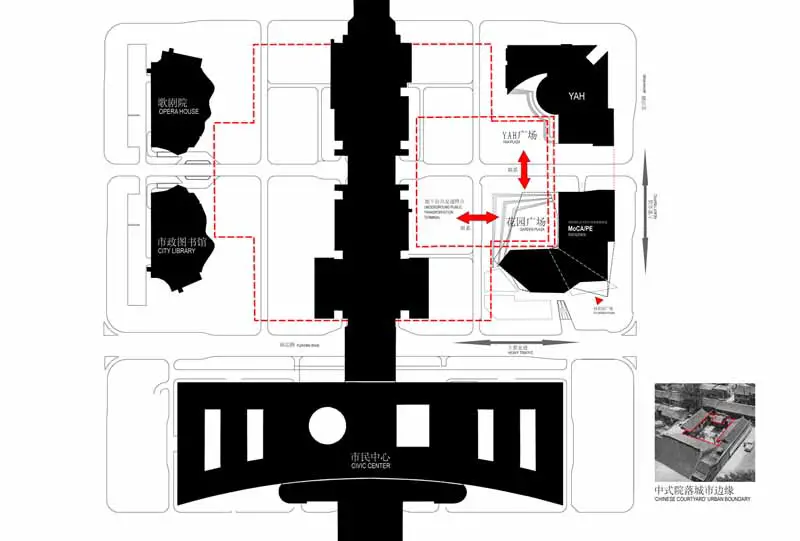
This proposal for MoCA/PE creates a world-class institution which is characterized by both its response to its local environment but also by its formal and structural elegance. The project embraces the concept of the northern part of the Futian Center District as a traditional Chinese courtyard space. In order to bound and intensify the monumental scale of this courtyard, the building massing is designed as a mirror reflection of the L-shaped YAH building massing. This move creates a defining corner for the urban space.
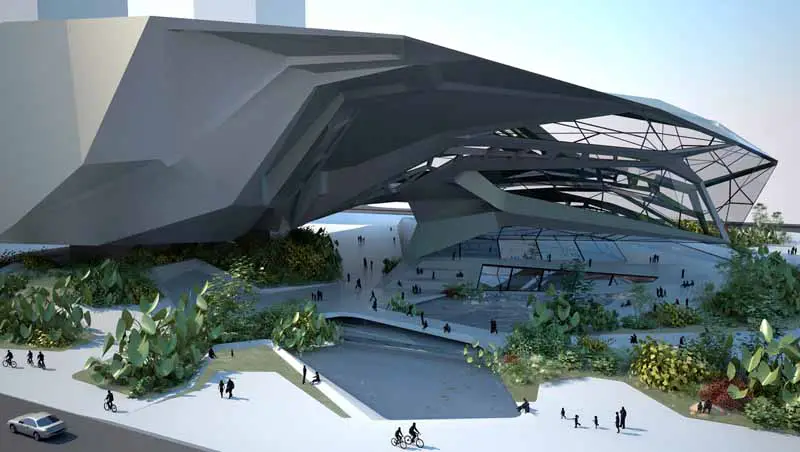
A Garden Plaza is located in the void created by the L-shape, which serves as a meeting point and gateway to the cultural delights offered inside the new building. This Plaza is connected to the Central Library and the YAH via pedestrian crosswalks. The space is defined by a cantilevered roof which encloses the space and offers climate protection. It features a landscaped topography which also serves to define the space while leaving it permeable to the outside urban environment. This space is a lush and tropical atmosphere including public amenities such as gift shops, bookstores, and cafes, allowing museum visitors sanctuary from the stresses of city life.

Organizational Concept
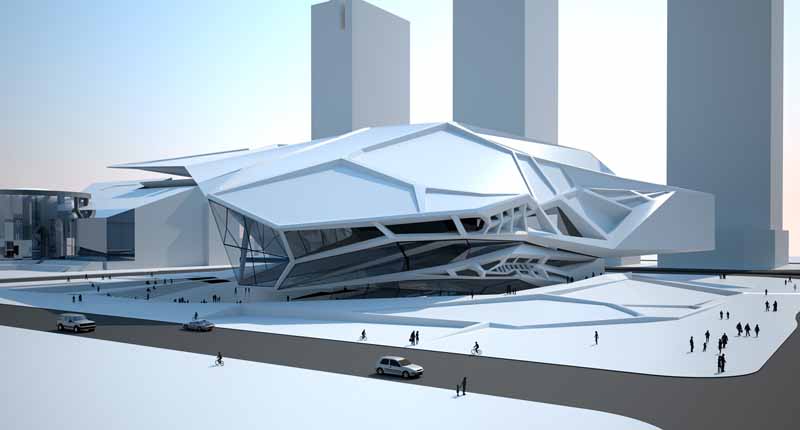
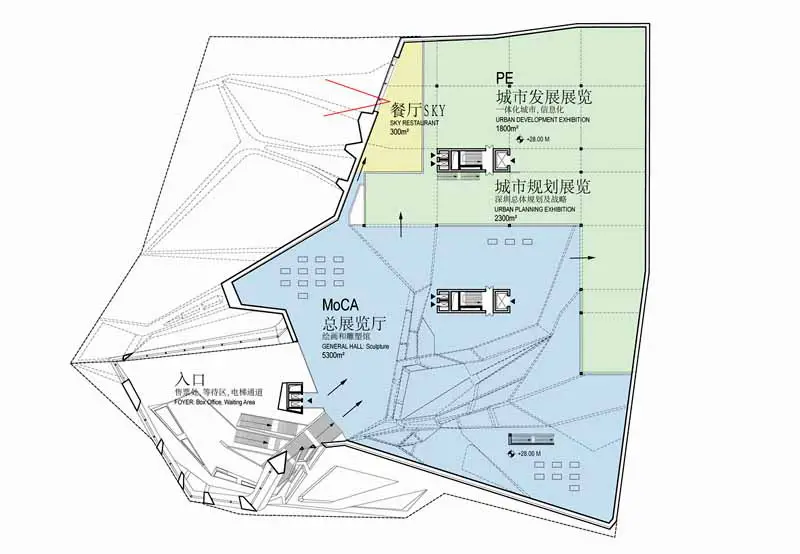
The design is based on integrating the MoCA and PE programs into a single unified project with a distinct presence in the city. The programs are easily unified due to their similar typology and functional requirements. Unification of the programs also allows for a greater efficiency due to reduction of redundant circulation and public amenity spaces.
All of the exhibition space for both programs is located in loft-like spaces in the L-shaped volume. These are open-plan spaces with high clear ceiling heights which can be reconfigured easily as exhibits change. Support spaces for these exhibition spaces, including administrative spaces, the PE Library, and a restaurant, are all located in this part of the building as well.
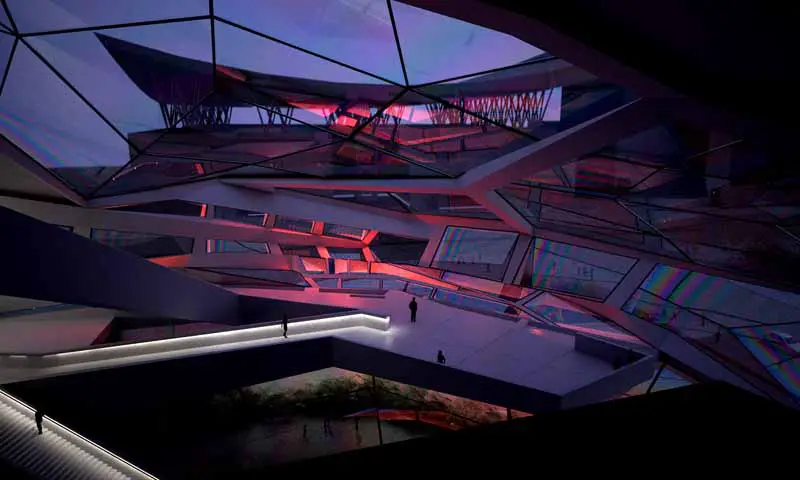
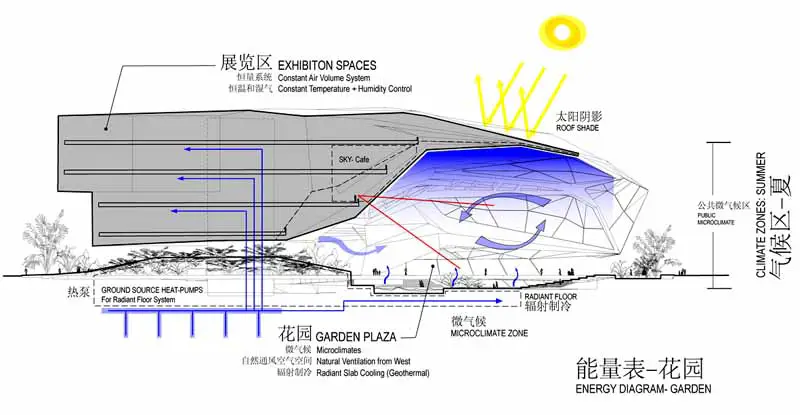
A crystalline Foyer connects these spaces together via escalators and elevators. This Foyer acts as an environmental buffer between the Garden Plaza outside and the more controlled exhibition spaces, in terms of temperature, humidity, noise, and light levels.
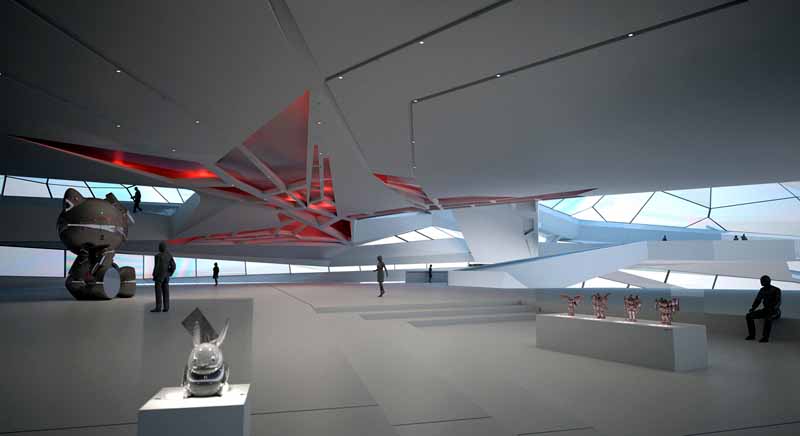
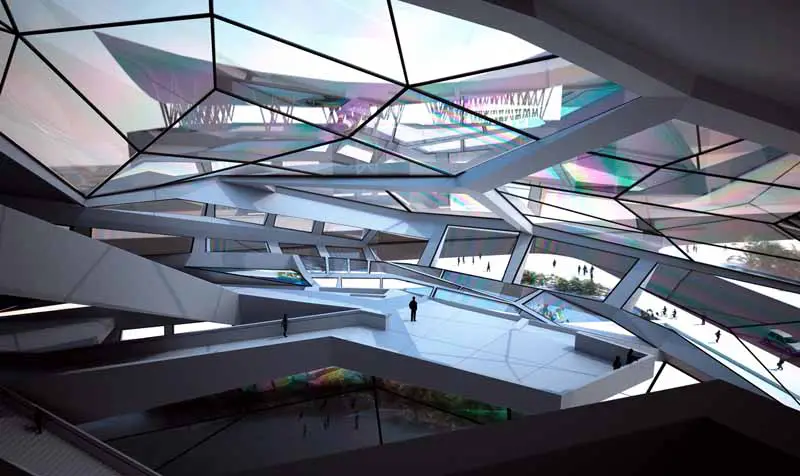
The Garden Plaza is a hub connecting the Foyer to the Landscape as well all of the related public functions such as Cultural Services, Auditoriums, Conference Rooms, VIP Entry, and the underground parking garage. This space is accessible from all sides and will become an urban destination for people just passing by as well as Museum visitors.
It is spatially defined on all sides by topography, plantings, furniture, and the Plaza Roof, creating a highly specific and integrated environment. The Plaza Roof, in combination with plant-life and water features, creates a high-performance urban microclimate utilizing natural ventilation and evaporative cooling.
Design Concept
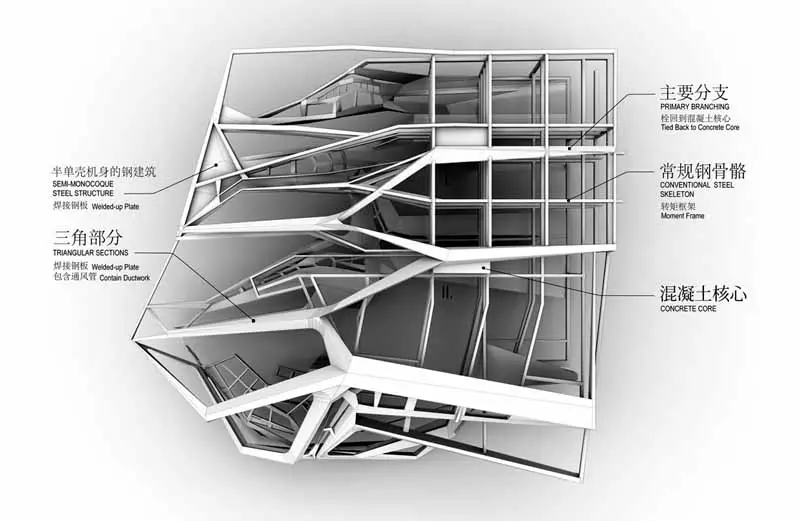
The design of MoCA/PE is based on structural morphologies found in nature, both in terms of their aesthetic and performative characteristics. Specifically, lilypads were examined for their biomathematical logic which includes a network of deep veins underneath their surface which support their wide diameters. Although lilypads float on water, their overall stability is determined by the depth, number, and distribution of these veins. The building structure similarly spreads over architectural surfaces according to force flows, driven by a rule-based system of branching and computational subdivision.
Ultimately, the morphology of veining and structural surface relief begins to contribute to the overall architectural sensibility of the project, beyond the simple solution of engineering problems.
Shenzhen Museum of Contemporary Art – Building Information
Shenzhen Museum of Contemporary Art, Shenzhen, 2007
DESIGNER: EMERGENT Tom Wiscombe, LCC
PRINCIPAL: Tom Wiscombe
DESIGN TEAM: Kevin Regalado, Chris Eskew, Gabriel Huerta, Sebastian Hiemisch
COST ESTIMATING: Davis Langdon Adamson

Emergent Architecture
Tom Wiscombe is Principal at EMERGENT, based in Los Angeles, USA.
Tom Wiscombe was formerly a partner at Coop Himmelb(l)au
Akron Art Museum
Coop Himmelb(l)au with Emergent Architecture
BMW Experience & Delivery Centre, Munich
Coop Himmelb(l)au with Emergent Architecture
Tom Wiscombe: 1993 MoMA Summer show at PS1
Shenzhen Museum of Contemporary Art images : EMERGENT architects Jul 2007
Location: Shenzhen, Eastern Asia
Shenzhen Architecture Designs
Shenzhen Architectural Designs
Museum of contemporary art & planning exhibition
Design: COOP HIMMELB(L)AU
image : SILKROAD Digital Technology Co. LTD
Shenzhen Museum of Contemporary Art & Planning
Konka Tower
Architects: Mecanoo
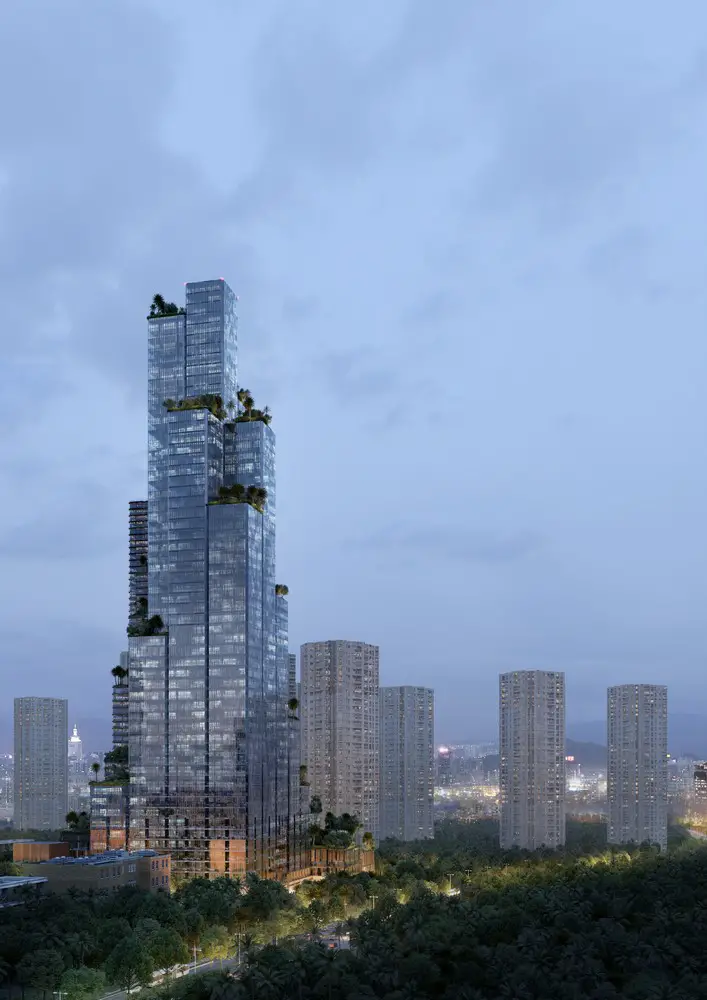
image courtesy of architects
Konka Tower
Shenzhen 4 in 1 Towers Design
MVRDV
Shenzhen 4 in 1 Towers
Shenzhen Crystal Island Competition
Office for Metropolitan Architecture (OMA)
Shenzhen Crystal Island
Hong Kong Architecture Designs – chronological list
Hong Kong Architecture Tours by e-architect
Buildings / photos for the Shenzhen Museum of Contemporary Art Design page welcome
