
Hull building, Niall McLaughlin Architects, Photo, Design, Architecture, Project
ARC Hull – Niall McLaughlin
Humberside Building, northern England, UK – design by Niall McLaughlin Architects
19 Oct 2007
ARC, Hull
Design: Niall McLaughlin Architects
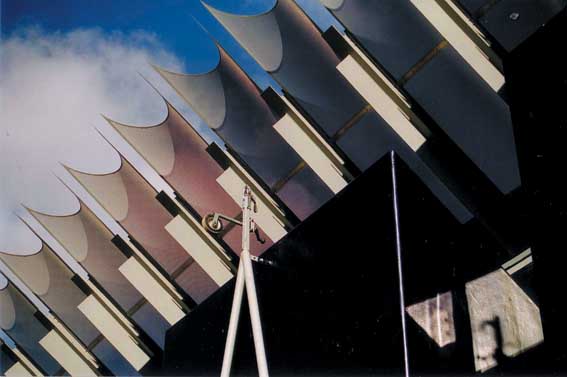
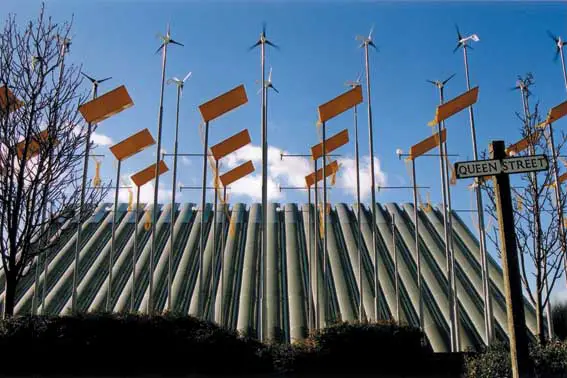
ARC Hull
Hull is a seaside town that has suffered from the collapse of the local fishing and shipping industry. The brief called for an innovative, iconic, movable building to house a new centre for the built environment in Hull. The building is relocatable and will be moved from key site to key site over a 20-year period. The centre will provide opportunities to showcase building and environmental developments arising from regeneration activities in the Humber region. We collaborated with local industries, construction companies, suppliers and labour to ensure maximum advantage for local business, and to give the sense that the building is from Hull, and would have only been possible to build in Hull.
The building is engineered to embody ‘carbonsense’ in an elegant and educational way and celebrates how new buildings can minimise their CO2 emissions through efficient design and use of renewable energy.
The design relates the built environment to the wider environment as a whole. The building itself is like an education tool, it overtly expresses the processes that enable it to function, both structurally and environmentally. NMLA worked with Price and Myers structural engineers and environmental consultants XCO2. The building is like a metabolism, it’s expression falls somewhere between botany and geology.
The building aims to express itself on the scale of the city – it is like a signboard, screen or advertising hoarding. It is seen from a distance – on this site it presents itself to the traffic passing on the motorway over the River Hull.
The building aims to connect Hull with its history and with the sea. From our conversations with some of Hull’s residents it seems that Hull has turned its back on the sea, once at the heart of the city. We were interested in Hull’s fading memory of the vast hinterland of the sea that once formed part of the imagination of the city. We were interested in engaging with the environment of the sea, and will project images of the sea filmed in real time onto the ‘screen’. Dancing patterns of light will illuminate the screen on dull days and at night. As the building ‘dreams’ about the sea the images and patterns will change depending on the conditions out at sea.
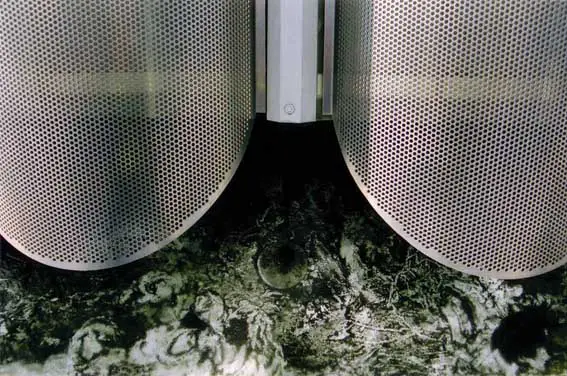
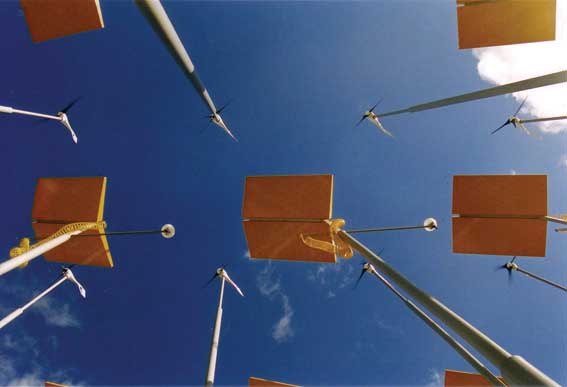
The building structure takes its cue from the estuarine nature of the landscape around Hull. Our building ‘floats’ on a raft of pre-fabricated floor cassettes bearing onto the hardcore and estuarine mud found on the site, via concrete padstones that sit on the ground surface. The building is formed of a kit of parts that will be assembled and re-assembled on future sites.
The foundations are constructed from reinforced concrete and sit on the surface of the site, so that they can be easily removed and moved to the next site. The bases of the renewables posts are also made from pre-cast concrete. The floor cassettes are constructed from a steel frame with brick rubble ballast (to hold the building down against wind uplift pressure). Each floor cassette is framed with timber and has insulation, underfloor heating and vinyl flooring installed as a unit, so that when the building moves, each cassette moves as one unit.
The caravans are steel and timber framed units with insulation built in to the walls floors and roofs. They are stressed skin plywood structures and the water-proofing is provided by epoxy fibre glass and epoxy paint, a system used on boats. These units form office spaces, storage, a plant room, kitchen and WCs. The roof is constructed using steel beams with translucent GRP insulating roofing panels. The outside of the roof is protected by perforated aluminium mesh, which also forms a screen for the projections.
An array of wind turbines and solar panels are mounted on tall poles in front of the building, and these form a ‘mechanical garden’. A wood pellet boiler provides the heating and hot water. In summer, air is cooled using water mist sprays in the pool at the lower edge of the roof – air is cooled by evaporative cooling before being drawn into the building at low level. The stack effect draws hot air out of the building at high level.
Sustainability was an important part of the brief and together with XCO2, we developed a proposal for a ‘zero carbon’ building. Electricity is generated by wind turbines and photovoltaics. The heating and hot water are provided by a wood pellet boiler, which emits zero carbon into the atmosphere. The building utilises high levels of insulation, so that minimum amounts of energy are required to heat up the building.
Photographs copyright : Niall McLaughlin
ARC Hull images / information from Niall McLaughlin Architects
ARC Hull design : Niall McLaughlin Architects
Location: Hull, England, UK
English Architecture
Contemporary Architecture in England
English Architecture Design – chronological list
Scale Lane Bridge, Hull
Design: McDowell+Benedetti
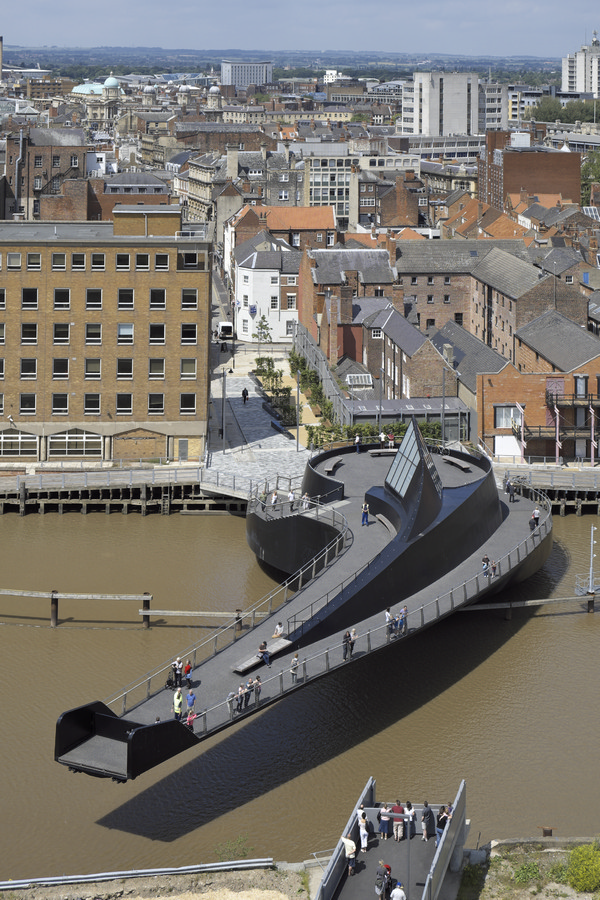
photo © Timothy Soar
Other Hull Buildings
University of Hull – Halls of Residence
1963
Gillespie Kidd & Coia Architects with Leslie Martin
The Deep
–
Terry Farrell Partnership
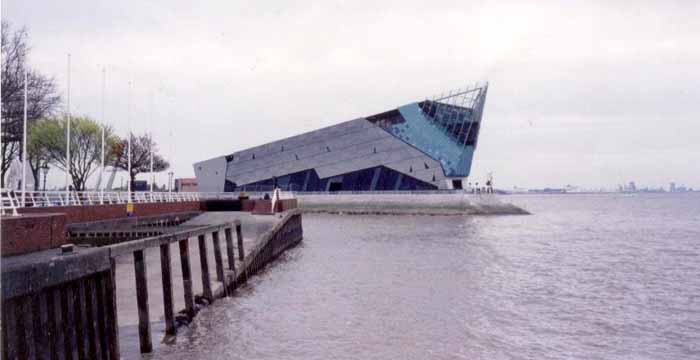
scanned photo
Buildings / photos for the Hull Architecture page welcome
