
Art Institute of Chicago, Modern Wing Building, Project, Photo, News, Design
Art Institute of Chicago Modern Wing : Architecture
Development by Renzo Piano in Chicago, United States of America
May 15, 2009
Art Institute of Chicago Building
The Art Institute Of Chicago Inaugurates Modern Wing Designed By Renzo Piano With Weeklong Free Open House May 16-22, 2009
Largest Addition in Museum History Houses Art Institute’s Renowned Collection of Modern and Contemporary Art and Provides Museum with 30 Percent More Exhibition Space
The Art Institute of Chicago is celebrating the May 16 opening of its new Modern Wing with a week of free admission. The 264,000-square-foot Renzo Piano-designed addition is the largest expansion in the museum’s history. The Modern Wing increases the museum’s size to more than a million square feet, making it the second largest art museum in the United States. Visitors can enjoy the Modern Wing as well as the complete museum complex free of charge from Saturday, May 16 through Friday, May 22, 2009
The Art Institute of Chicago. Aerial View Looking South
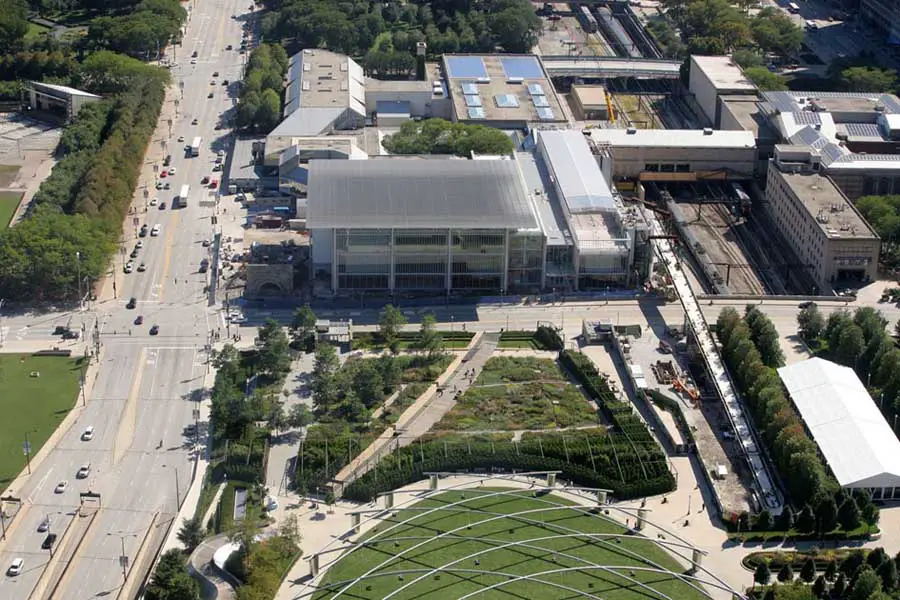
Photo : Andrew Campbell Photography
JPMorgan Chase & Co. is the Founding Civic Sponsor of the Building of the Century Campaign. Target is the Exclusive Sponsor of the Modern Wing Free Grand Opening Weekend on May 16 and 17. For opening week, the Art Institute is collaborating with the Greater Chicago Food Depository and asks visitors to bring canned goods to the museum to help provide food for the Chicago community.
In thanks for the support of Chicagoans while the museum has undergone such extensive renovation over the past five years, the Art Institute is pleased to offer a $2.00 discount for all Chicago residents, effective May 23, 2009, and is doubling its contributions to the Chicago Public Library’s Museum Passport program. These benefits join the efforts the museum already makes to ensure accessibility for residents and visitors, including more than 400 free hours a year and free admission for children under 12, all Illinois school groups and teachers, members of the Chicago Police Department and Chicago Fire Department, and all active members of the military.
“To say this is a historic moment in the history of the Art Institute is almost an understatement,” said James Cuno, President and Eloise W. Martin Director of the museum. “What we celebrate on May 16 is nothing less than the reinvention of the Art Institute. With an entire new building devoted to the museum’s collection of twentieth- and twenty-first century art and design, we can now take our place as one of the leading encyclopedic collections in the country that has also remained steadfastly committed to collecting the art of our time. We are particularly excited to renew and expand our commitment to our visitors. With free and open access to the Ryan Education Center and the Bluhm Family Terrace, as well as our Chicago resident discount, we hope to serve the city and its citizens better than ever before.”
“The Modern Wing embodies Chicago in so many ways,” said Thomas J. Pritzker, chairman of the Board of Trustees of the museum. “It is forward-looking and fresh, certainly, but it also represents a monumental and successful philanthropic effort that no other cultural institution in the city can match. The Modern Wing would not have been possible without the unwavering support of members, visitors, donors, and benefactors. It is our hope that the building we open on May 16 shows that all these efforts, support, and patience are rewarded. While the museum itself showcases art of the past and the present, we can now officially say it is built for the future.”
The Building of the Century Campaign, the largest fundraising effort for any cultural organization in Chicago, has already raised more than $410 million for the design and construction of the Modern Wing, an operating endowment for the building, and related gallery reinstallation projects in the existing building. These reinstallations include the new Alsdorf Galleries of Indian, Southeast Asian, Himalayan, and Islamic Art, the new Goldman Prints and Drawings Galleries in the Richard and Mary L. Gray Wing, and the new Eloise W. Martin Galleries of European Decorative Arts.
The Modern Wing offers brand new galleries for the Art Institute’s renowned collection of modern European painting and sculpture as well as its revelatory collection of contemporary art, including film, video, and new media. The Modern Wing also offers much needed additional special exhibition space and gallery space for the museum’s Department of Architecture and Design and Department of Photography.
Added to the 65,000 square feet of new gallery space are a number of visitor amenities, including an interior garden, an open-air sculpture terrace, a mezzanine café, a pedestrian bridge to Millennium Park, and a fine-dining restaurant managed by award-winning Spiaggia chef Tony Mantuano. The Modern Wing opens with its permanent collection galleries as well as six special exhibitions.
Significantly, the Modern Wing also greatly expands the areas of the museum open to the public without an admission fee. The Ryan Education Center is a complete renovation of the museum’s education and interpretive facilities, featuring state-of-the-art technology, classrooms, studios, resource centers, and a library. This entire area is open free to the public. On the third floor, visitors can enjoy free of charge the Nichols Bridgeway, the Bluhm Family Terrace, which features exhibitions of contemporary sculpture, and access to the restaurant, Terzo Piano.
Griffin Court
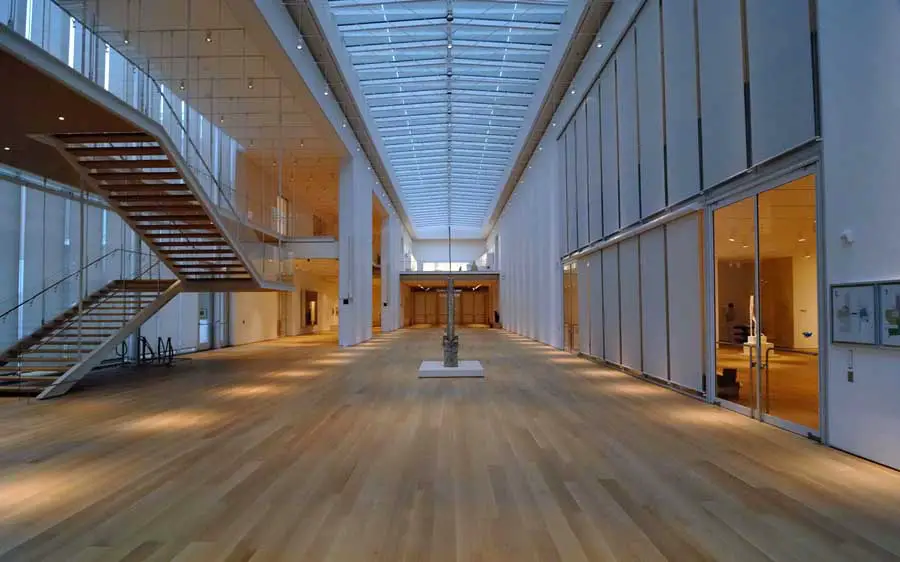
Photo : Charles G. Young, Interactive Design Architects
The Building
Consisting of two pavilions flanking the Kenneth and Anne Griffin Court, the central circulation area, the Modern Wing offers three floors of gallery space and amenities, including a museum shop, new ticketing and coat check facilities, a café and fine-dining restaurant, and an interior garden. The east pavilion houses the education center as well as photography and film, video, and new media galleries on the first floor, galleries for the museum’s permanent collection of contemporary art on the second floor, and galleries for the permanent collection of modern European art on the third floor, under an innovative sun shade system that allows natural light into the galleries.
All three floors of the east pavilion feature full-length striking views of Millennium Park and the city beyond, a vantage point not available from any other location in Chicago. The exterior of the building features new landscaping by Gustafson Guthrie Nichol Ltd. along Monroe Street and Columbus Avenue and in the new Brooks McCormick Court, home of the preserved Chicago Stock Exchange Arch designed by Louis Sullivan. Gustafson Guthrie Nichol also designed the Lurie Garden across the street from the Modern Wing in Millennium Park.
In the west pavilion, the first floor is devoted to the new museum shop, the Modern Shop, visitor services facilities, and special exhibition galleries that will feature modern and contemporary art. The inaugural exhibition in the Abbott Galleries is Cy Twombly: The Natural World, Selected Works 2000-2007. On the second floor, visitors will find galleries devoted to the Department of Architecture and Design that triple the existing space for that collection. The third floor connects to Millennium Park via the Nichols Bridgeway and offers the Bluhm Family Terrace, with the inaugural exhibition of the work of Scott Burton, and the Terzo Piano restaurant.
For the Art Institute, Pritzker Prize-winning architect Renzo Piano designed a canopy, or “flying carpet,” of precisely modeled aluminum blades that allow northern light into the third floor galleries through skylights while shielding the galleries from the more intense southern light. The flying carpet hovers above the third floor skylights, echoing the flat plane of the lake to the east and allowing the Modern Wing to use an estimated 50% less energy for light and heat than the existing building.
Bluhm Family Terrace
The Bluhm Family Terrace, named for donors Neil G. Bluhm, Barbara Bluhm-Kaul, Leslie Bluhm, Andrew Bluhm, and Meredith Bluhm Wolf, is an open-air terrace overlooking Millennium Park and the city skyline. The 3400-square-foot terrace will feature rotating contemporary sculpture exhibitions. A snow-melt system installed on the terrace ensures that it can be used year-round by visitors seeking contemporary sculpture or the spectacular views offered by the Modern Wing. Al fresco dining on the terrace through Terzo Piano will be available throughout the spring, summer, and fall. The Bluhm Family Terrace will be open during museum hours throughout the year.
Griffin Court
The two pavilions of the Modern Wing are connected by the Kenneth and Anne Griffin Court. Visitors enter Griffin Court from the new “second front doors” of the museum, the Millennium Park entrance at Monroe Street. Griffin Court is a light-filled double-height circulation space that offers views of Pritzker Pavilion to the north and access to the Thomas and Margot Pritzker Garden and to the galleries devoted to photography, new media, and special exhibitions. There is one work of art in Griffin Court, Cy Twombly’s Untitled (2005), a slender, vertical piece that punctuates the horizontality of this “Main Street of the Modern Wing.”
The Nichols Bridgeway
The Nichols Bridgeway stretches nearly an eighth of a mile from the edge of the Great Lawn of the Pritzker Pavilion in Millennium Park to the third floor of the west pavilion of the Modern Wing. Funded by Alexandra C. and John D. Nichols, the Nichols Bridgeway, with its white rounded form that supports a textured aluminum walking surface, was inspired by the shape of a sleek, racing scull. The pedestrian bridge is cantilevered off the side of the Modern Wing and slopes gently down into Millennium Park, rising 30 feet above Monroe Street at its highest point. The Nichols Bridgeway will be open from 7:30 am until dusk.
Pritzker Garden
On the east side of the Modern Wing, facing Columbus Drive, lies the Margot and Thomas Pritzker Garden, a 12,000-square-foot oasis of rest and contemplation. Shaded by the flying carpet three stories overhead, the Pritzker Garden is a crushed stone and grass terrace with comfortable outdoor seating and is accessible from Griffin Court. Named for long-time and generous supporters of the Art Institute, the garden also features the only commissioned work in the Modern Wing, Ellsworth Kelly’s White Curve (2009), the largest work Kelly has made to date and the first collaboration between the artist and Piano. White Curve was commissioned by director Jim Cuno in honor of his friend and predecessor James Wood, the Art Institute’s director from 1980 to 2004 who initiated the Modern Wing project.
Ryan Education Center
The Patrick G. and Shirley W. Ryan Education Center is the latest chapter in the museum’s longstanding commitment to museum education. As one of the first museums in the country to emphasize the role of museum education, with programs dating from the 1940s, the Art Institute has now fully updated its education and orientation facilities.
The Ryan Education Center is centrally located on the first floor of the east pavilion of the Modern Wing, with views of Millennium Park and Monroe Street to the north and the Pritzker Garden to the south. Flooded with natural light, this 20,000-square-foot space is double the size of the previous facility.
The Ryan Education Center includes five classrooms, three studios, an educator resource center, a family orientation room, a special kids shop, and a dedicated entrance, the BP Student Esplanade, for school groups. The entire center is fully wired and features computer learning centers, Smartboard imaging technology, and wall-mounted monitors to serve multi-media platforms. With the new space and capabilities, the Ryan Education Center is prepared to serve 2000 people daily, double the number of students, families, teens, and school groups served by the previous facility.
View of Modern Wing from Monroe Street
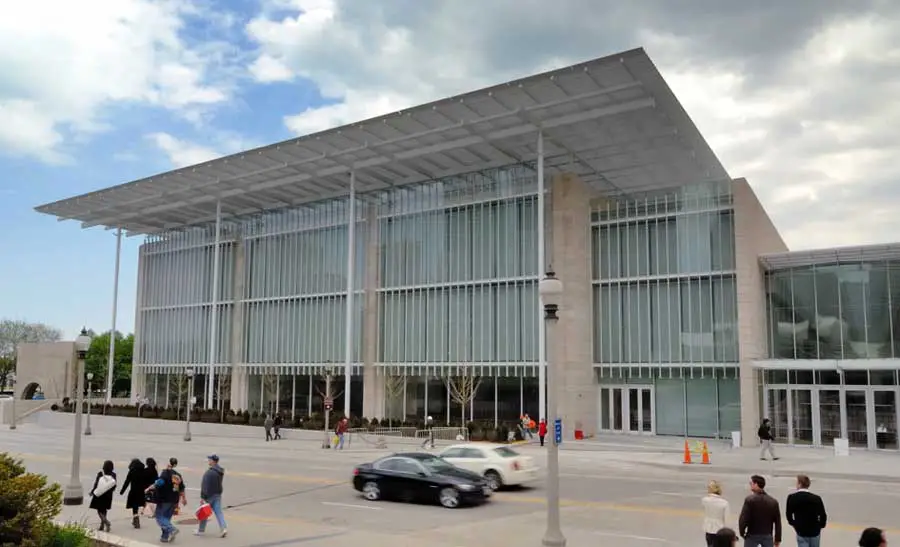
Photo : Charles G. Young, Interactive Design Architects
The Collections
The Modern Wing features permanent collection galleries for modern European art and contemporary art. The building also features rotating galleries devoted to photography as well as film and video on the first floor of the east pavilion and architecture and design on the second floor of the west pavilion.
Modern European Painting and Sculpture
The Art Institute is widely recognized as having one of the finest collections of modern European painting and sculpture in the United States, with particularly fine holdings in the work of artists such as Constantin Brâncusi, Wassily Kandinsky, Paul Klee, Henri Matisse, and Pablo Picasso as well as significant movements such as Surrealism. The galleries devoted to this collection, curated by Douglas Druick, Searle Chair of Medieval to Modern European Painting and Sculpture, and Stephanie D’Alessandro, Gary C. and Frances Comer Curator of Modern Art, open with Matisse’s monumental Bathers by a River, a pivotal work in the artist’s career, which has been the subject of major treatment and research in preparation for the new installation.
The galleries proceed chronologically, allowing a variety of works to be experienced in different contexts and points within artistic careers. Key installations of the modern European art galleries include a spectacular display of the Lindy and Edwin Bergman Collection of surrealist works, installed in a dramatic setting for the largest permanent display of Joseph Cornell’s boxes in the world.
Facing Millennium Park is an elegant presentation of abstract sculpture highlighting the work of Brâncusi, Alberto Giacometti, and Henry Moore. Nearly one-third of the 300 works in these galleries have been cleaned and treated by the Art Institute’s Department of Conservation, and approximately one quarter of the total works have been reframed; graced by the natural illumination of the “flying carpet,” the new installation provides a literal and figural new light on this world-renowned collection.
Contemporary Art
The Art Institute of Chicago has always been committed to collecting and displaying the art of its time, whether that time was the late nineteenth century or 2009. The contemporary art galleries, curated by James Rondeau, Frances and Thomas Dittmer Chair of Contemporary Art, begin with the museum’s collection of “classic contemporary” work from the 1940s through the 1960s, including paintings by Jackson Pollock, Willem de Kooning, Franz Kline, Jasper Johns, and Joan Mitchell.
Works from this era are displayed on the second floor in gallery space across Pritzker Garden from the east pavilion. In the east pavilion, the sequence begins with Pop Art and a monumental shaped canvas by Frank Stella, De la nada vida a la nada muerte (1965). “Cool” New York Pop is juxtaposed with “Hot” Imagist work in galleries devoted, for the first time, to Chicago art movements of the 1960s.
The chronological sequence of work in the contemporary galleries, which runs from the 1960s to the present, is interspersed with single-artist installations that allow the museum to show the depth of its holdings in the work of such artists as Gerhard Richter, Ellsworth Kelly, and Robert Gober. Many works in the contemporary galleries are shown for the first time, including Richard Serra’s monumental Weights and Measures, Mary Heilmann’s Heaven, and Gerhard Richter’s Set of Four Drawings.
New acquisitions include Charles Ray’s Hinoki (2007), Kerry James Marshall’s Vignette Suite (2005-08), and Kelly’s Tableau Vert (1952), recently given to the museum by the artist in tribute to the museum’s strong collection of French Impressionist work. On the first floor of the Modern Wing, visitors will find the Donna and Howard Stone gallery devoted to film, video, and new media, which will feature rotations from the museum’s significant holdings of electronic media.
Architecture and Design
The vast increase of space given to the museum’s Department of Architecture and Design-from 2500 feet to nearly 8000 feet-signals the commitment of the Art Institute to deepening its already extensive holdings in architecture. Based in a regional archival collection, the department has expanded under the direction of Joseph Rosa, the John H. Bryan Chair of Architecture and Design, and Zoë Ryan, the Neville Bryan Curator of Design.
The museum’s holdings now include architecture and design of national and international significance and have grown to more than 170,000 objects, drawings, models, and installations. The architecture and design galleries will rotate frequently and will display selections from the permanent collection, curated exhibitions organized around specific themes or concepts, and exhibitions devoted to the work of emerging architects and designers.
Photography
The Department of Photography has galleries devoted to modern and contemporary photography in the Modern Wing, which come in addition to existing galleries on the lower level of the Allerton Building. Led by curator and chair Matthew Witkovsky, the department holds nearly 18,000 objects that span the history of photography from its emergence in the nineteenth century to the present.
Pillars of the collection include the Alfred Stieglitz bequest of 246 works, given to the museum by Georgia O’Keeffe in 1949, and the Julien Levy collection of more than 300 photographs. At its opening in 1982, the Mary and Leigh Block Study Center of the department held the first climate-controlled vaults for photography storage in a United States art museum. The Center, open by appointment to students and researchers, brings work from those vaults to between one and two thousand visitors per year.
Location: Chicago, IL, USA
Chicago Architecture
Chicago Architecture Design – chronological list
Chicago Architectural Walking Tours
The Shard – key design by Renzo Piano
MUSEUM HOURS
10:30 am-5:00 pm Monday, Tuesday, Wednesday, Friday
10:30 am-8:00 pm Thursday
10:00 am-5:00 pm Saturday, Sunday
TARGET FREE THURSDAY EVENINGS AFTER 5:00 pm
SUMMER HOURS (from Memorial Day to Labor Day)
10:30 am-5:00 pm Monday, Tuesday, Wednesday
10:30 am-9:00 pm Thursday, Friday
10:00 am-5:00 pm Saturday, Sunday
TARGET FREE SUMMER EVENINGS THURSDAY AND FRIDAY AFTER 5:00 pm
FREE FEBRUARY 1 TO 28
Closed Thanksgiving Day, Christmas Day, and New Year’s Day.
Please check www.artinstituteofchicago.org before your visit.
ADMISSION
Effective May 23, 2009
Adults $18.00 Includes all special exhibitions and coat check
Children 12 and over, students, and seniors $12.00 Includes all special exhibitions and coat check
Chicago residents receive a $2.00 discount with proof of residency
Children under 12 always free
Members always free
Free Evenings are free to all. City of Chicago residents with Chicago Public Library cards can borrow a “Museum Passport” card from any library branch for free general admission to the nine members of Museums in the Park, including the Art Institute of Chicago.
The Art Institute of Chicago is a museum in Chicago’s Grant Park, located across from Millennium Park. Visitors can enter the museum via the Michigan Avenue entrance or the Millennium Park entrance on Monroe Street.
American Buildings by Renzo Piano
Comments / photos for the Art Institute of Chicago Modern Wing Architecture page welcome
