|
|
Liege-Guillemins TGV Railway Station, Belgian Building, News, Design
TGV Railway Station Belgium : Architecture Information
Development by Santiago Calatrava in Belgium
LIÈGE-GUILLEMINS
TGV STATION
2009
Santiago Calatrava
DESCRIPTION
The city of Liège is now a major node in the European high-speed
rail network, which links England, France, Belgium, and Germany. When
the city's existing station had to be replaced, as unsuitable for
the demands of high-speed rail travel, Euro Liège TGV issued
a request for proposals from European architects. Santiago Calatrava
received the commission to design the new Liège-Guillemins
station, largely because of his vast experience in the field, in projects
such as the Lyon-Satolas air-rail link and the Oriente station in
Lisbon.
Calatrava conceived the station as a link between two distinct areas
of the city of Liège, which previously had been separated by
the railroad tracks. On the north side of the site is a rundown urban
area, laid out in a typical 19th century scheme. On the south side,
on the slopes of the Cointe Hill, is a less dense, landscaped residential
area. Calatrava's design bridges these two areas with a 200 m (656
ft) passenger terminal, built symmetrically about a northwest-southeast
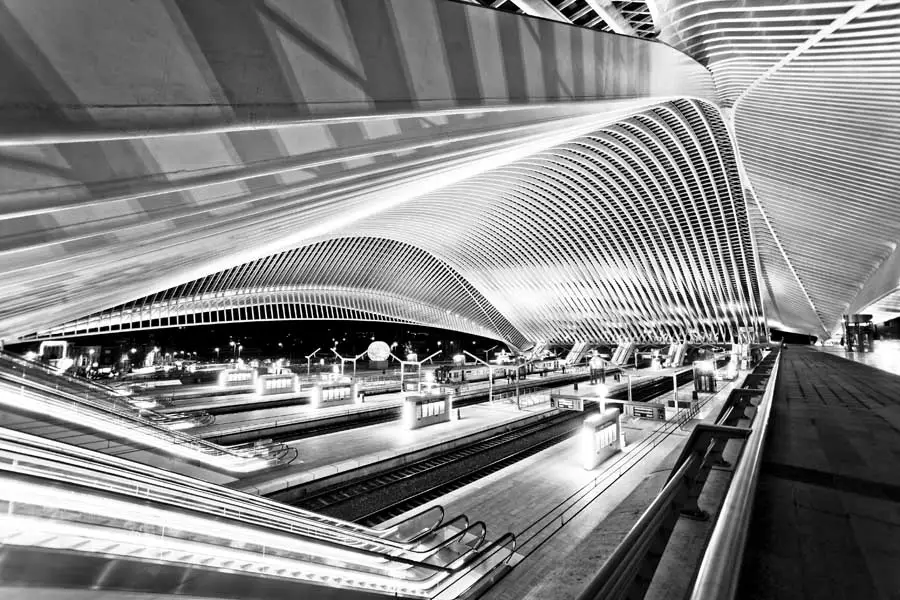
axis. The arched roof of the terminal building extends over the five
platforms for another 145 m (476 ft).
photos : www.palladium.de, Barbara Burg/Oliver Schuh
The station is three levels high on the urban (north) side, stacking
an access footbridge and a level of rail platforms. At the level of
the Place de la Gare (under the platform), a strip of commercial units
helps to reinforce the streetscape. These units include the Passenger
Hall on the main axis, with the ticketing area on the left and a bar-restaurant
on the right. On the hill (south) side are five levels: three levels
of parking, a vehicular access deck linked with the access footbridge,
and a raised pedestrian walkway.
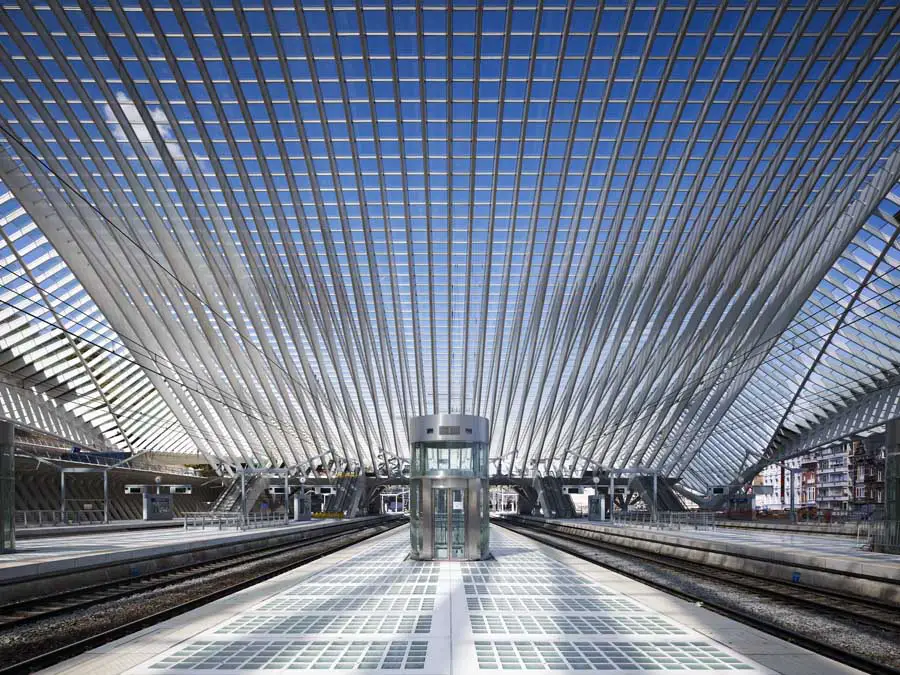
Transparency is achieved by means of the monumental vault, constructed
of glass and steel, which allows for a sense of interpenetration between
the station and the city. The pedestrian bridges and a walkway under
the tracks allow for fluid communication between the two sides of
the station. Particular attention is paid to the architectural detailing
of these transitional spaces.
The project has no facade in the traditional sense, since the interaction
between interior and exterior is seamless. The monumental roof becomes,
in effect, the project's facade. To an observer on the hill, the roof
reveals something of the inner organization of the station. To an
observer within the station, the structural arches of the roof frame
the views to the outside. From any vantage point, the sensation of
transparency prevails.
Because the metal frame of the station must be put in place without
disrupting train service, a technique normally employed in bridge
construction is being used. The principal frames are assembled in
an area away from the trains, located at the proposed Place de la
Gare. At night, the frames are pushed in groups of six onto the principal
supports. Once the principal roofs are in place, the two canopies
can be assembled in position and glazed.
Liege-Guillemins TGV Railway Station - Building Information
Architect: Santiago Calatrava
Client: SNCB Holding, Infrabel and Euro Liège TGV
Location: Liège, Belgium
Start of Construction: 1996
Opening: September 18, 2009
Function: Train Station
Materials: Concrete, steel and glass. Floor: Blue limestone.
Dimensions:
Construction Area: 49.000 m2 (including roads)
Overall Length: 488 m
Total Length of Steel Work Built: 410 m
Total Width of Steel Work Built: 160 m
Maximum Distance Between Supports: 158 m
Total Area of Glass Roof: 33. 000 m2
Santiago
Calatrava Architect
Belgian Architect Studios
SANTIAGO CALATRAVA ARCHITECT STATEMENT
My intention from the outset has been to create a highly modern 21st
century integrated Transportation facility that responds to its position
at the foot of the Cointe Hills and from a belief that it must act
as a catalyst for regeneration of the Guillemins quarter.
This portion of the City of Liege has sadly degraded due to being
blocked in on all sides by railway tracks, a highway to Brussels and
an expressway that cuts the link to the Meuse river banks. Its natural
quality has been lost and replaced with a feeling of insecurity. The
area directly in front of the Station is the site of asbestos ridden
blocks and surface car parking erected in the 1960's to house the
"Citê Administrative de Finances" . These will give
way to an urban plaza linking the Station back to the Meuse providing
a focal point for renewal of the quarter as a whole.
The global orientation of the Station is prescribed by the railway
lines but this provided a spur to generate a perpendicular axis along
the new "Avenue de la Liberté" thrusting out toward
the Meuse River. My sincere hope is that the new station and this
new axis act together to create a project on an urban scale that the
will lead to a regeneration of the entire quarter and act as an open
invitation to the City of Liege to reconnect to the Meuse River.
My goal was to create a building that reflects the new stations potential
significance as a high speed inter-urban link between Europe's cities.
The new rail links provide 20 minute travel times to Aachen, Cologne
and Brussels while Frankfurt, Paris, London and the Southern portions
of Europe are only a few hours away.
I decided that the station should not only be a transport hub but
also a gateway to Liege itself. This idea provoked the development
of the vaulted roof. I saw this as working in two distinct ways. When
viewed from within the station (by passengers arriving by train) the
vaulted roof and canopies form a balcony on a grand scale framing
the City of Liege. For departing passengers arriving to the plaza
the vision is inverted to frame the station itself and the Cointe
hills beyond.
If this was to be achieved the station would have to be as transparent
as possible. I imagined a building without facades with a soaring
roof above offering protection from the elements (particularly the
ever present rain of the Belgian Winter). This could maintain the
views through and of the station. The vaulted shape was a natural
development of this vision while the soft (perhaps feminine) undulating
curve of the roof was selected to mimic the graceful rise and fall
of the Cointe hills beyond.
I felt that there was no better way to celebrate the technological
achievement of the TGV trains than to expose the working platforms
and the dynamism of the moving ensemble of passengers and trains.
With such levels of service to such varied destinations I was acutely
aware of the danger that a new station could become a disorientating
labyrinth of interconnections. Every station requires space for ticketing,
waiting rooms, retail facilities etc. that must link directly with
the trains. I chose to combine all these spaces in a zone below the
platforms, "the Galleria". To avoid this space having the
feel of an underpass I filtered daylight through from above using
glass block paving cast into the platforms above to convey the abundant
natural light down through from the glazed roof. The use of natural
daylight to create a feeling of wellbeing throughout all the spaces
of the project is a recurring theme.
The glazed roof (tinted slightly to provide protection from the harshest
rays) means that no additional artificial lighting is required during
the day to the naturally ventilated space below. This ecological sensitivity
is reflected in the choice of local materials, the specification of
recycled or recyclable materials and ordering the replanting of the
sections of the hills touched by the project. All thought through
with a conscious notion to reduce the Carbon footprint of the project.
The station is arranged around a number of levels with the generous
proportions of the Galleria space being mirrored in the wide walkways
that provide the primary links across the station. These routes enable
passengers to reach the covered parking facilities, as well as provide
a quick and easy route for residents of the Cointe quarter to pass
through the station and reach the platforms. I have found that the
generous, well lit spaces that are created allow passengers to orientate
themselves with great ease and that significant signage is no longer
required.
Guillemins Station is a true multi-modal transport hub with Covered
parking for 800 cars (with 1200 more spaces to follow) while the regions
buses serve the front and rear of the station. A drop off zone is
provided to allow taxis and private vehicles to enter and exit the
station environs with a minimum of fuss. The overall dimensions of
the Hall and the side wings was based on the practical considerations
of the length of the trains serving the station with the more standard
trains fitting in to the dimensions of the main hall. Oversized trains
can be accommodated using the wing extensions as ancillary sections
connecting back via travelators to the center.
The primary materials used to create the station are concrete (both
precast and cast in situ) and steel (used for the 180m span ribbed
shell-like roof). The station make as much use as possible of exposed
structural finishes while "bluestone" (used historically
throughout the region) has been selected for use in the floor paving,
the cobbles of the plaza and feature elements such as the benches.
Perhaps the greatest, but unseen, achievement in constructing this
station was that the station was erected in multiple small phases
over an extended period of time allowing the station to remain open
throughout. Indeed only short overnight closures were required to
move 5-rib-wide segments of the roof over the working platforms section
by section.
We have delivered a most Modern Station into the heart of a City creating
a rightly prominent and vital link for Liege with the rest of Europe.
I have no doubt that the quarter in which it sits and the City as
a whole will benefit from its completion.
Liege-Guillemins TGV Railway Station - Building Information received
290909
|
Herge Museum
Railway Station Buildings
KMSKA Antwerp
NATO Belgium building

World Architecture : e-architect
- key buildings across the globe
Comments / photos
for the Liege-Guillemins TGV Railway Station Belgium Architecture page welcome:
info@e-architect.co.uk
Liege-Guillemins TGV Railway Station : page
- adrian welch / isabelle lomholt |
|
|
|