
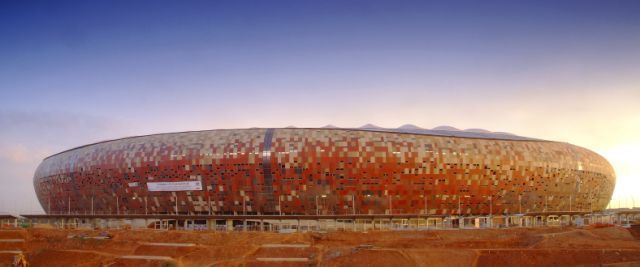
Soccer City Stadium, South African football ground building, Sports project design photo, Sokkerstad Pictures
Soccer City Stadium Africa : African World Cup Venue
Football Area Development in South Africa – Sokkerstad – The Pot
19 Aug 2009
Soccer City Stadium, Johannesburg, South Africa
Design: Boogertman Urban Edge and Partners in partnership with Populous
Soccer City location: Nasrec Road, Soweto
Soccer City Stadium photo from BUE & Partners
Soccer City Stadium Building, Johannesburg
By 2010, 80 000 cubic metres of concrete will have been poured, 9000 tons of reinforcing steel would have been placed and 8000 tons of structural steel will have been erected. This, in combination with the moving of approximately 120 000 cubic metres of soil, fine architecture and dedicated efforts in the design offices and on site, will result in Soccer City being transformed into one of the most striking, impressive and well-equipped stadiums in the world. The ±90 000 seater Soccer City Stadium venue will host both the opening match and the final of the 2010 FIFA World Cup.
The existing structural concrete profile of the two suite levels and upper tier are extended all round to encircle the pitch. The existing lower embankment is rebuilt in insitu off-shutter concrete to vastly improve the view lines and comfort of the most popular seats in the house. The upper third of the existing embankment is raised to form a secondary tier on new concrete rakers and pre-cast concrete steppings. The upper embankment and the rebuilt lower embankment are accessible from the lower concourse, which is fed from the podium level. The two suite levels and the upper tier are accessed via 3-dimensional concrete ramp structures that are contained within the façade of the pot. The suite levels also have separate lift and stair lobbies at each corner for secure VIP access.
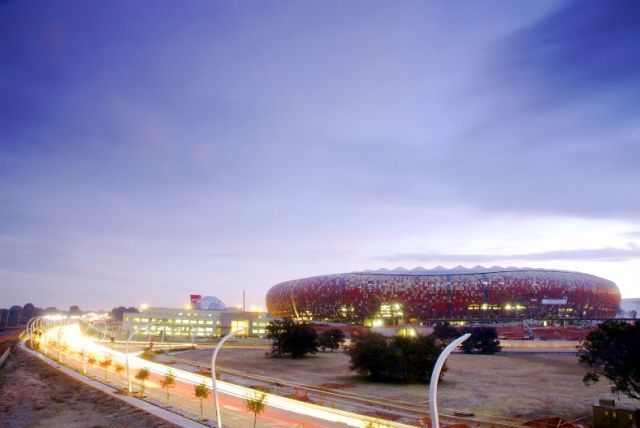
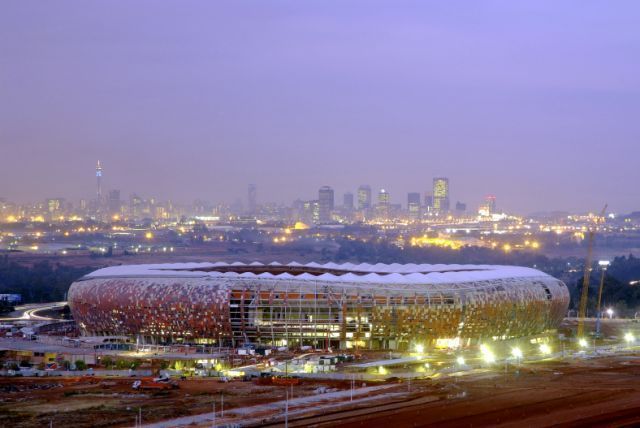
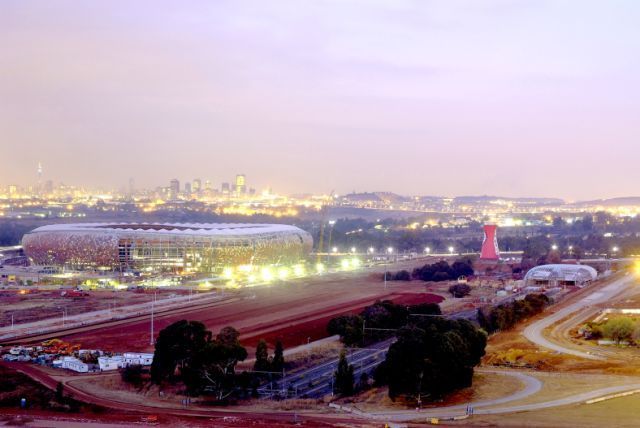
Sokkerstad pictures from BUE & Partners
The pot’s façade is made up of fibre reinforced concrete panels, in a selection of 8 colours and 2 textures that reference the shades and textures of the calabash. The pot is punctured by open or glazed panels that suggest pattern on the façade, which comes into its own when the inside volumes are illuminated. The Soccer City Stadium façade is articulated by 10 vertical slots which are aligned geographically with the 9 other 2010 stadia as well as the Berlin stadium. They are -representative of the road to the final. The calabash façade is supported by inclined off shutter 3 dimensional curved concrete columns which have a horizontal eccentricity of 6.5m in relation to its base.
The upper roof, which is cantilevered from an enormous triangular spatial ring truss, is covered by a PTFE membrane in a colour similar to that of mine-dump sand. The bottom of the trusses will be covered by a perforated mesh membrane, thus giving the appearance of a smooth under-slung ceiling. The triangular spatial ring truss is supported by twelve, 40 meter high concrete shafts which are subjected to huge tension and compressive forces and consequently have piles which are anchored in the bedrock below the Sokkerstad building.
The choice of concrete for the bulk of the Soccer City Stadium structure was taken to match with the existing structural profile so as to enable all pre-cast units to be made on site, and to improve on the costs and lead times of a structural steel framework.
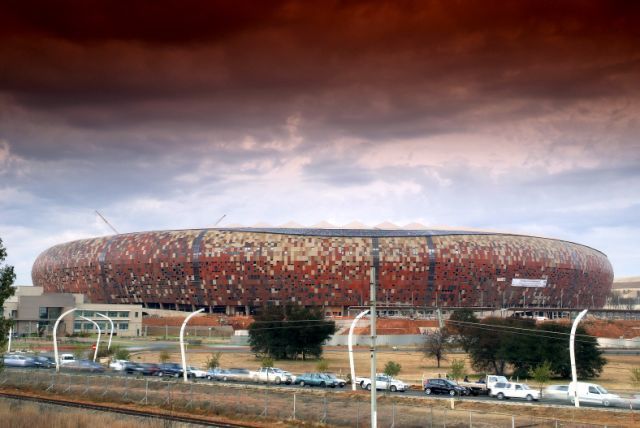
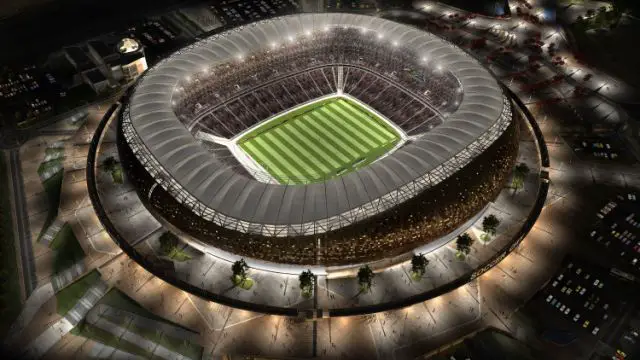
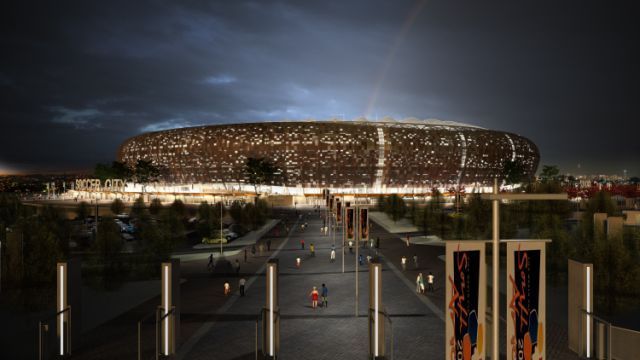
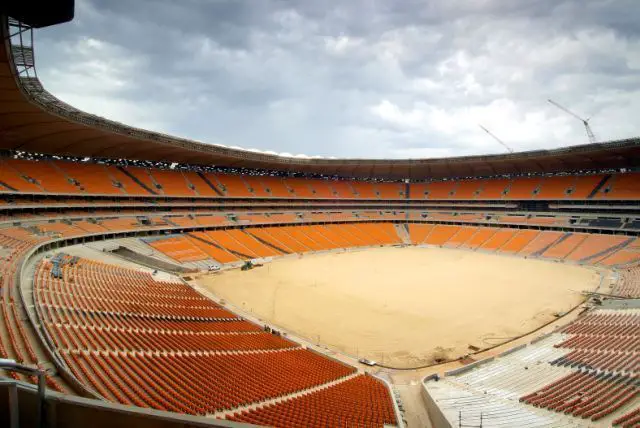
Soccer City Stadium pictures from BUE & Partners
Sokkerstad Site
The site is directly north of the proposed new Nasrec Transportation Hub and pedestrian mall, linking the Soccer City Stadium to the redeveloped Expo Centre to the south. The transportation hub will accommodate taxi, bus, and rapid transit services, thus providing good public transport links to the precinct and the Soccer City Stadium. A secondary Bus Rapid Transit station is also proposed on the Soweto highway to the north of the stadium, which will further strengthen the public transport links to the Soccer City Stadium. All of this is to be set in a revamped Nasrec precinct, which will boast new roads, and pedestrian walkways with lighting, signage, landscaping, CCTV, and public amenities.
Soccer City Stadium Architecture + Design
The architectural design of the Soccer City Stadium was selected from a series of concept designs, ranging from acknowledgement of Jo’burg’s disappearing mine dumps; the kgotla (defined by the tree) of the African city state; the African map as a horizontal representation, which included the roof as a desert plane supported on tropical trees set within the mineral wealth of Southern African; to a representation of the protea, our national flower.
The calabash, or African pot design, proposed by Boogertman Urban Edge + Partners was selected as being the most recognisable object to represent what would automatically be associated with the African continent and not any other. The calabash, or ‘melting pot of African cultures’, sits on a raised podium, on top of which is located a ‘pit of fire’. Thus the pot sits in a depression, which is the ‘pit of fire’, as if it were being naturally fired. The pit of fire demarcates the security and turnstile line separating the outer areas and the secure inner areas.
The structural profile of the existing suite levels and upper-tier seating of the existing western grandstand are extended all round to encircle the pitch. The existing lower embankment will be rebuilt to vastly improve the view lines and comfort of the most popular seats in the house. The upper third of the existing embankment is to be raised to form a secondary tier, thus turning the stadium into a 3-tiered, rather than a 2-tiered, stadium. The upper embankment and the rebuilt lower embankment are accessible from the lower concourse, which is fed from the podium level. The two suite levels and the upper tier are accessed via 3-dimensional ramp structures that are contained within the façade of the pot. The suite levels also have separate lift and stair lobbies at each corner for dedicated secure VIP access.
The pot’s façade is made up of laminated fibre reinforced concrete panels, in a selection of 8 colours and 2 textures that make reference to the shades and textures of the calabash. The pot is punctured by open or glazed panels which create a suggestion of pattern on the façade that comes into its own when the inside volumes are illuminated. The Soccer City Stadium façade is articulated by 10 vertical slots which are aligned geographically with the 9 other 2010 stadia, as well as the Berlin stadium. These are representative of the road to the final, and it is hoped that, after the World Cup, the scores of each game at each venue will be placed in pre-cast concrete panels on the podium. A visit to the stadium will thus provide one with a full history of the World Cup and all its scores.
The Soccer City Stadium upper roof, which is cantilevered from an enormous triangular spatial ring truss, is covered by a PTFE membrane in a colour similar to that of the adjacent mine-dump sand. The bottom of the trusses will be covered by a perforated mesh membrane, thus giving the appearance of a smooth under-slung ceiling.
All VIP areas and the stadium management offices in the Soccer City Stadium will be located behind the main western grandstand, with a dedicated VIP entrance. New change rooms, media work areas, auditorium, and VIP parking are located within a new basement under the podium on the western side of the stadium.
Sokkerstad South Africa Architectural Design Team
Notwithstanding the numerous architects, technicians and specialists involved in the Soccer City project the principal design team are:
– Bob van Bebber – Project Director: Boogertman Urban Edge + Partners
– Piet Boer – Senior Associate & Project Architect: Boogertman Urban Edge + Partners
– Damon Lavelle – Associate Principal: Populous

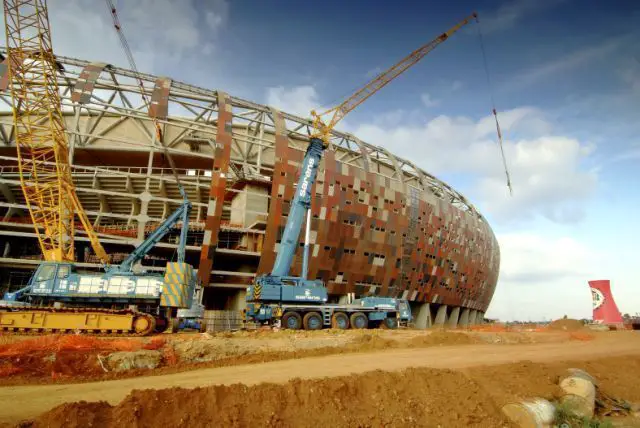

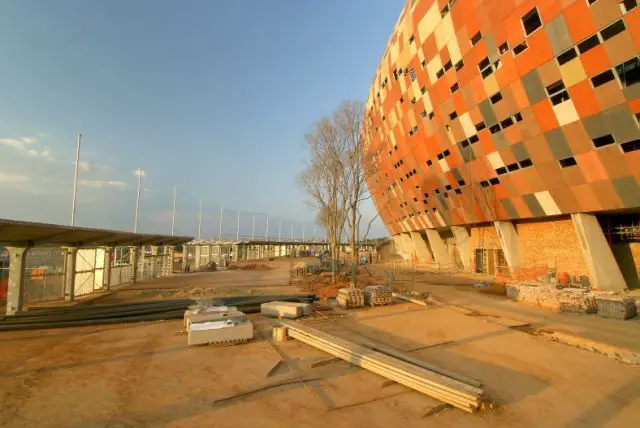
Soccer City Stadium pictures from BUE & Partners
Soccer City Stadium images / information from Boogertman Urban Edge and Partners
Soccer City Stadium South Africa – Further Building Information
World Architecture Festival Awards 2010
WAF Awards – World’s Best Sport Building
Location: Nasrec Road, Soweto, Johannesburg, South Africa
South Africa World Cup Stadiums
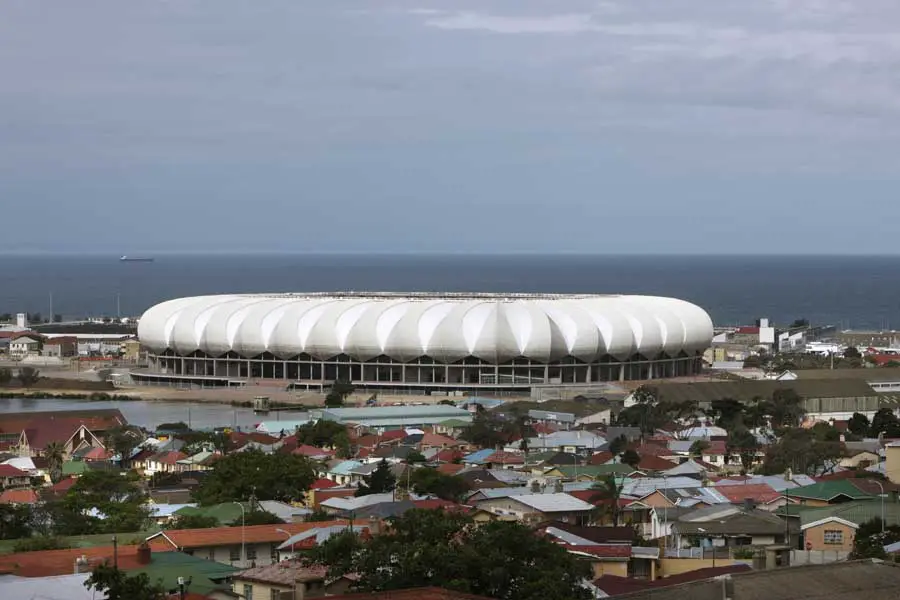
image © Marcus Bredt, Berlin
Soccer City is the largest stadium in the whole of Africa
Football for Hope Centres Africa
Soccer City – official title is FNB Stadium
Boogertman Urban Edge and Partners : South African Architect – contact details
Soccer City is located next to the South African Football Association headquarters
Cape Town Stadium, South Africa – World Cup 2010 venue
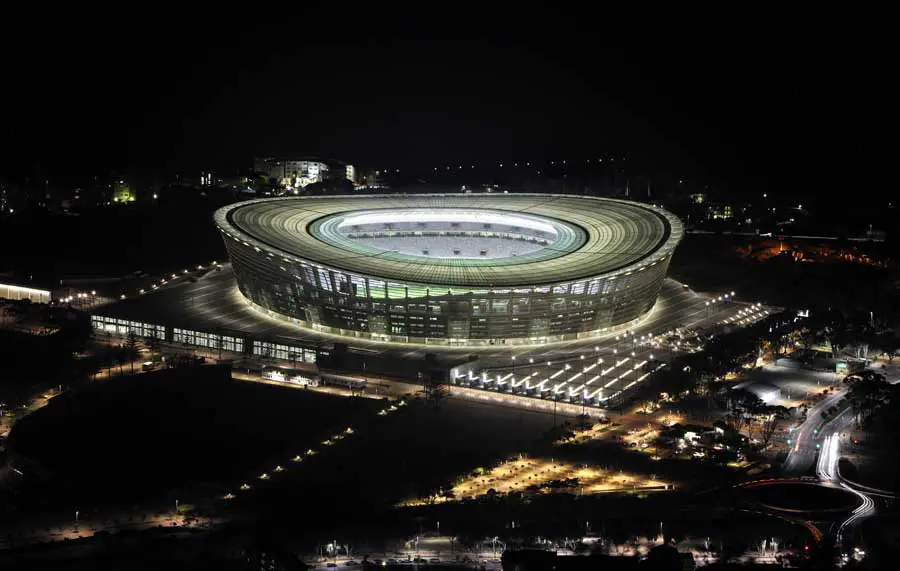
image © Marcus Bredt, Berlin
Durban Stadium, South Africa – World Cup 2010 venue
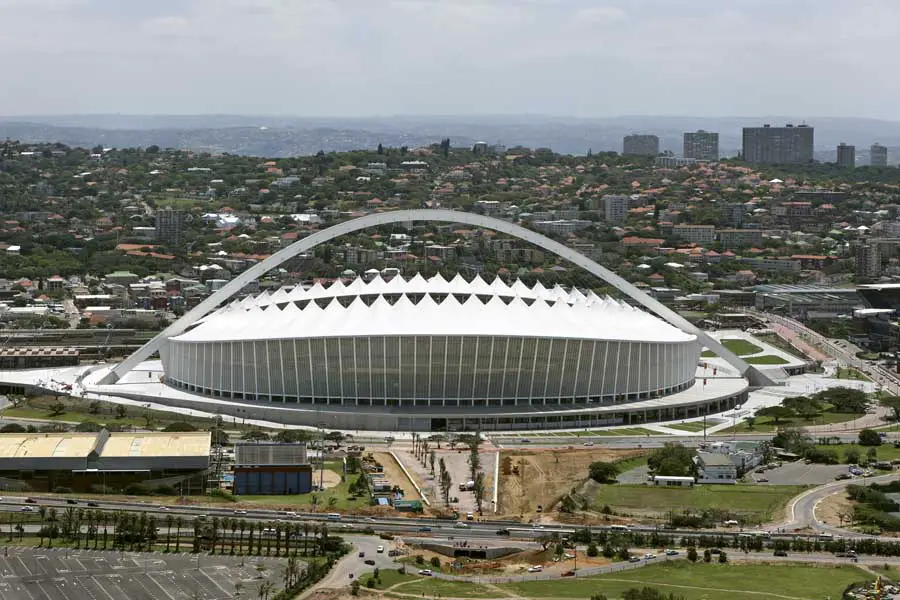
picture © Marcus Bredt, Berlin
Populous – partner Soccer City Stadium architects
Portside Cape Town, South Africa
Soccer City is Sokkerstad in Afrikaans
Comments / photos for the Soccer City Stadium – South Africa Football Arena page welcome

