
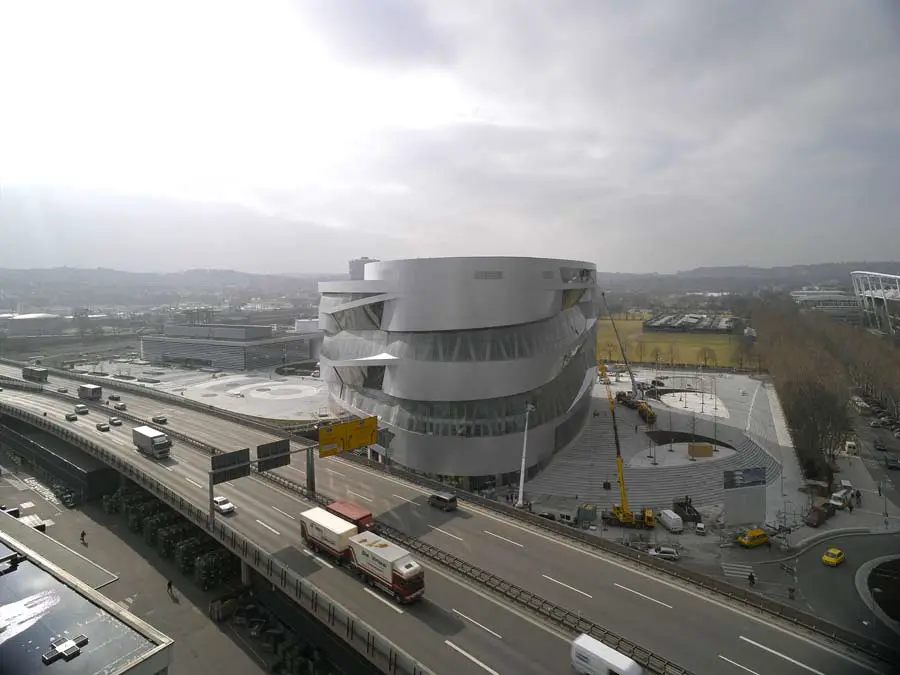
Mercedes Museum Stuttgart, Germany building design images, Architect, Picture, Award
Mercedes-Benz Museum Stuttgart
German car architecture design by UNStudio Architects
13 Nov 2008
photo : Christian Richters
Hugo-Haring Prize – Mercedes-Benz Museum
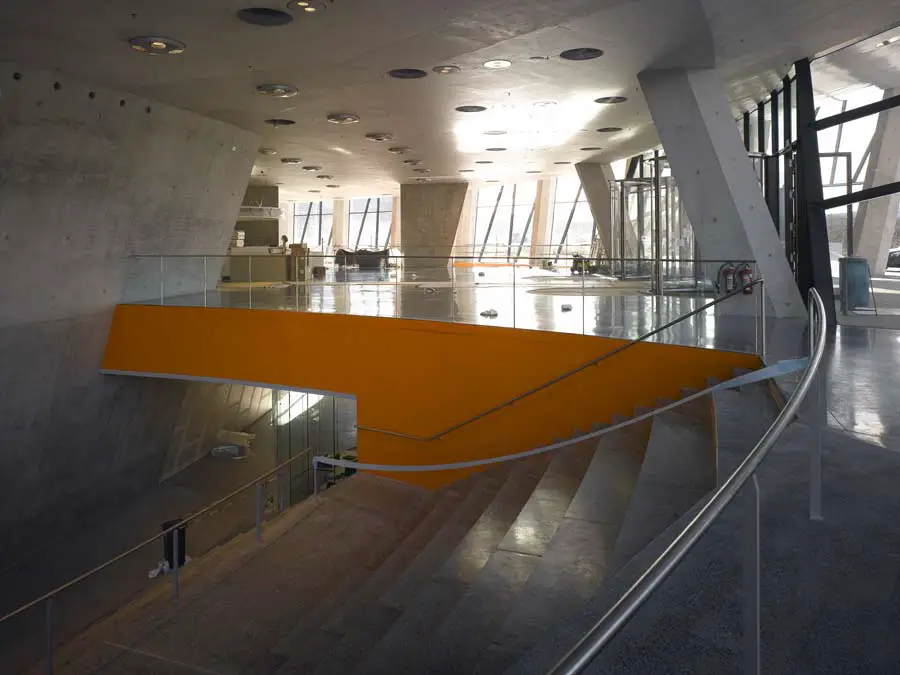

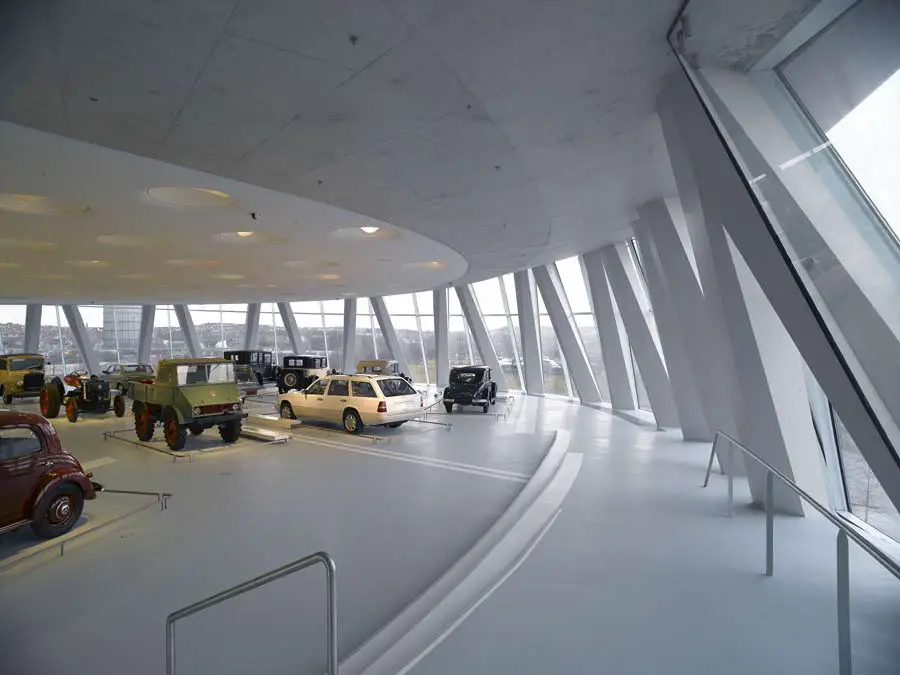
photos : Christian Richters
We are pleased to announce that The Mercedes-Benz Museum has been awarded a Hugo-Häring Prize in the category Guter Bauten, for the Stuttgart region. The award ceremony is due to take place on Nov 14th 2008 in Stuttgart.
Previous Hugo-Häring-Preise winners include Prof. Dr. Werner Sobek, Barkow Leibinger Architekten and Peter Kulka Architektur.
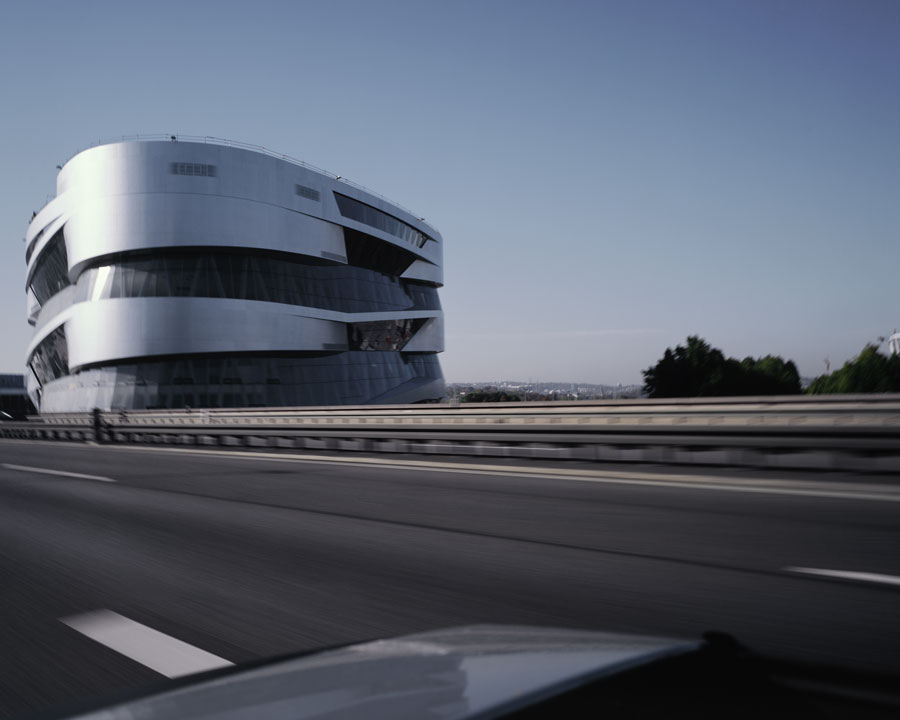
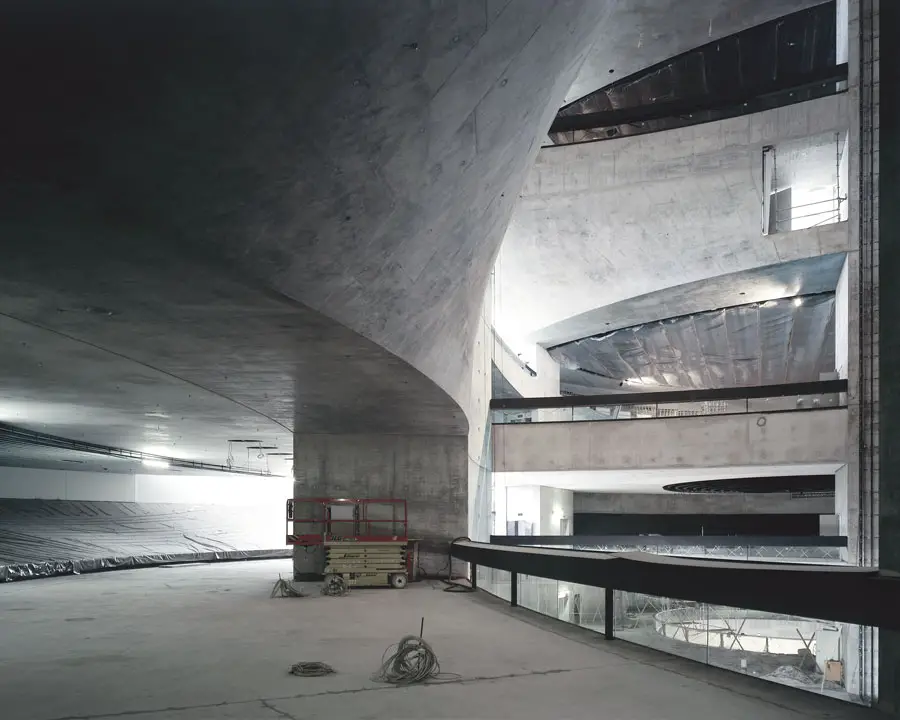
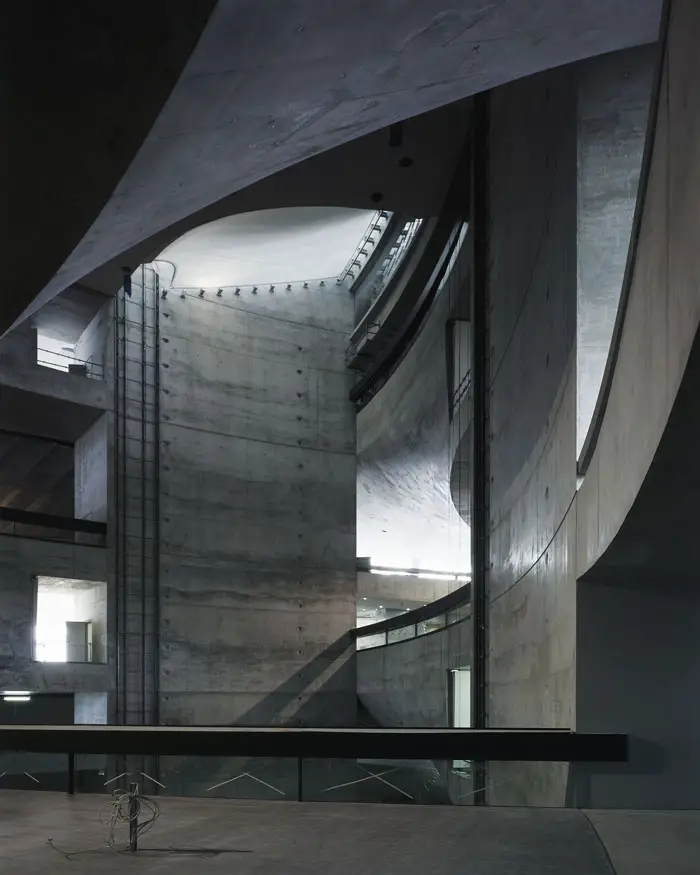

photos : Brigida Gonzalez
Building Description from UNStudio:
The Museum of the Twenty-first Century
The Mercedes-Benz Museum makes everyone forget that they are in a museum. None of the problems that make the traditional museum less and less sustainable occur. The works around you belong to no other culture than your own. They are much closer to you and speak more clearly to you than most of today’s art. Subliminally, we already know this: now, when you enter the MoMA in New York, the first important object you encounter is not art, but a helicopter that floats above your head. The helicopter speaks to us about the achievements and the problems of our society, as do the cars and their history in the Mercedes-Benz Museum.

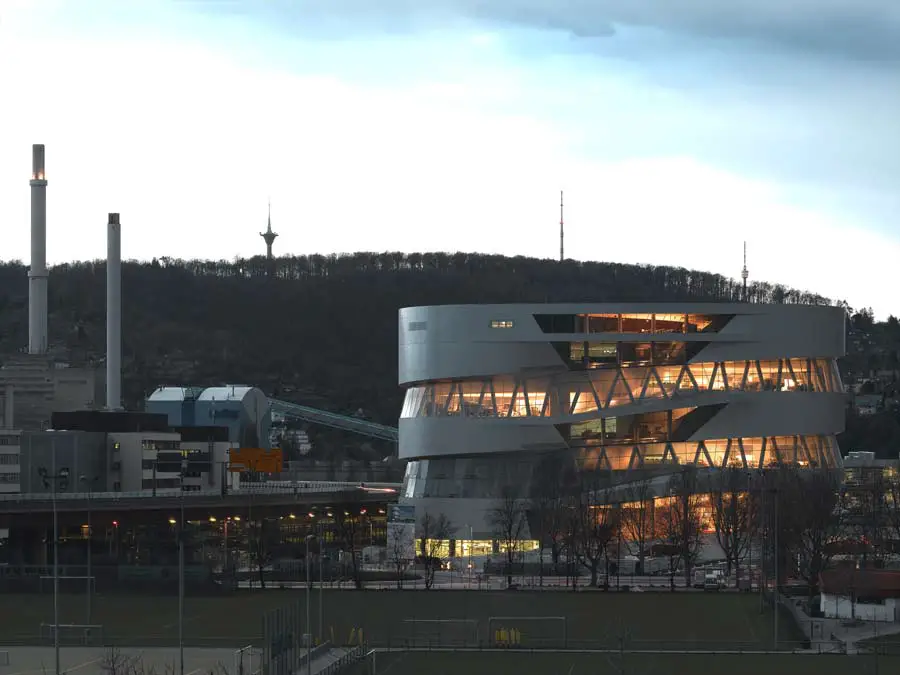
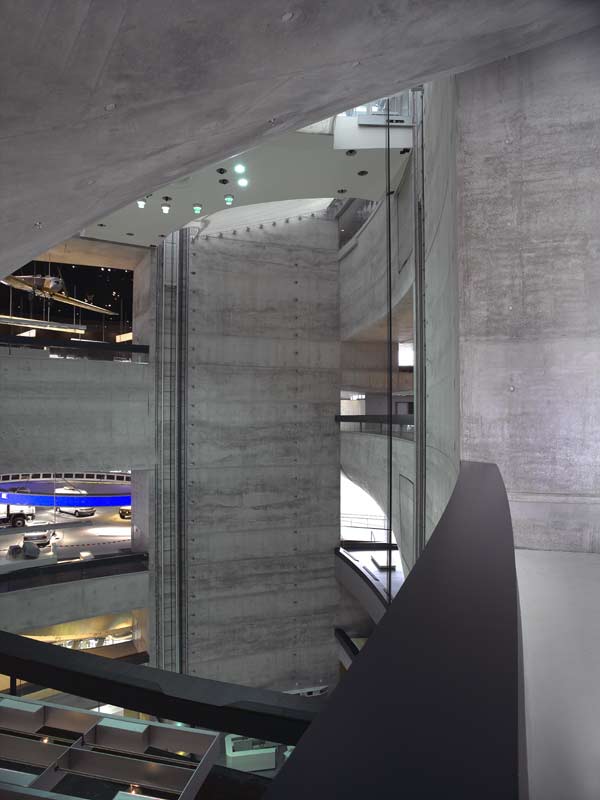
photos : Christian Richters
People like going to museums, but above all people like going to special museums, just as they like those roving monster shows showing all the works of El Greco or Vermeer. They just get more out of them than wandering aimlessly around all those big warehouse type of museums that have a bit of everything. At the top of the scale of the generalist museum is the Louvre; at the bottom is the V & A – it all depends upon the right proportion of highlights in relation to the rest. Today, the exceptional, top pieces are all in place. The future therefore belongs to specialist collections that communicate strongly what they are about and in this way stimulate culture far more than generalist collections without direction.
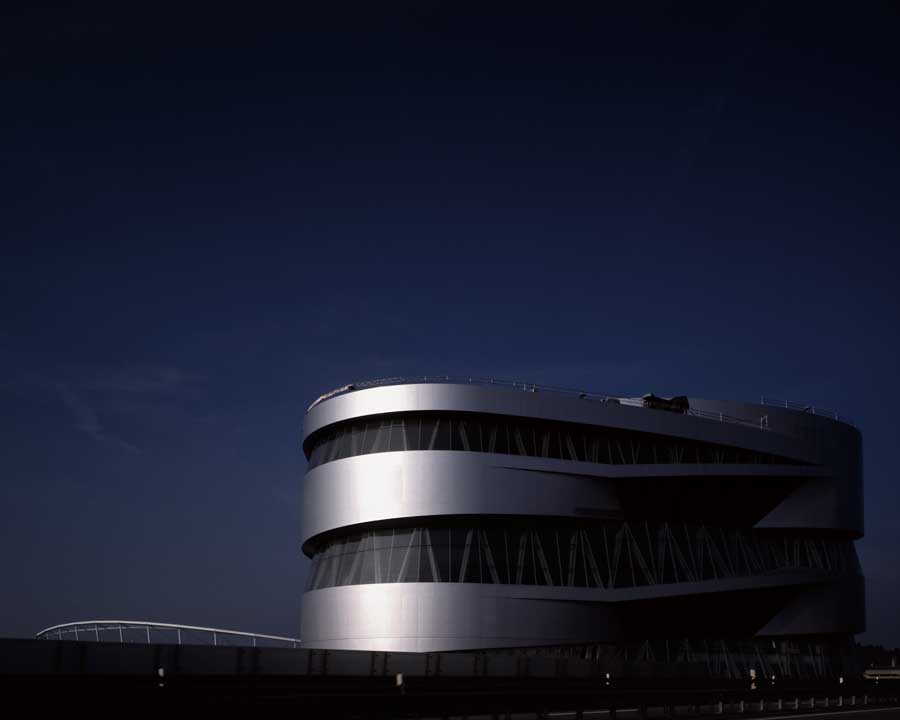
photo : Brigida Gonzalez
Inventions for a new museology
The display of art and artifacts has its own history, its own traditions, and its own dogmas. We like to challenge these conventions because everything can always be better. Things that are new and different are appealing. Even if eventually they don’t work out, they will have fulfilled a role in making everyone see stuff in a fresh way.
At the same time, we worry about the fact that at the moment the interest in the architecture of museums almost surpasses the interest in the works that are inside them. The objects that culture produces deserve more attention. We want to put art, high and low, back on its pedestal. Our museological ambition is to make the objects in the museum look just as good as the merchandise in the greatest shops in the world, so that they fascinate and evoke the same amount of admiration and longing.
When we say we are thinking about putting the objects in the museum back on pedestals we mean this less metaphorically than literally. Pedestals are vital in generating the right viewpoints; each work must have its own, precise platform. Classical and Modern sculptors knew this. The masters of the pedestal are Bernini and Brancusi.
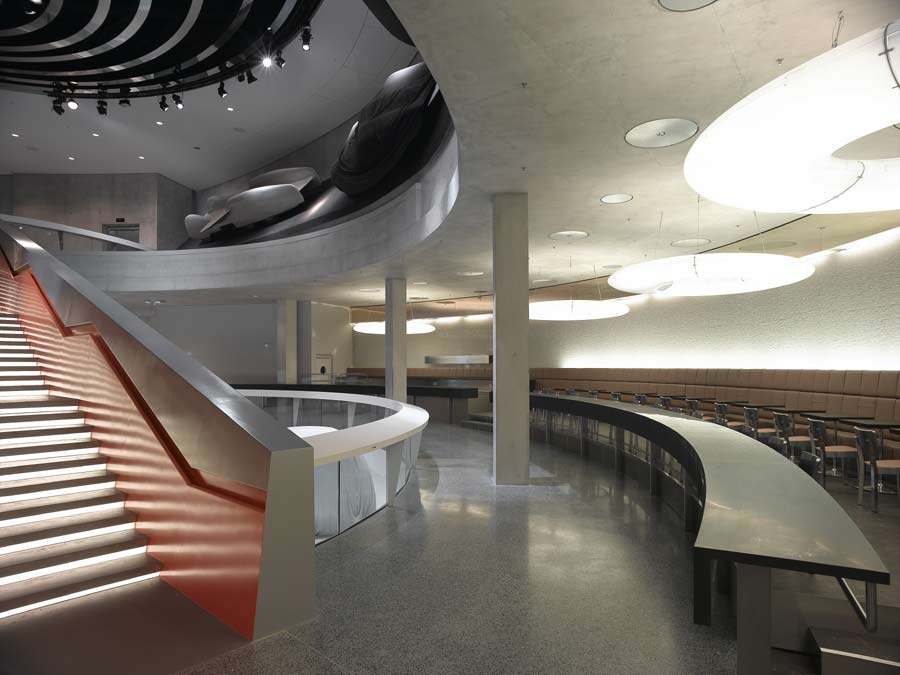
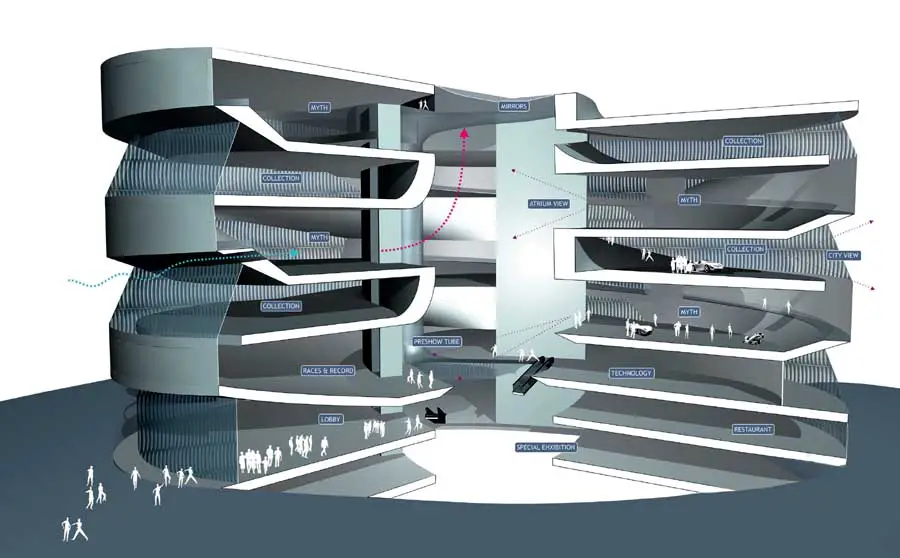
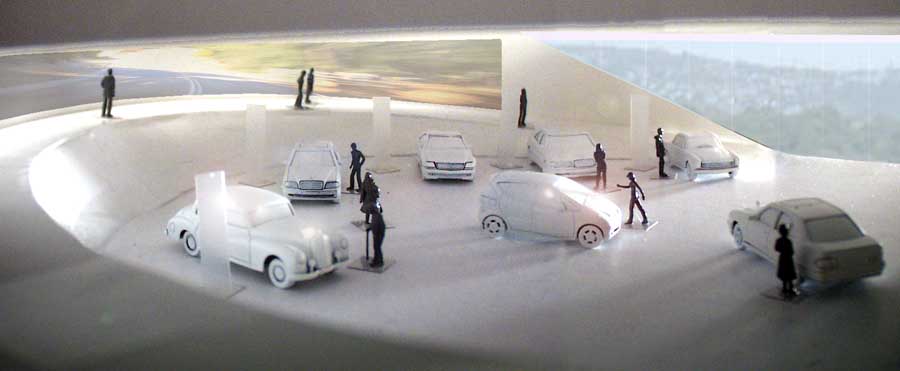
In the Mercedes-Benz Museum we do exactly the same as they did, but on a larger scale. We integrate the pedestal into the architecture. Instead of individual plinths, in the Legend Rooms we have made semi-circular ramps to generate different perspectives. You see the cars alternately from higher, lower, closer and more distant, frontal and more oblique points of view as you move around them. In the Collections Rooms you gain access via a high staircase and then you find yourselves at equal level with the cars. Maybe you could say that in the Mercedes-Benz Museum it is the visitor who is put on a pedestal.


photos : Christian Richters
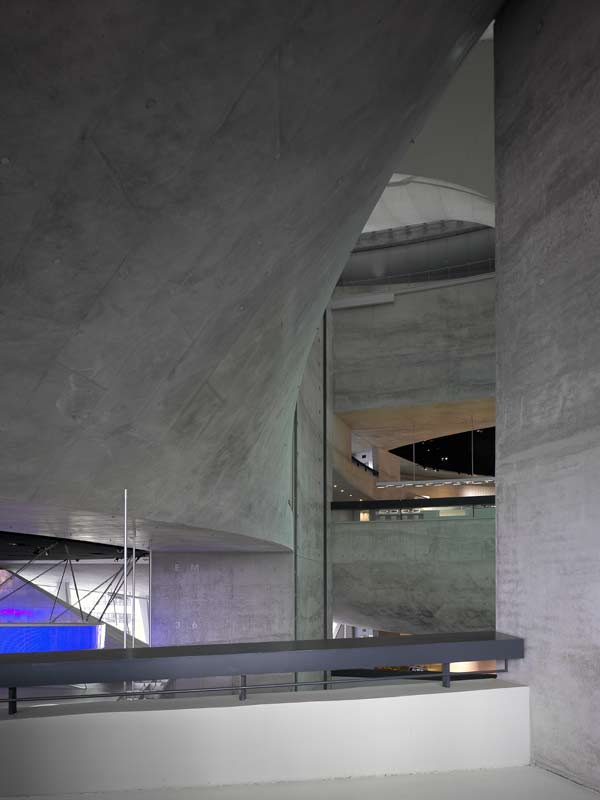
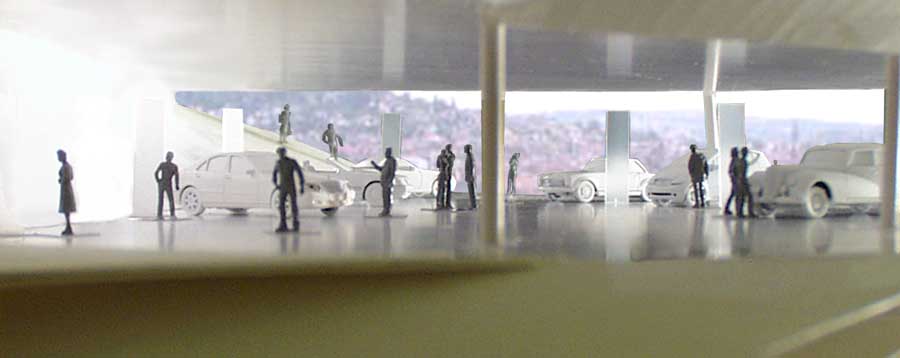
Viewing the leaf-shaped exhibition spaces from variable heights generates panoramic overviews. We are not just interested in helping the visitor to find a focus on each object, but also in the question of the perception of the individual work in relation to the exhibition as a whole. Together, the long pedestal and the panoramic room produce a new type of museological space, reacting against spatial arrangements that we dislike in museums.
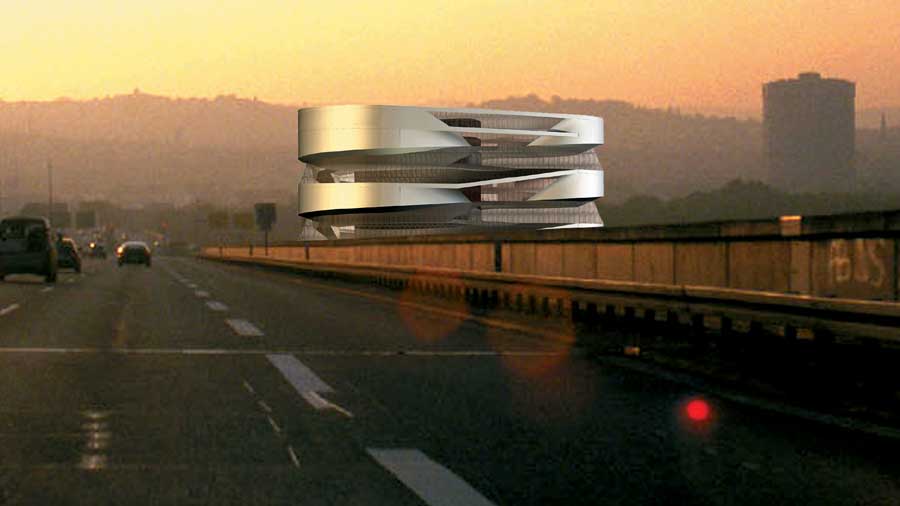
We don’t like, for instance, rooms that are overly large or high, which, when you enter them, feel like a slap in the face and which never let you see the whole. It is our ambition to make an environment that stimulates contemplation, but by other means than enforcing a restricted optical field. We want to achieve an intense visual experience by relating the work to the space it is in, to other works in its vicinity, and to the outside world. In the Mercedes-Benz Museum you can look past the cars and see road outside, and beyond that the vineyards on the rolling hills at the outskirts of Stuttgart.
Museum Architecture
The success of a museum structure depends upon the inventiveness and adequacy of its internal arrangement of spaces. It’s not the iconic face that makes a museum great. To explain the unique structure of the Mercedes-Benz Museum we compare it to three buildings that have made an enormous difference to museum architecture in the twentieth century.
The National Gallery by Mies van der Rohe in Berlin is characterized by large-span, column-free exhibition rooms. The same effect of free, unobstructed spaces flowing into each other is achieved in the Mercedes-Benz Museum thanks to its intricate load bearing construction. This construction system, in turn, is integrated with the circulation system, which takes up and transforms the most challenging museum structure of all: Frank Lloyd Wright’s Guggenheim in New York.
The Guggenheim ramp circles down the inner core, but in the Mercedes Benz Museum the visitors take one of two interweaving spirals down. This circulation system, like Rogers’ and Piano’s Centre Pompidou in Paris is placed on the outside of the building to enliven the surroundings and to make a compellingly inviting gesture to the public. The Centre Pompidou revolutionized architecture by making a play of the technical installations. The Mercedes-Benz Museum also elevates the installations to the status of architecture, not by exposing them but by incorporating them in an inclusive design philosophy.
Architecture for the sake of architecture
The art of the Mercedes-Benz Museum is that it binds together several radical spatial principles, and generates a wholly new typology as a result. It does this partly in response to its museum function, partly in response to its peripheral situation, and partly in response to questions and concerns that belong to the discipline of architecture itself.
One question that has generated a lot of architectural thinking for the last three decades or so, has been the replacement of the modernist cube by a more dynamic constellation of oblique surfaces. The application of non-straight lines and planes has been present in our work from the beginning. The teachers and historic examples we sought out have all worked outside the Modernist tradition. But architects interpret the oblique in different ways; to each architect the slanting line means something else.

image : UN Studio
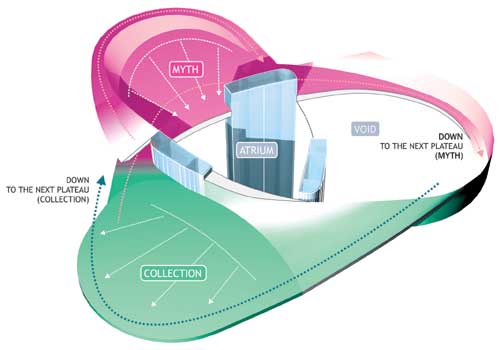
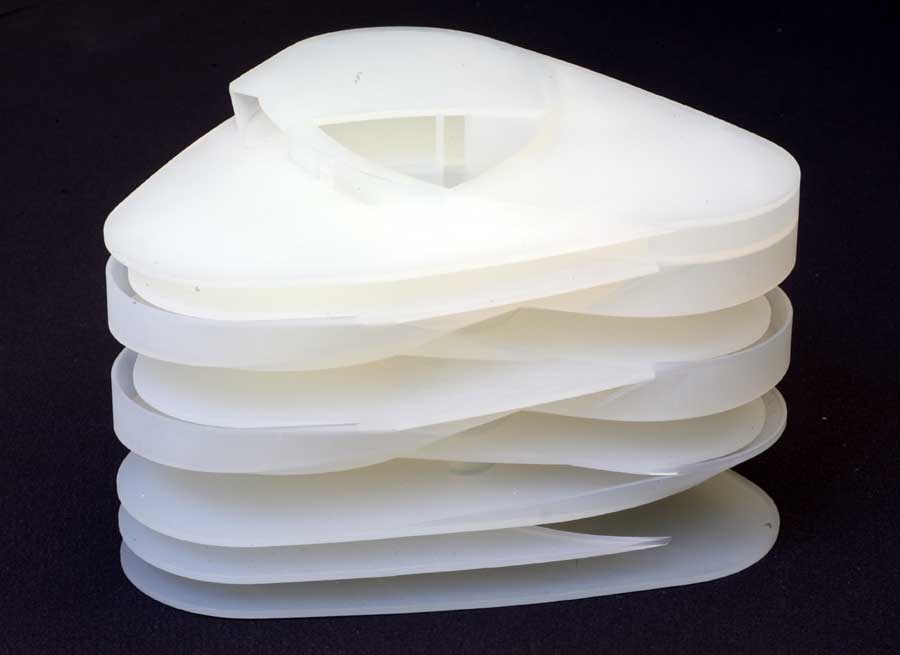
We have focused on the oblique as a means to stimulate mobility, the sense of direction, and the communication between people in buildings. The use of angles in walls, floors and ceilings gives the eye something to focus on; the repetition of these elements paradoxically results in environments that are experienced as tranquil. As such the oblique condition is ideal for the museum since it brings into being spaces that provide minimum distraction. Especially, when, as in the Mercedes-Benz Museum, the repetition of oblique elements is combined with another architectural ingredient with which we have experimented profusely: the curve. The merging of oblique surfaces with symmetrical curves, engendering deep, asymmetrical spaces is found in the plans and the facades of the building.
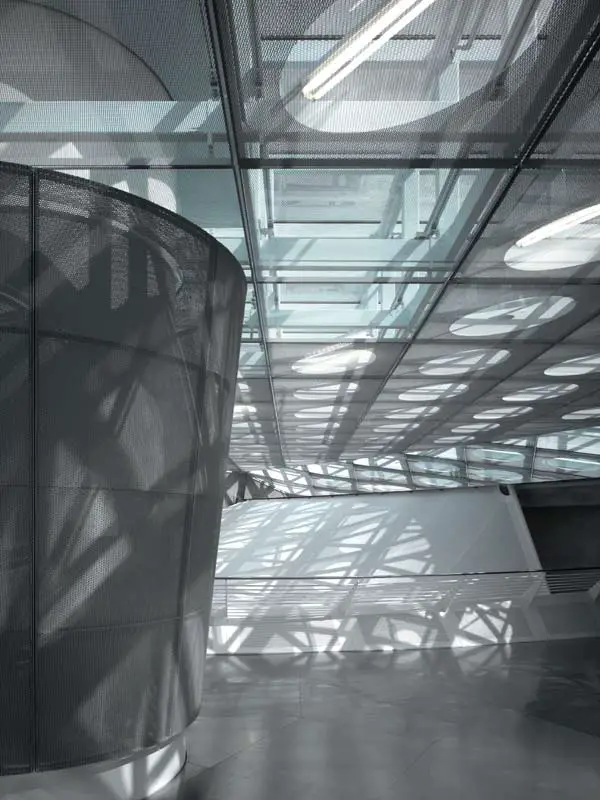
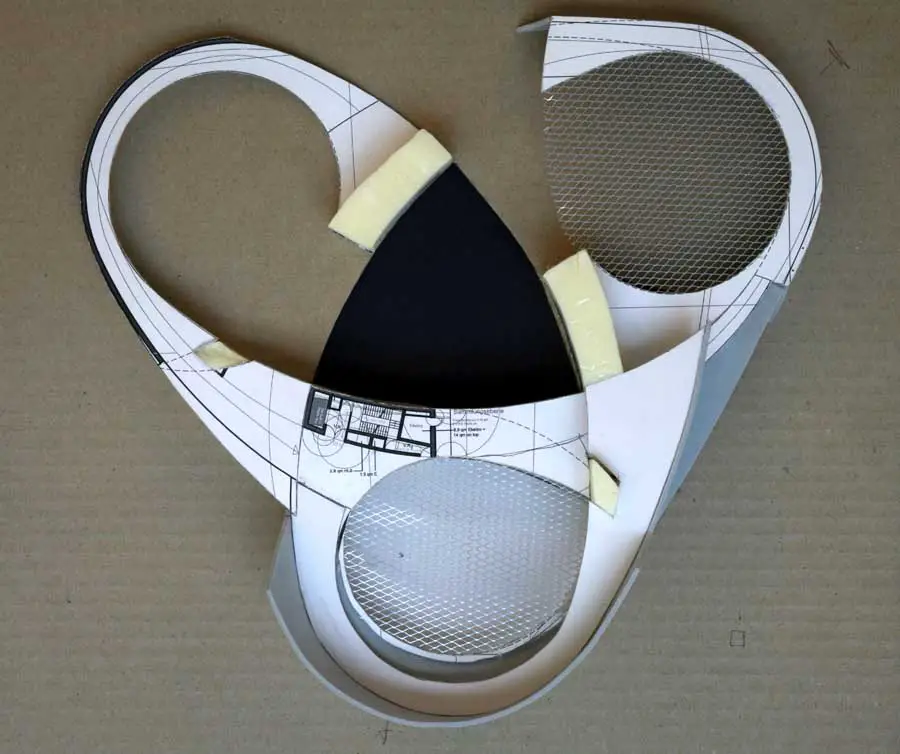
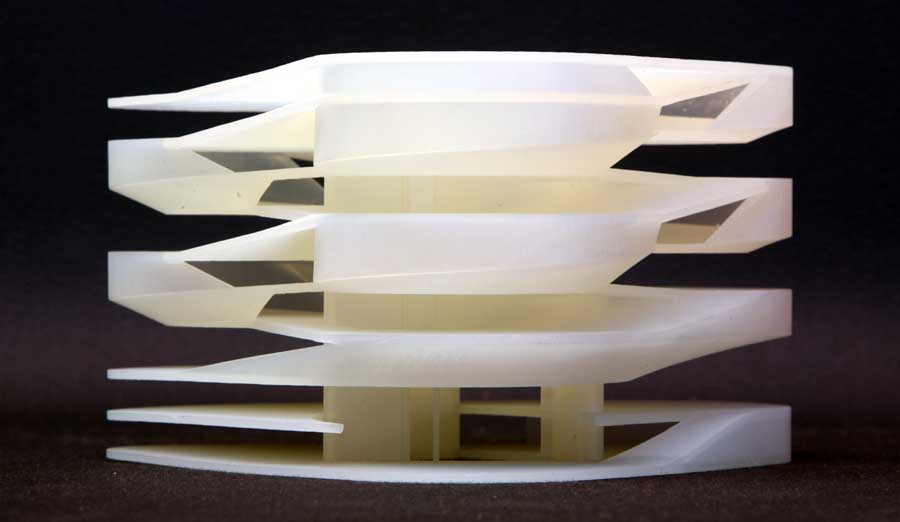
The fusion of curvature and obliqueness produces folding surfaces – the great architectural theme of the 1990-s. The fold, usually incarnated in a very visible way, has in the Mercedes-Benz Museum become invisible under our self-imposed regime of inclusiveness. It has become absorbed into the building’s construction, structure-giving system, daylight-bringing device, and arrangement for separating and bringing together again the two types of different exhibition spaces.
images : UN Studio
Time machine
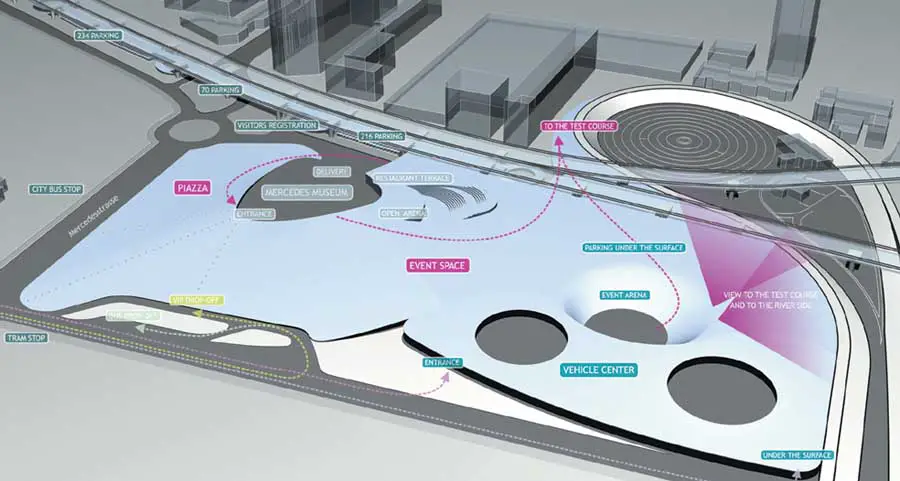
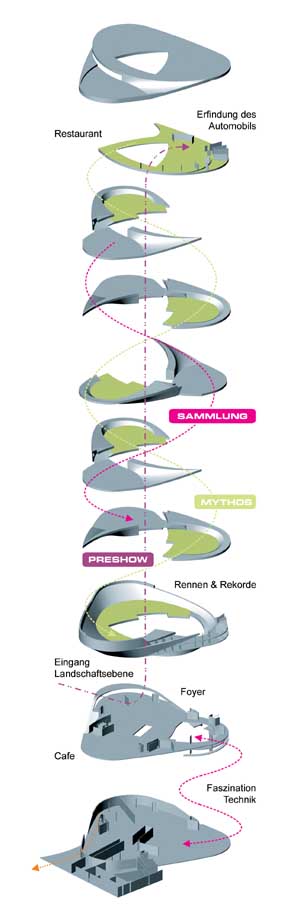
The mobility of the museum visitor is enforced by the oblique surfaces. The chronology of the car unfolds along a spiraling trajectory, which is counter-balanced by the horizontal platforms that provide restfulness. Telling the story of the car in this spatial manner, instead of simply hanging or placing objects next to each other is telling the story of automobility. Movement and the machines that produce it are intrinsic to the Museum and its contents.

images : UN Studio
The veneration of the machine runs deep in architecture; many architects have wanted to emulate the efficiency, the technological intelligence, the compactness, the very modernity of machines in their buildings. The Mercedes-Benz Museum showcases the machines themselves. The shiny objects can be approached from all sides and evoke the same focused attention in the viewer as that which caused their existence in the first place. All the details speaking of everyday human actions are exposed. As you walk on, the object only slowly fades from your angle of vision. Gradually, you leave it behind you. The machines are still; you are the one who moves.
The building twist and turns around you like a sculpture full of contrapposto; now you see things and people, now you don’t. It would take you six hours to see every car, every display of the winding exhibition without ends. It will certainly take you several visits to figure the building out. At any point, it is difficult to know where you are precisely. You can be in the right space in the wrong place, or you can be in the right place in the wrong space. The building keeps unfolding, keeps surprising you. But you cannot lose your way.
Ben van Berkel / Caroline Bos

images : UN Studio
Mercedes-Benz Museum Stuttgart images / information from UNStudio Architects
Mercedes-Benz Museum Stuttgart design : UNStudio
Mercedes-Benz Museum Stuttgart : Further Information
Location: Mercedes-Benz Museum, Stuttgart, Germany, western Europe
Architecture in Stuttgart
Stuttgart Architecture Designs – selection:
Stuttgart Architecture Designs – chronological list
Mercedes-Benz Museum Stuttgart architect : Ben van Berkel of UNStudio
Architecture Walking Tours by e-architect
Neue Staatsgalerie Stuttgart Museum
Key Building Design by UNStudio
Comments / photos for this Mercedes-Benz Museum Stuttgart building design by UNStudio Architects page welcome
