
Perm Museum Competition, Russia Architecture Contest, Entry, Image, Prize, Architect
Russian Architecture Competition : Entry
Center of Contemporary Architecture Contest – design by Acconci Studio
1 May 2008
Russian Architecture Contest
PermMuseumXXI architectural competition
For new museum center building for Perm Art Gallery, Perm, Russia
One of 8 Special prize holders : Acconci Studio
PERM MUSEUM XXI: CONCEPTUAL APPROACH – ‘THE MUSEUM THAT FALLS AWAY, THE MUSEUM THAT FALLS BACK, ETC…’
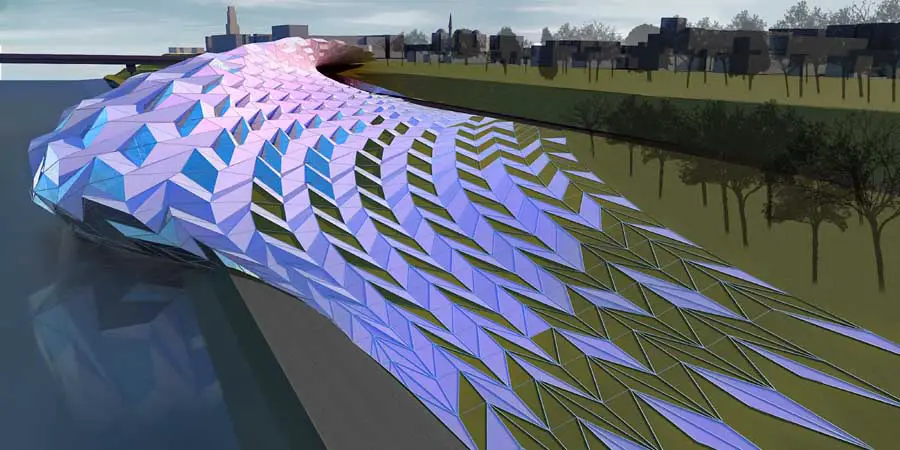
A. NARRATIVE DESCRIPTION
1. Prelude: The Call Of The Wild
Everybody knows the museum should be on the high ground, at the top of the slope. But this museum doesn’t know; even before it’s a building, even when the museum is only a vague idea of a museum, it can’t stay where it should, on flat level land, it starts to slip – it can’t resist the slope, the slope is the call of the wild, the museum can’t say no, the museum loses its foundation and slides down the slope, toward the river…
Sloping – slanting – swaying – bias – oblique – divergent – devious – askew — askance – crooked —
2. Pre-Building, Para-Building
As we start the museum, let’s not think of a building, let’s not assume a building, let’s not get stuck in the convention of a building. Instead, let’s start by thinking of nothing: let’s think of the museum as nothing, nothing but the slope itself…But that’s not possible anymore, the slope is already occupied: as soon as we start thinking of the possibility of a museum, before we have even an inkling of any specific museum, there’s something there, on the slope – the temptation of a museum, the foreboding of a museum, the wishful thinking of a museum – as thin, as transparent, as evanescent as it might possibly be…
Overlay — overlap – coating – veneer –film – screen — curtain – cloak –camouflage – armor —
Begin the museum as a carpet laid down over the slope.
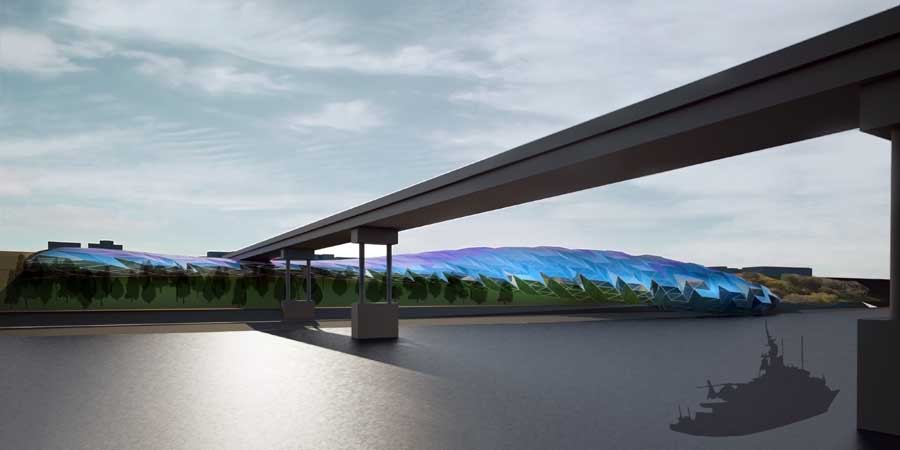
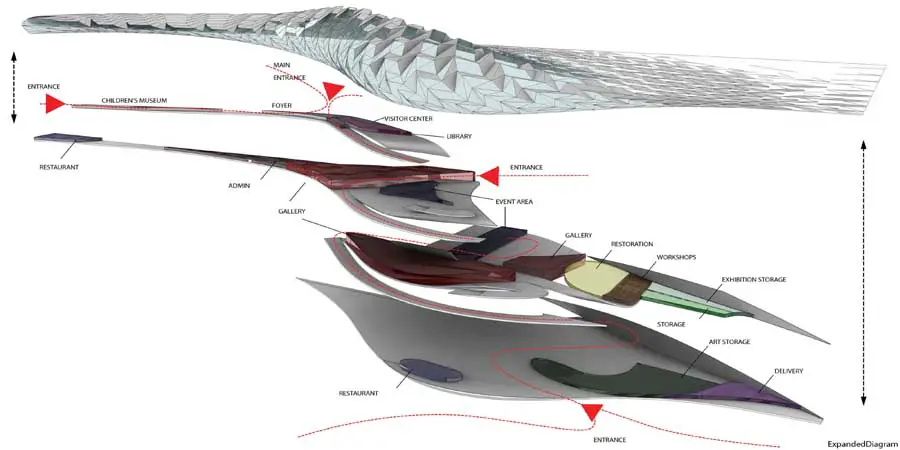
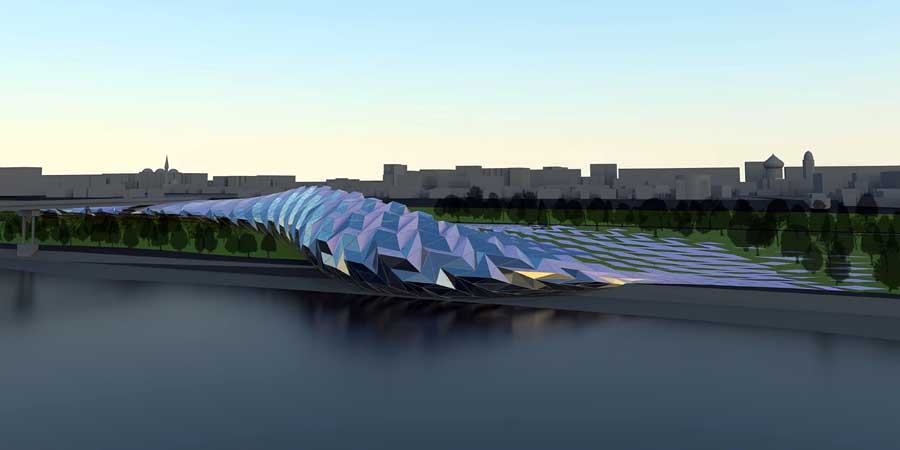
3. From The Bottom Up
Begin the action of building the museum from the bottom of the slope, at the water. In the beginning (at the bottom of the slope), the museum is underground, it’s hidden under its own skin…
Peel – pare — uncover – lay bare – unveil —
Pull the skin of the museum up and inflate it like a balloon, the body of the museum builds up, out in the open. As the rising museum gains space above ground, it loses space underground…
Wave – undulate — swell – surge – peak – rise & fall – ebb & flow —
Pull the body of the museum out into the water and then up the slope…
Twist & turn – veer – sheer – sway – cut across – zigzag – wind in & out —
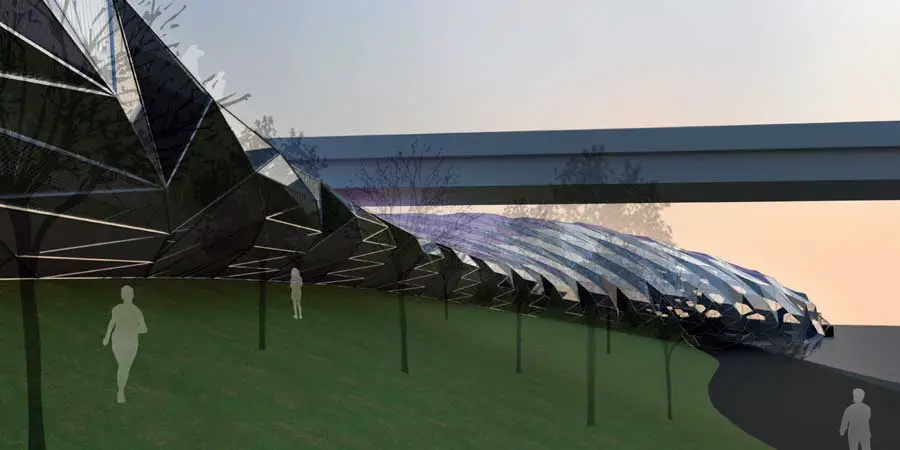
Then stretch the skin again, away from the body of the museum, and fold the skin back on itself and arc it over the train-racks. The stretched-over skin makes the museum lobby, with a train-station inside.
4. From The Top Down
Or start the action of building the museum in the other direction, from the top of the slope: fling the skin out into the air, over the train-tracks, then pull it back down onto the ground, let it roll down the slope…
Drop – fall –free-fall – slide – glide – coast – skim — sprawl out – swoop down –
The slope forms the museum by de-forming the museum, the museum loses shape, takes the shape of the slope, the museum is a flow whose goal is the river…
Slip – flow – run out – run its course – subside – sag – slump – sink – submerge —
As the museum sinks underground, it loses all the space it had above-ground.
5. Folding: One Surface Into Multi-Surfaces
Scale – plate – slice – sliver – slab –
The surfaces are transparent, translucent, reflective, opaque, prismatic, clear, colored, convex, concave, thick-lensed, thin-lensed…
Weave – woof – nap – pile – shag – feel – touch –
6. Folding: Folding The Surface Into Facets Divides Waves Into Particles
Face – facet –
Flake – scale – shaving – paring – particles – parts – part & parcel – bits – specks – flecks – dots – motes – grains – granular — grains of sand – pixels –
Cells – capsules –
7. Folding: Folding Surface Into Structure
Turn – turn over – turn under — doubling — doubling over – ply — fold – fold over — fold on itself — origami –
Crease – tuck – gather – ruffle – frill – flounce – buckle – pleat –
Wrinkle – corrugation – ridge – furrow –crimp – pucker – crinkle – knit – knot –
Furrowed – grooved – scored – incised – cut – gashed – gouged – striated – slotted – slit – split — strip – strip away –shear – slip off – slough off – unwrap – undo –
8. Folding Structure Into Display
The walls of this museum are used to bring in light, & views; walls aren’t needed here to hang paintings – the paintings in this museum hang in mid-air, on cable-systems stretched within the structure.
9. Split, Strip, Strip Away: Splitting Into Strips & Folding Back To Make Floors
10. Splitting & Folding Back To Make Entrances
11. Folding Landscape With Building
The edges of the building are blurred as the landscape grows onto the building. (The building can be folded in, punched in, sucked in, here & there throughout, making private sculpture-gardens for museum-goers.)
12. Folding Public With Private
Passageways – like tubes, like highways, like tangled hairs – take you through the museum without having to pay & enter the museum.
13. Folding The City Within The Museum, & Vice Versa
As a local train comes into the station, inside the lobby, as other trains pass the station by, they pass through other parts of the museum – the children’s museum, a gift-shop, a restaurant….
14. Folding The Museum Within The Ground, & Vice Versa
These underground places, with no natural light, are media-rooms, and theaters. Around the corners, further inside the ground, is storage.


B. TECHNICAL DESCRIPTION
The skin is envisioned as a hybrid shell-like system with two-way spanning characteristics that exhibit both robustness and efficiency. Folded-plate trusses span along the first principle axis. The complementary span is facilitated with cable tendons. As the surface geometry transitions from convex to concave curvature along the longitudinal ridgeline, a transition of structural hierarchy also occurs. When the surface is convex, the truss elements provide the dominant load-carrying capacity. In this scenario the cables provide secondary stabilization and essentially lock the geometry in place.
This hierarchy changes, however, when the surface inverts and becomes concave. Here the cable tendons become dominant as they act in catenary and the folded-plate trusses become secondary structural elements. In this way, the folded plate elements and cable elements express or achieve maximum structural performance. Central A-frame supports provide both gravity and lateral support and serve to balance asymmetric loading conditions. These supports are loosely organized within the space and provide a convenient means of installing the roof as a series of pre-fabricated ladder elements to be assembled and erected on-site.
Organiser C:CA / Center of Contemporary Architecture, Moscow
In collaboration with Union of Russian Architects
1st & 2nd prizes shared ($100,000 & $70,000):
Bernaskoni + Valerio Olgiati
3rd prize ($50 000):
Zaha Hadid Architects
8 Special prize holders ($ 10,000 each)
Acconci Studio, New York, USA
Asymptote Architecture PLLC, Hani Rashid and Lise Anne Couture, New York, USA
Esa Ruskeepaa, Helsinki, Finland
Søren Robert Lund Arkitekter, Copenhagen, Denmark
Meili, Peter Architekten AG, Zurich, Switzerland
A-B, Moscow, Russia
Alexandr Brodsky bureau, Moscow, Russia
Totan Kuzembaev Architectural workshop, Moscow, Russia
Acconci Studio Credits:
Preliminary structural consultation has been provided by Matthew Melnyk at Buro Happold.
Design team members include: Vito Acconci, Ezio Blasetti, Nathan DeGraaf, Adam Elstein, Eduardo Marques, Dario Nunez
Perm Museum Entry architects : Acconci Studio
Location: Perm, Russia
Moscow Architecture Developments
Contemporary Moscow Buildings
Moscow Building Developments – chronological list
Russian Architecture Tours by e-architect
Russian Architecture Competition
Perm Opera & Ballet Theatre, Russia : David Chipperfield Architects
Comments / photos for the Perm Museum Architecture Competition page welcome
Website: www.permm.org
