
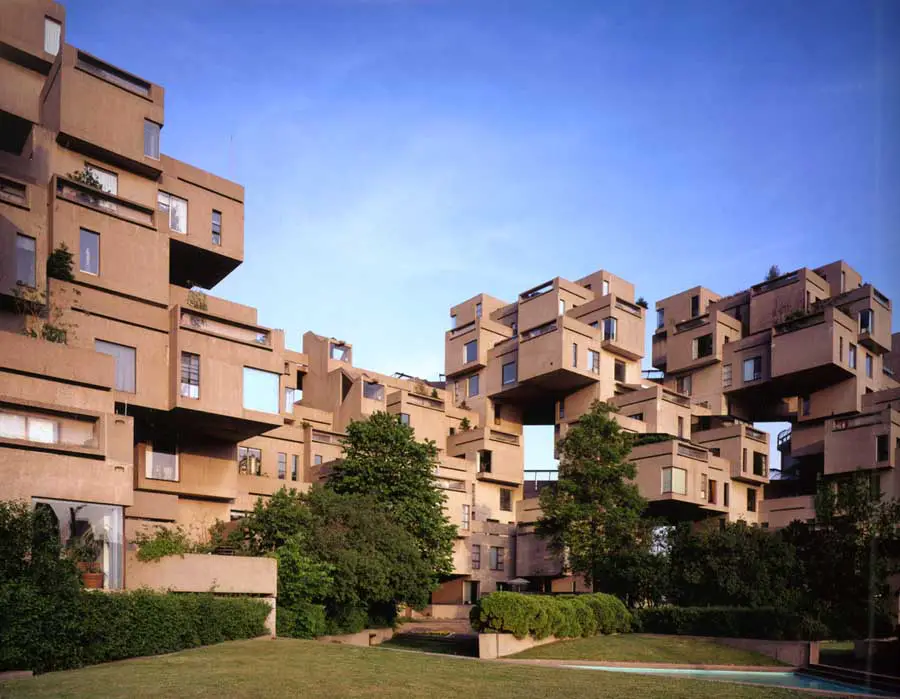
Habitat 67 Montreal, Quebec Modern Building Photo, Housing Design News, Architect, Photos
Habitat 67 Montreal : Architecture
Canadian Historic monument: Housing by Moshe Safdie in Quebec, Canada
27 Mar 2009
Habitat 67, designed by Moshe Safdie, bestowed historic monument status
Press release from the office of the Minister of Culture for Quebec:
Habitat 67 – classified a historic monument
Montréal, March 27, 2009 – Christine St-Pierre, Minister of Culture, Communications and the Status of Women, today announced the classification of Habitat 67 as a historic monument. Units 1011 and 1012, which are owned by architect and designer Moshe Safdie, were also classified. Mr. Safdie was present at the announcement.
Habitat 67 Photo © Timothy Hursley
“Habitat 67 was showered with praise from the day it was created. Specialists and the uninitiated alike were won over by its original, bold design, which showcased construction techniques unheard of at the time,” said St-Pierre. “I am very proud to announce the classification of this unique architecture. It is a fine example of modern heritage and will henceforth be classified under the Cultural Property Act.”
“I am very moved and honored that Habitat 67 has been classified as a historic monument,” stated Mr. Safdie, “the greatest pleasure for an architect is to see the creation alive, as a thriving community, 42 years later.”
Habitat 67 began life as a master’s thesis project prepared in 1961 by Mr. Safdie, then an architecture student at McGill University. He came up with the idea of a high density apartment building that would provide residents with privacy as well as peace and quiet. He was invited to develop his idea for Expo 67 and did so alongside engineer August E. Komendant. By the time the universal exhibition came round, the project was partially completed, and 26 apartments were reserved for the Expo.
The housing complex had 354 prefabricated units, initially forming 158 one or two story apartments with one to four bedrooms. The apartments were divided into three pryamids. Each apartment featured a landscaped garden built on the roof of the level below (see www.habitat67.com for more information). Dwellings had a molded plastic bathroom and a modular kitchen that are still incredibly modern even by today’s standards.
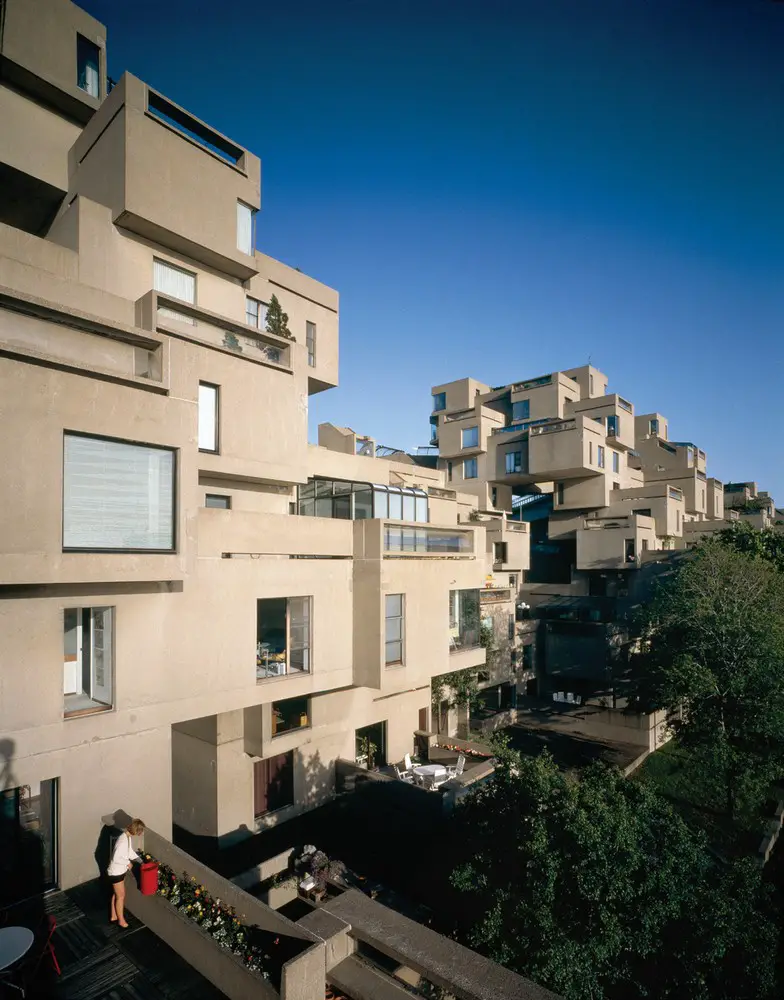
Habitat 67 Photo © Timothy Hursley
Habitat 67 pioneered the design and implementation of three-dimensional prefabricated units of habitation. Stepped back in their modular placement, each residence has its own roof garden. Three separate elevator cores direct vertical circulation throughout the complex, with cabs stopping at every fourth floor to serve pedestrian streets.
Every part of the building, including units, pedestrian streets and elevator cores, participate as load-bearing members; units are connected to each other by post-tensioning, hightension rods, cables and welding, forming a continuous suspension system.
Habitat 67 served as the focus of the 1974 book by Moshe Safdie entitled For Everyone a Garden and has continued to influence and inspire the work of the firm. Habitat 67 continues to offer influence within the firms’ work; revisiting the concept of Habitat 67 and ruminations on future ideas and applications is the centerpiece of one of five exhibition components for the firm’s upcoming Global Citizen: The Architecture of Moshe Safdie.
Moshe Safdie and Associates Moshe Safdie first established his architectural practice in 1964 in Montreal to design and supervise the construction of Habitat 67. Today the principal office is in Boston, Massachusetts with branch offices in Jerusalem, Toronto, and Singapore.
The international practice provides a full range of urban planning, architectural and interior design services. Currently, the firm is engaged in activities ranging from the design of public institutions – including museums, performing arts centers, libraries, and university campuses – to the design of airports, housing, mixed-use complexes, and new communities.
All of the projects that Moshe Safdie and Associates are engaged in are designed personally by Moshe Safdie, who is supported by a diverse team experienced in the design and execution of complex buildings. Together the group effectively utilizes a host of resources to create buildings that are unified expressions of their technology and construction materials, as well as their settings and purpose.
Significant completed efforts have included the National Gallery of Canada; Vancouver Library Square; Ottawa City Hall; Salt Lake City Public Library; Peabody Essex Museum; Skirball Cultural Center; Exploration Place Science Center and Children’s Museum; Telfair Museum of Art; the Springfield, Massachusetts Federal Courthouse; and the Alcohol Tobacco & Firearms Headquarters Building in Washington, DC.
Projects currently in design and construction include the United States Institute of Peace Headquarters in Washington, D.C; a renovation and addition to the Free Library of Philadelphia; the new city of Modi’in, Israel; the Khalsa National Museum of the Sikhs in Anandpur Sahib, Punjab, India; the Yitzhak Rabin Center for Israel Studies in Tel Aviv; the Kauffman Center for the Performing Arts in Kansas City, Missouri; the Crystal Bridges Museum of American Art in Bentonville, Arkansas; the National Campus for Archeology of Israel in Jerusalem; the National Health Museum in Atlanta, Georgia; and Marina Bay Sands, an integrated resort in Singapore. A new monograph, Moshe Safdie II, depicting the firm’s work from 1996-2008 will be published later this year.
Habitat 67 images / information from Minister of Culture for Quebec
Moshe Safdie Architect
28 Apr 2017
Pioneering Habitat ’67 Exhibition in Montreal
Curated by Donald Albrecht
Location: UQAM Centre de Design, Montréal, Quebec, Canada
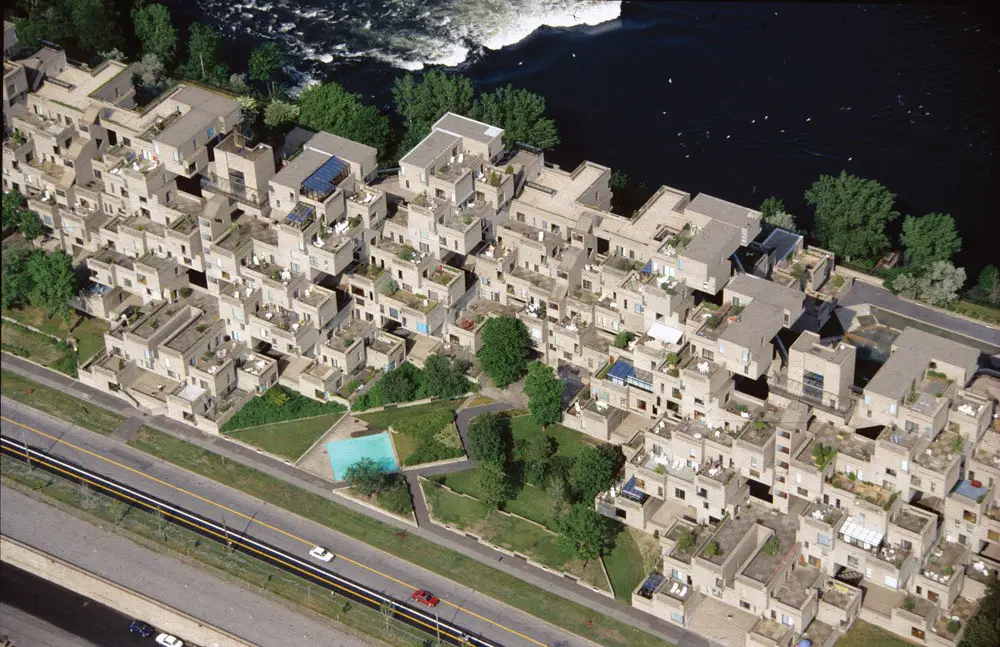
image by Studio Graetz
Pioneering Habitat ’67 Exhibition in Montreal
Location: Montréal, Quebec, Canada
Montréal Architecture Developments
Contemporary Montréal Buildings
Montreal Architecture Designs – chronological list
Montreal Architecture Walking Tours – North American architectural tours by e-architect
McGill University Schulich School of Music – New Music Building, Montreal
Design: Saucier + Perrotte
McGill University Schulich School of Music
Palais des Congrés Montreal
Portland Residence, Mont-Royal, Québec
Architects: Atelier Barda architecture
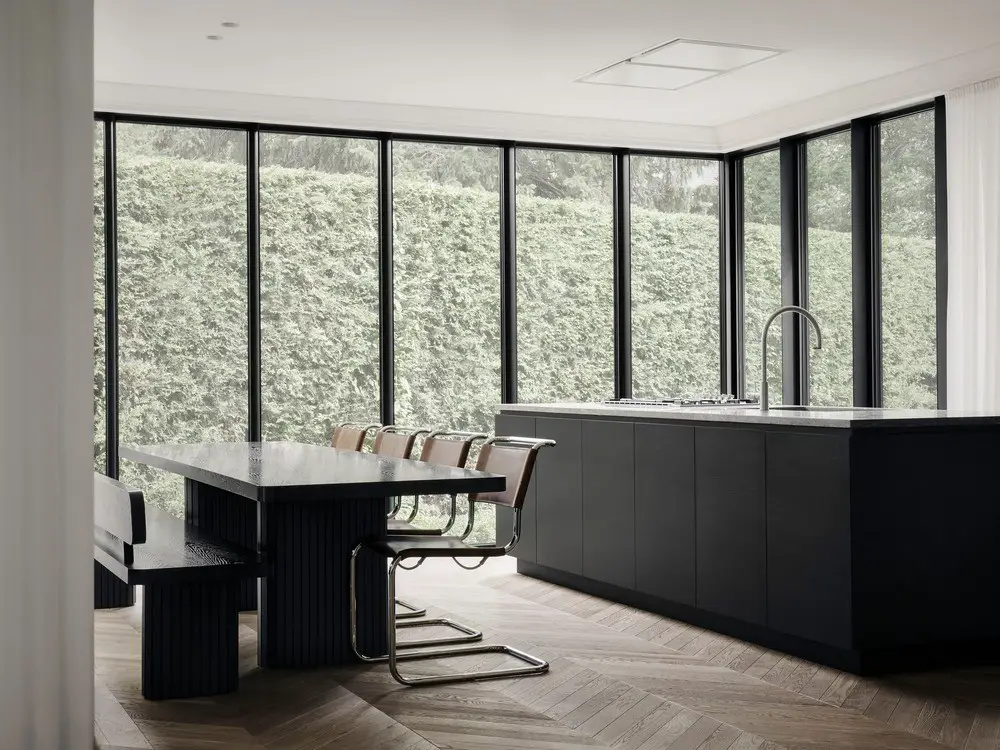
photographer : Alex Lesage, Threefold
Portland Residence in Mont-Royal, Québec
La Frangine, Lac-Brome, Québec
Design: Bourgeois / Lechasseur architects
photo : Maxime Brouillet
La Frangine Residence Stoneham-et-Tewkesbury
Comments / photos for the Habitat 67 Montreal Architecture page welcome
Website: www.habitat67.com
