
Maggie’s Centre London, Charing Cross Hospital Building, Cancer Care Hammersmith
Maggie’s London Building
Charing Cross Hospital Project – design by Rogers Stirk Harbour + Partners Architects
22 Oct 2009
Maggie’s London
Hammersmith, west London, England
Date built: 2008
Design: Rogers Stirk Harbour + Partners
Address: Palace Wharf, Rainville Rd, London W6 9HN
Phone: 0300 123 1801
Stirling Prize Winner 2009
Maggie’s Centre London – Sustainability Statement
Sustainable Features
The fundamental design challenge for Maggie’s Centre, London, lay in creating a sequence of internal and external environments cocooned from its inhospitable location next to a heavily congested and polluted main road. The aim was to make the building a welcoming retreat in this busy London streetscape and make the most of a difficult corner site in the grounds of Charing Cross Hospital.
The building’s key architectural ‘feature’ is its ‘floating’ roof which oversails the outer wall. The roof of the Maggie’s Centre is punctuated by a distinctive series of openings, many of which are visible from street level. These unglazed rooflights allow natural light, wind and rain into the garden areas below, whilst allowing the roof to shade the façades beneath. Low-iron glass with a high level of transparency has been used where the roof meets the Maggie’s Centre building to enhance the impression of a floating structure. The key environmental features include natural ventilation; a high level of insulation; recycling of rainwater; use of timber from renewable sources only; planting to filter road traffic noise and enhance the surroundings; and the significant planting of over 80 trees across the site.
The building is naturally ventilated throughout (using cross ventilation) by the use of internal gardens and roof gardens, whereby each room of the Maggie’s Centre London opens onto an internal garden space. The glass façades are shaded from solar gain and the building’s high level of insulation greatly reduces heat loss from within. Low E Argon-filled glass is used for the majority of the external glazing. The external temperature is continuously monitored and when necessary a control overrides the heating control system to maximise the efficiency and reduce unnecessary heat loss.
The Maggie’s Centre building is also designed to harness the maximum amount of daylight. Light fitting efficiency is managed by individual task lighting throughout the building but a solar clock is used for all outside lights. The roofs of the building and gardens and the external walls are overinsulated to reduce energy consumption. The Centre has a typical domestic condensing boiler and is heated through the use underfloor heating, supplemented by trench heaters built into the furniture on the first floor. Unlike an equivalent-sized office building, the London Maggie’s Centre uses standard domestic meters and feed.
The raised roof allows natural light to enter the whole of the building whilst limiting the view of the adjacent hospital tower. The external wall forms both a weather seal to the internal rooms and a shield to the internal garden spaces from Fulham Palace Road.
In choosing timber for the building, the emphasis has been on materials from sustainable sources using softwoods such as Siberian larch and birch-faced ply. Hardwoods – such as European oak – have only been used where hardwearing timber is absolutely necessary, for example for the thresholds. Mineral Fibre, instead of Polystyrene compounds, has also been used for all insulation.
High quality acoustics are key to creating an attractive environment for staff and visitors alike. High external walls protect the inner space from the relentless daytime noise and visual distractions of Fulham Palace Road both on the ground and mezzanine levels. The design allows people using Maggie’s Centre London to be aware of life going on around them while still maintaining their personal privacy. A careful balance has been achieved whereby conversations between visitors can be discreet yet still allowing a vibrant environments to exist. Reverberation within the double-height volumes is further reduced by carpets and furnishings, while personal discussion spaces are located at the edges of the building which can be segregated from the central space. A wrap of fast-growing birch trees has been planted along the edges of Maggie’s Centre which will help filter traffic noise from the busy street beyond.
All the rainwater from the main roof is collected and stored in a large submerged water tank. This is used to irrigate the gardens and external landscaping.
Maggie’s Centre London – Context and Landscaping
The design of the Centre was conceived to make the building as accessible, homely, personal and comfortable as possible, with a layout that is open but which incorporates varying degrees of private space. The site was originally occupied by a wing of the hospital which was demolished in 1995. The site was partially used as a car park for A+E with the majority as a little-used green space housing the Charing Cross Mobile Breast Screening Unit.
The entrance to the Centre is approached from within the hospital grounds. The building is made up of four components: a wall that wraps around four sides, providing protection from its exposed location; the kitchen – a double-height central space which will be the main focus and heart of the building; annexes off the main space, conceived as meeting, sitting and consulting rooms; and a ‘floating roof’ that appears to ‘hover’ over the outer wall and acts as the enclosure to the heart of the building.
Landscaping is a fundamental component of any Maggie’s Centre, but is particularly important in Maggie’s London given the relatively harsh physical nature of the surrounding urban environment. It is hoped that within this hostile environment that an oasis of calm has been achieved. Rogers Stirk Harbour + Partners worked with landscape architect, Dan Pearson, to transform this challenging part of Fulham Palace Road. This partnership extended the remit of the Centre and built on the passion for landscape architecture of Maggie’s founder, Maggie Keswick Jencks. The three key external garden areas – the northern, eastern and southern winter gardens – are effectively treated as extensions of the internal areas, even though they are open to the elements. All areas of the ground floor – which has underfloor heating – are accessible to visitors, who are encouraged to find their own space in the building.
The landscaping strategy knits together the existing hospital and the new Maggie’s Centre, while creating a distinct and therapeutic environment around – and within – the building which, in turn, helps to contribute to its healing potential. Stone sculptures and wooden benches provide welcome and tranquil places to sit along the winding path to the front door. Users of the London Maggie’s Centre will be actively encouraged to participate in the maintenance of the plants and gardens to give them a sense of ownership of the building. The impression of an insular, protected environment extends through the courtyard winter gardens by use of selected vistas to the landscaped public spaces beyond. The centre is surrounded by a collection of multi-stemmed trees, which wrap the Maggie’s Centre building on the two sides which face the outside world. These trees will help to filter the noise pollution from the nearby road, whilst providing an attractive view from both the inside and out.
Maggie’s Centre London Information from Rogers Stirk Harbour + Partners
Maggies Centre London : main page with photos
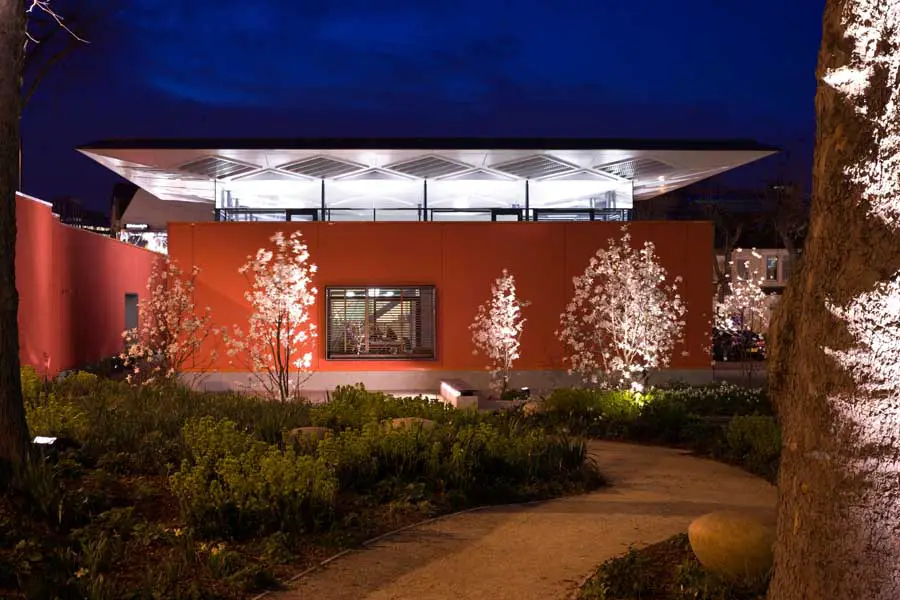
photo : Speirs and Major Associates / James Newton
Maggies Centre London design : Rogers Stirk Harbour + Partners
Maggie’s Cancer Care Centre Buildings
Location: Charing Cross Hospital, Hammersmith, West London, England, UK
London Buildings
Contemporary London Architecture
London Architecture Designs – chronological list
Architecture Tours in London by e-architect
Maggie’s Centres : Buildings across the UK – information + images
Richard Rogers Architect
Chelsea Barracks – previously designed by Rogers Stirk Harbour + Partners
Maggie’s Centre Building : Design in Fife by Zaha Hadid Architects
UCL Cancer Institute building by Grimshaw
University College Hospital London
Comments / photos for the Maggie’s London page welcome
Website: www.maggiescentres.org
