
Highgate House by Cemetery, North London Luxury Property, Building Photos, Design
House in Highgate Cemetery
Contemporary Residence in north London design by Eldridge Smerin architects
29 Jul 2009
House in Highgate Cemetery, London
Dates built: 2006-08
Design: Eldridge Smerin, Architects
House in Highgate Cemetery, north London
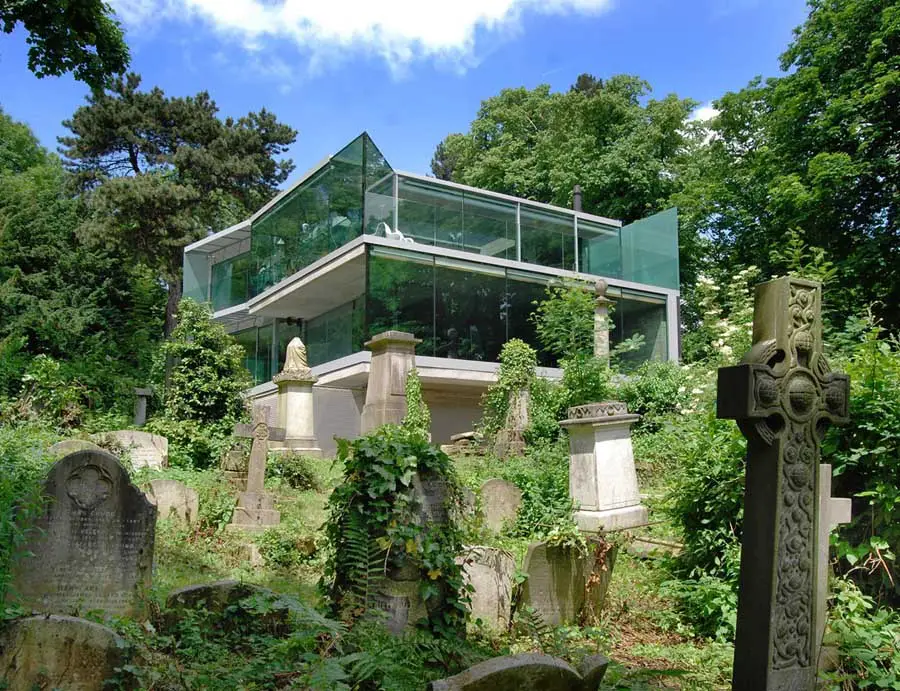
Inspired by seeing Eldridge Smerin’s Stirling Prize shortlisted house The Lawns, on Highgate Hill in north London, the owner of a nearby house approached the practice about designing a new house on the same site. The existing house dating from the 1970’s was designed by noted Architect John Winter and sat next to Highgate Cemetery, London’s greatest Victorian cemetery.
Photographs: Lyndon Douglas
Highgate Cemetery House
Although the site offered spectacular views over the cemetery, Waterlow Park opposite and the city skyline beyond, replacing a John Winter house is a decision not taken lightly. When Eldridge Smerin had investigated options for either retaining the corroding steel structure or for replacement, it was clear that to restore the Winter house would have required complete reconstruction and would have compromised the greater potential for a new house on such a unique site.
top floor kitchen open to sky
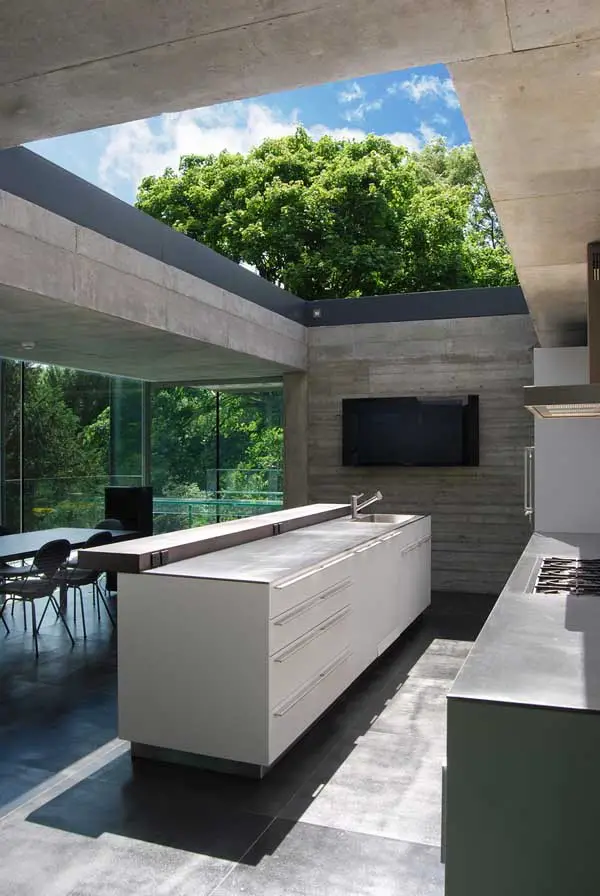
The resulting new house is located on the footprint of the existing house. It is set over four floors with a generous proportion of living to bedroom space including balconies, terraces and a sizable sliding glass rooflight enabling the top floor to become an open-air court. The new house is an additional storey higher than the previous one and is conceived with two strongly contrasting faces.
Hard facade to the lane – security:
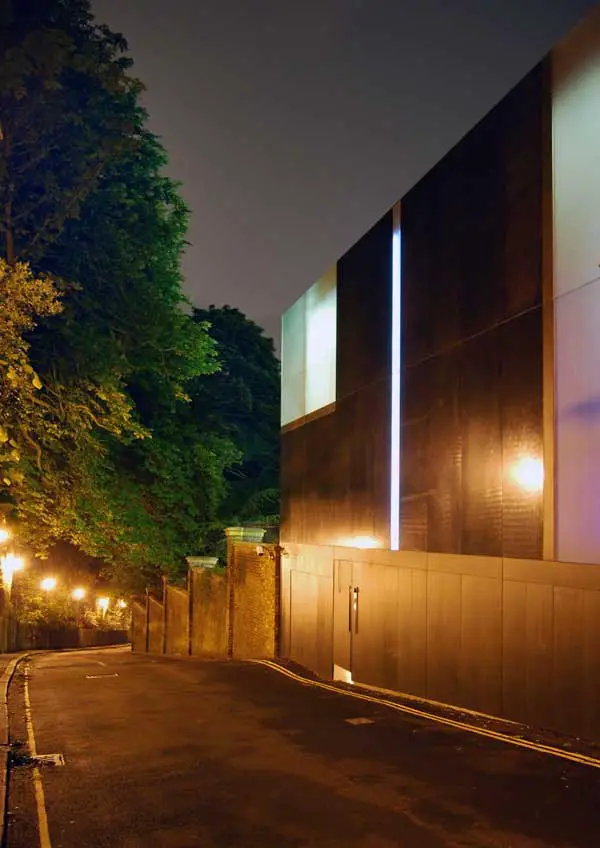
To the street a sheer façade of honed black granite, translucent glass and black steel panels set flush to one another echoes the massiveness of the cemetery wall. This gives the house an air of mystery and intrigue whilst also making reference to the monumental masonry of the cemetery.
In contrast, the elevations facing the cemetery are largely glazed, suffusing the interior with natural light and washing the fair-faced concrete structural frame and walls with sunlight. Unlike the lower part of the cemetery where people often go to see Karl Marx’s grave, the upper part where the house is located is overgrown and largely unvisited allowing it to act as a stunning backdrop for the spaces within the house.
wood burner:
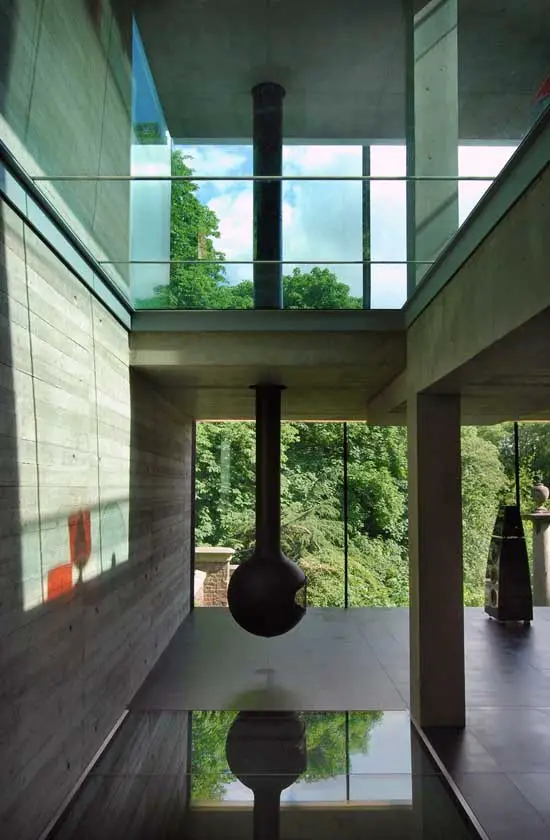
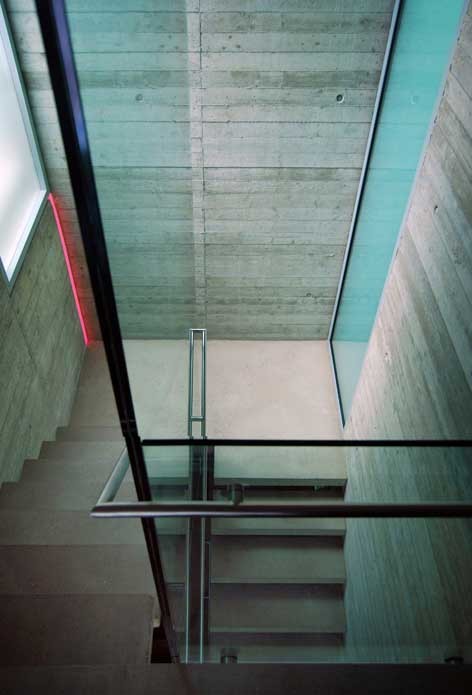
The full-height glazing to the perimeter of the house was enabled by the use of flat concrete slabs with long cantilevers back to the four central columns supporting each floor. The concrete supporting internal and external areas was kept separate to provide a thermal break between inside and out. In contrast to the smooth fair-faced finish of the concrete columns and soffits and the smooth stone flooring, the concrete walls facing the street and adjoining property to the north have a strong horizontal pattern from the timber boards used to shutter the concrete.
The use of a concrete frame with a high quality exposed finish internally also allows a more sustainable environmental strategy for the house to be developed than the lightweight construction of the original house allowed. The intention was to produce a house with significantly lower energy usage than the original even with an increased floor area.
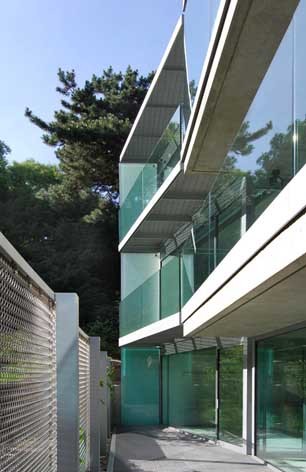
The slow heat response characteristics of the concrete allow the frame to act as an environmental modifier slowing down heat gain in summer and limiting heat loss in winter whilst the form of the house with large glazed openings facing south allow passive solar gain to be maximised during winter months. The use of stone cladding and a green sedum roof system similarly help control temperature fluctuations.
The use of concrete as a structure and finish, when sourced from a local plant that uses a proportion of recycled material, helps minimise the embodied energy in the envelope of the house as does the choice of generally natural materials for the internal finishes. Internally a low temperature hot water underfloor heating system is used in conjunction with the thermal mass of the house to maintain comfortable conditions with minimised energy usage. The high natural light levels mean there is little need for artificial lighting during daylight hours whilst all light fittings use low energy lamps.
shuttered concrete:
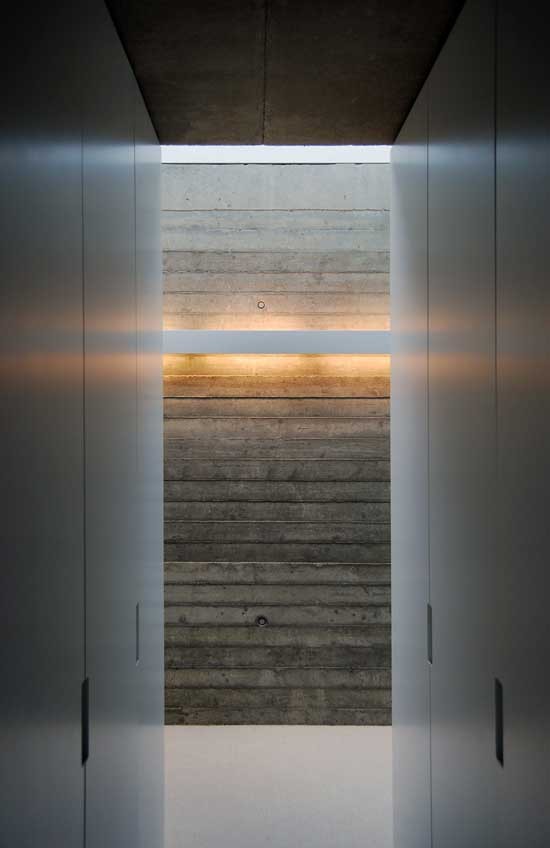
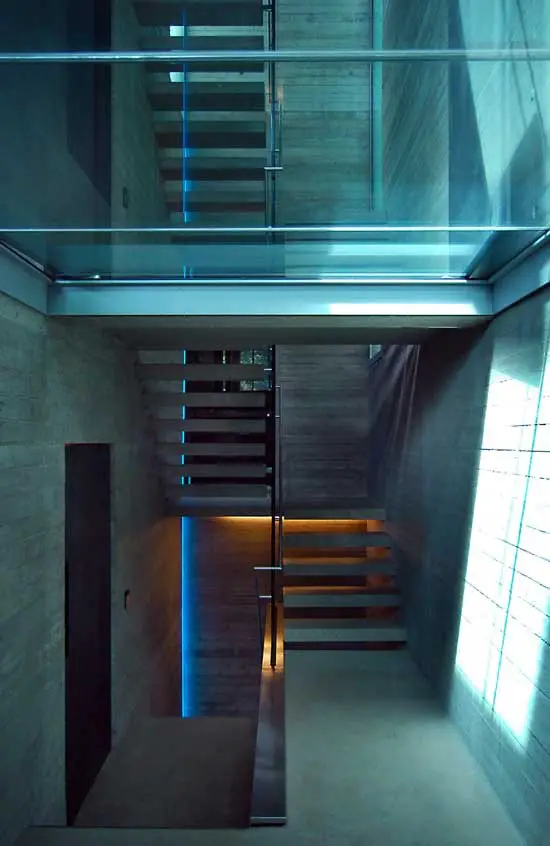
The interior spaces are linked vertically by a series of large areas of clear glass floor panels which filter daylight from the main sliding rooflight down to the entrance area off the street. Full height frameless pivoted doors veneered in bog aged oak separate the living spaces and bedrooms from the main stair.
The stair itself has pre-cast concrete treads cantilevered from the concrete walls each side with a clear glass fin to the centre supporting a stainless steel handrail which is resin bonded to the glass. The fin is formed from two four metre high sheets of toughened laminated glass which were craned into position through a slot created in the roof slab. Bathrooms on each floor are lined with white corian and have white marble floors.
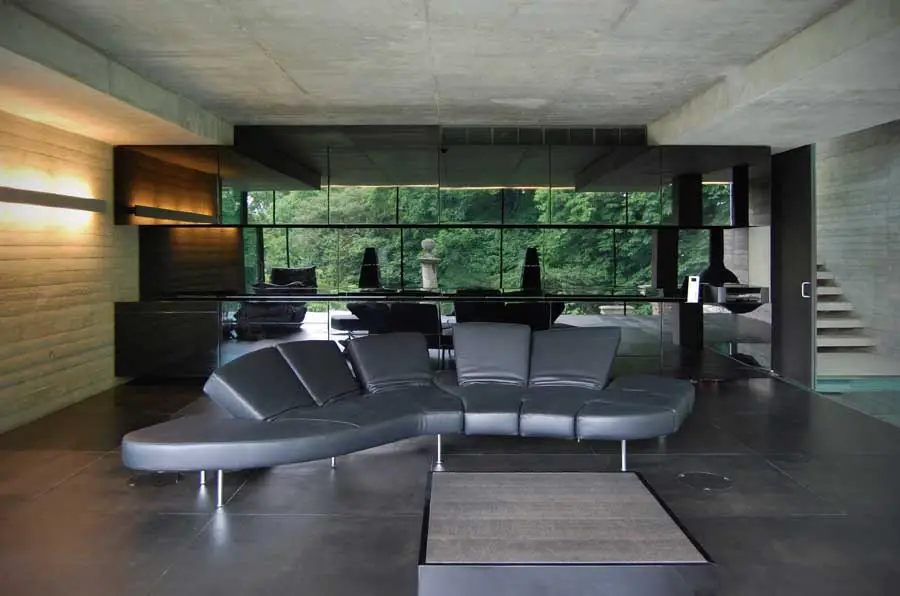
Eldridge Smerin were also responsible for designing bespoke joinery and furniture throughout the house. Built-in storage is generally in timber behind white lacquered doors but the Music Room on the first floor has a wall of storage units in high gloss black lacquer and side tables in bog aged oak. The second floor Study features a continuous worksurface formed from and supported by clear frameless toughed glass sheets bonded together.
Prior to work starting on site John Winter was philosophical about the demolition of the house he had designed, saying that there would be no hard feelings ‘so long as the new house was better’. Reviewing the completed house for Architecture Today magazine John Winter was generous enough to say he felt the new house was both better and ‘as near to a faultless building as I have seen for a long time’.
stairs:
Green credentials of the proposals
Whilst there is much interest in the construction industry generally in sustainability issues there are as yet no clear accepted definitions of what makes a building sustainable. However, with 30% of all UK delivered energy currently being used on domestic heating, this far outweighs other energy uses and makes producing a house with low energy the key environmental issue. The intention is to produce a house with a significantly lower energy usage than the current house even with an increased floor area.
This is achieved in a number of ways. The form of the house with a series of large glazed openings facing south coupled with the use of a heavyweight concrete structure will allow passive solar gain to be maximised during winter months. The high thermal mass of the reinforced concrete structure acts as a temperature stabiliser moderating temperature fluctuations; this is helped by the extent to which the house is set into the ground.
The use of a heavy, stone covered roof system will similarly help control temperature fluctuations. The possibility of incorporating photovoltaic cells and of collecting and recycling wastewater is also being considered. The use of concrete as a structure and finish, when sourced from a local plant that utilises a proportion of recycled material, helps minimise the embodied energy in the envelope of the building.
Internally a low temperature hot water underfloor heating system would be used in conjunction with the thermal mass of the buildings envelope to maintain comfortable conditions with minimised energy usage. Other finishes specified within the building would be carefully audited to ensure where possible they have zero ozone depletion potential and are environmentally passive in manufacture and use.
Highgate Cemetery House – Building Information
Project Commencement: Oct 2003
Construction: Oct 2006 – Jan 2008
Contract Value: £1.7m
House in Highgate Cemetery – Project Team
Architect: Eldridge Smerin (Nick Eldridge, Piers Smerin, George Dawes, Alison Poole, Amalia Skoufoglou)
Quantity Surveyor: AB Associates
Structural Engineer: Elliott Wood Partnership
Services Engineer: Mendick Waring
Concrete Consultant: David Bennett Associates
Lighting Designer: International Lighting Solutions
Home Entertainment/Security: SMC Systems Integration
Main Contractor: Harris Calnan
Key Sub-contractors/Suppliers
In-situ concrete: Harris Calnan
Structural Glass: Ide Contracting
Glass Sliding Doors: Fineline Aluminium
Glass Floors : Compass Glass
Sliding glass rooflight: Glazing vision
Grass Roof System: Bauder
Stone cladding/ flooring: G. Miccoli and Son
Steel Mesh: Potter and Soar
Metal Cladding/ Flashings: Dutton Engineering, Brent Fabrications
Doors/ Specialist Joinery : Opus Magnum, 3D Joinery
Kitchen supplier: Bulthaup
Bathroom Fixtures: Alternative Plans
Blinds: Levolux
House in Highgate Cemetery London images / information from eldridge smerin Architects
House in Highgate Cemetery architect : eldridge smerin
Location: Swain’s Lane, Highgate, London, England, UK
Highgate House Designs
Highgate Residential Properties
Victorian Townhouse Property
Design: LLI Design
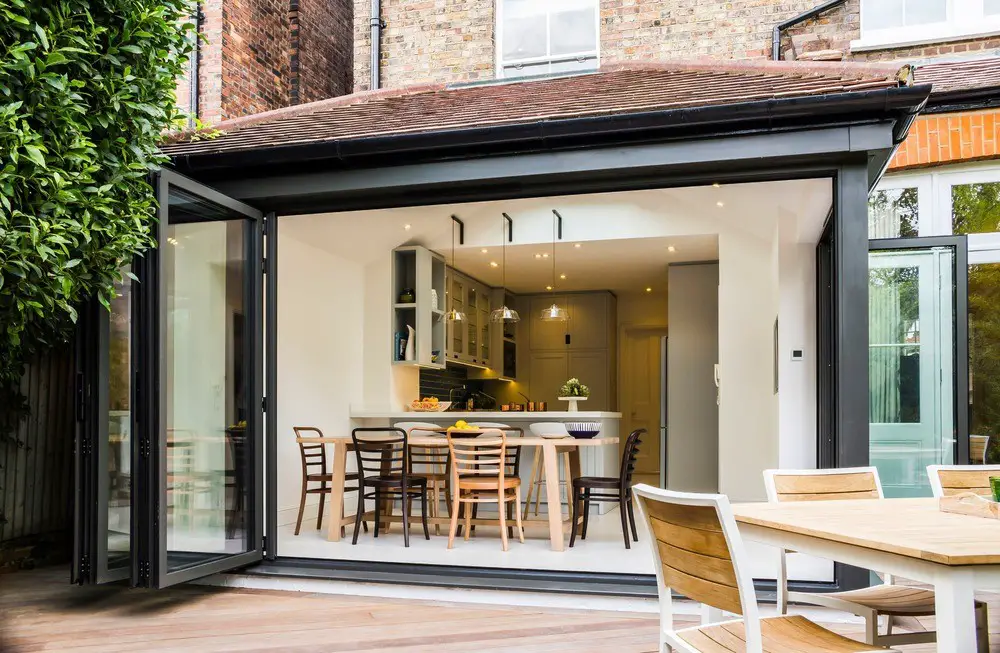
photo courtesy of architects
Victorian Townhouse Property in Highgate
New Highgate Townhouse Property
Design: LLI Design
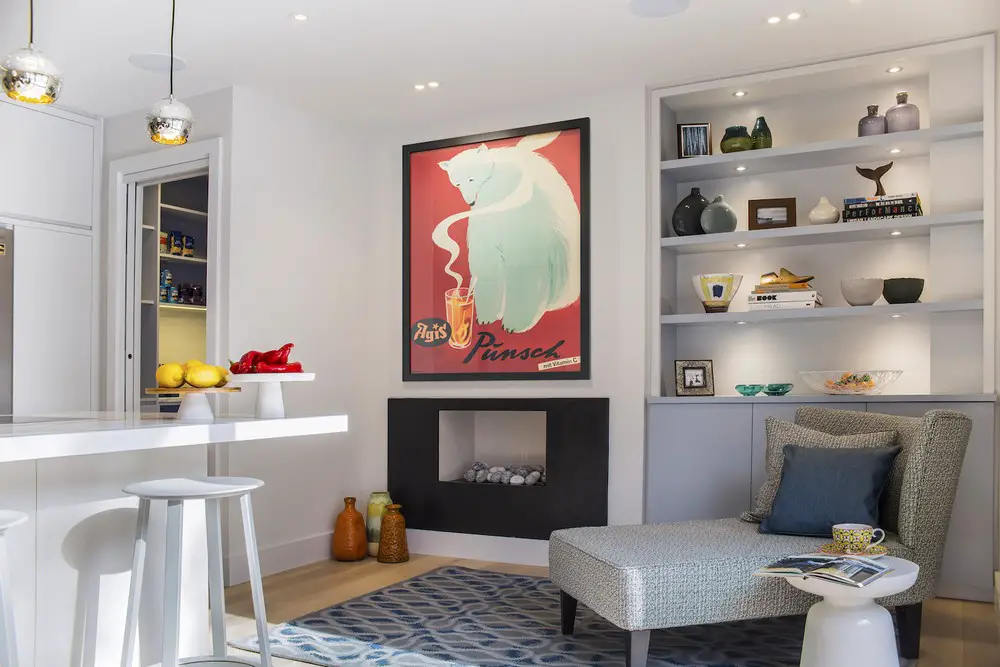
photo : Rick Mccullagh
Highgate Townhouse Property
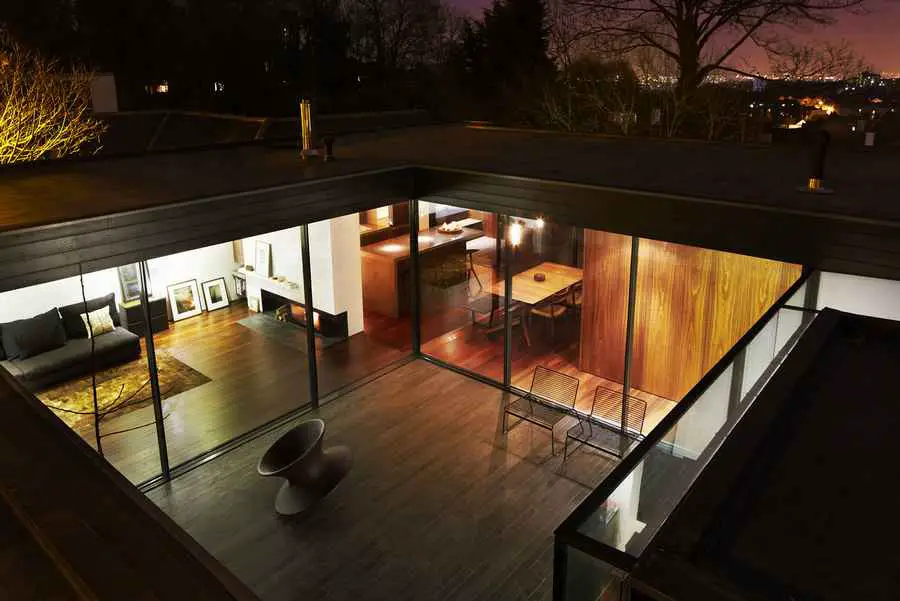
Kingsley Place Property
Design: Zuber Architecture
photograph : Mel Yates
Kingsley Place House, Highgate Property
Highpoint
Design: Berthold Lubetkin Architect / Tecton
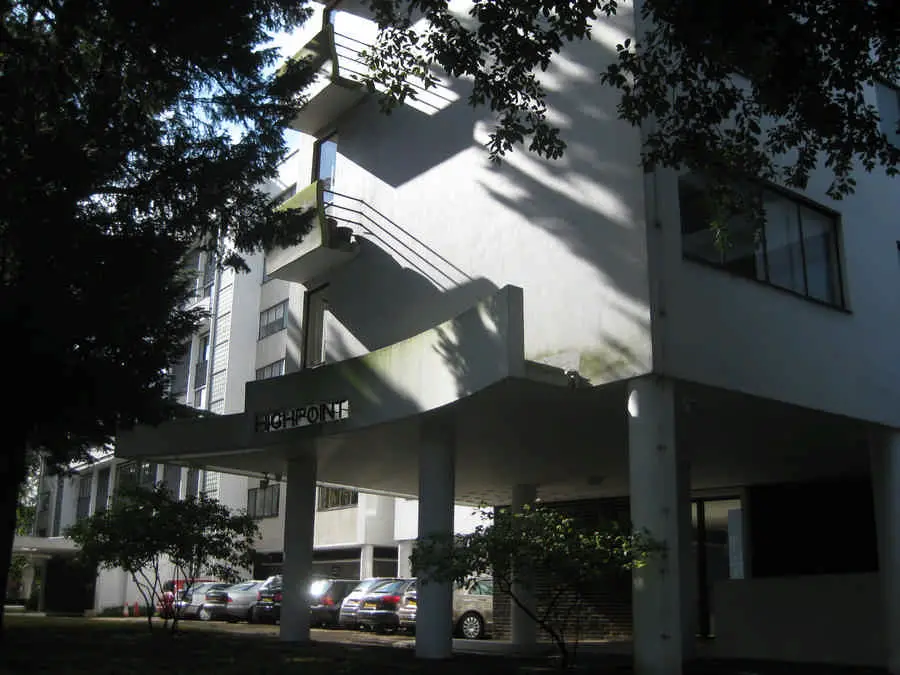
photo © Adrian Welch
Highpoint London, Highgate Flats
Sheldon Avenue house
Design: Belsize architects

image courtesy of architects
Sheldon Avenue House, Highgate Home
Highgate Architecture
Highgate Junior School Building
Channing School Extension in Highgate
London Buildings
Contemporary London Architecture
London Architecture Designs – chronological list
Architecture Walking Tours in London by e-architect
Cannon Place House
Design: Belsize Architects
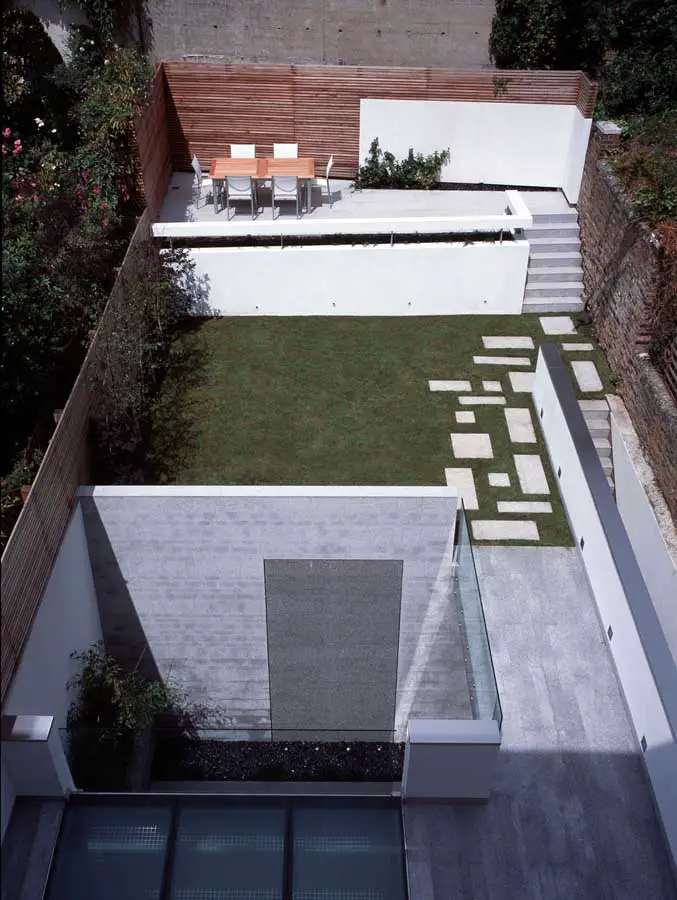
image from architects
Comments / photos for the House in Highgate Cemetery London Architecture page welcome
