
Clapham Manor Primary School, London Education Building, Photo, Design, Property
Clapham Manor Primary School
Education Development in London, England design by dRMM architects, UK
22 Jul 2010
Clapham Manor Primary School makes Stirling Prize shortlist
Design: dRMM architects
dRMM’s vibrant intervention into a Victorian Board School
Photos © Jonas Lencer
Clapham Manor School
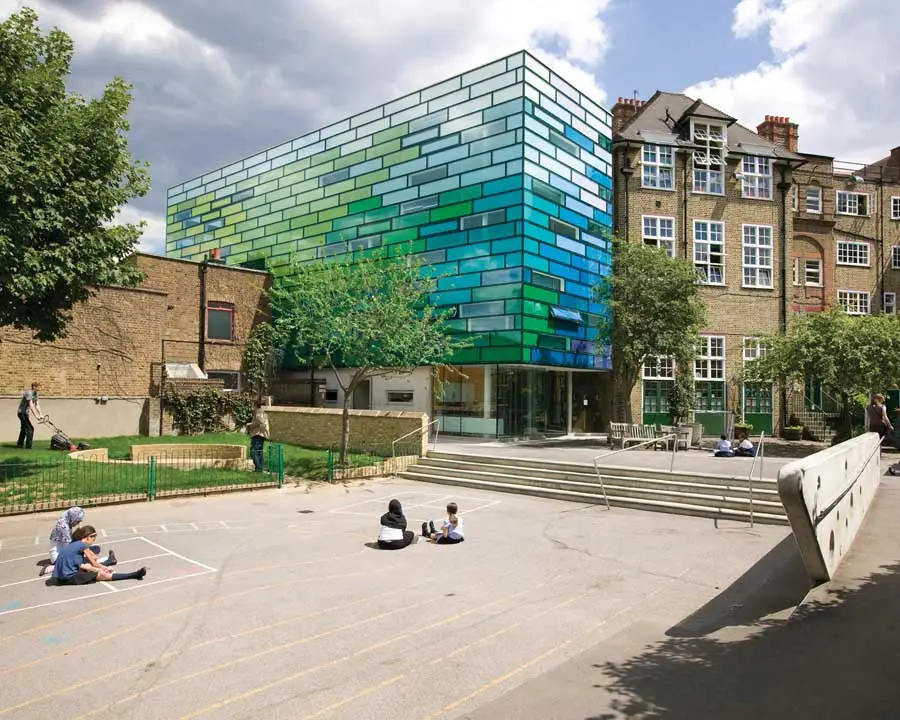
This polychromatic extension inserted into a tight urban context offers the school a new identity, much-needed learning spaces and an organisational hub, while maximising play space.
Clapham Manor Primary School had become a victim of its own success, having grown from a oneto two-form entry, placing considerable pressure on successful delivery of curriculum within the restrictions of the original building. Yet despite the physical constraints, the school has excelled under the leadership of head teacher Brian Hazell, achieving Ofsted ‘Outstanding School’ status. The driver for this project has been to improve the pupils’ experience by providing facilities that support both learning and play.
dRMM was asked to consider the provision of additional learning spaces within the site. As a masterplan to restructure the school was developed in consultation with the school community and local authority, it became apparent that the school was successful because everything was ‘under one roof’. The new wing was therefore conceived as a freestanding addition that plugged into the Victorian Board School, allowing the school to work efficiently and holistically as a single entity.
The extension forms phase ‘1’ of the project, comprising additional learning spaces, performance space, an organisational hub, formal entrance and improved access whilst minimising the loss of external play space. Phase ‘2’ will be the remodelling of the Board School in order to bring all classrooms up to DCSF space standards.
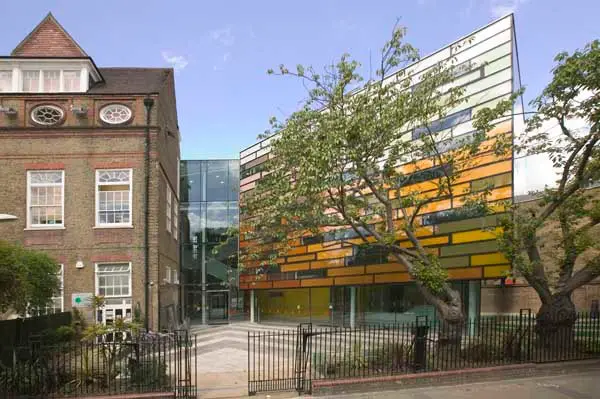
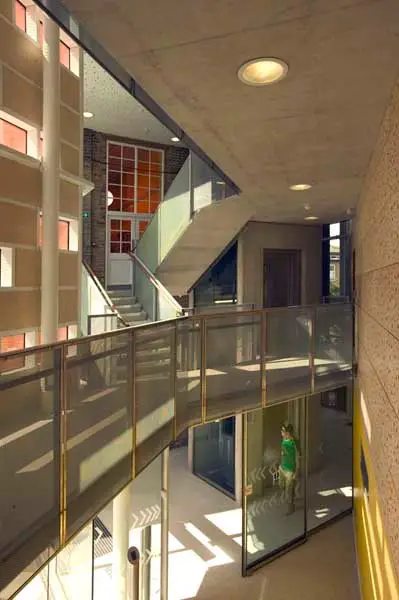
The first move: to locate the wing within what was the most constrained, under-utilised portion of the site – a former caretakers’ house and awkward 60’s extension. The new intervention is pulled away from the flank wall to sit parallel with the neighbouring Grade II Listed Odd Fellows Hall. The resultant interstitial space establishes a formal entrance into the school, improving security by acting as an organisational hub for access to the entire premises. This new entrance from pedestrian Stonhouse Street provides safer access for children and the local community also benefit from the feeling of greater safety as the building affords improved passive surveillance along the street. Pupils enter a triple height transparent atrium that separates new and old. Stairs that scissor overhead and a glazed lift reconcile the four contemporary storeys that have been created within the height of three Victorian storeys.
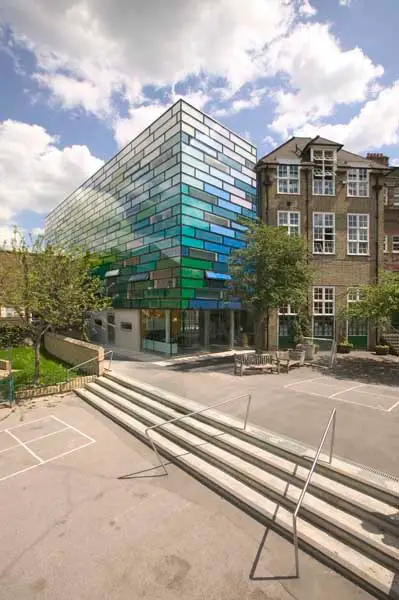
The architectural aspiration was to create a building that would sit shoulder to shoulder with the two great brick exemplars but not be subservient. The Conservation Office was supportive of a contemporary intervention provided it was of the highest standard. The façade is inspired by post war system-built schools, which utilised the benefits of curtain walling to create bright and airy teaching spaces.
The objective was to create a solution that exploited the technological benefits whilst addressing the failings of a glazed façade (heat gain/heat loss). The formal grid that typically defines curtain walling is replaced by a random grid to provide an expression appropriate for a primary school, both inside and out. Compositionally it would be difficult to reconcile the difference between the window and sill heights of the two existing buildings. Avoiding a compositional dialog allows the building to create its own expression.
The building appears without scale as the façade conceals clues to storey heights. It is contextualised through colour rather than composition. The façade is a polychromatic loop of colour that shifts as it moves around the building. The contextual colours of the Board School and the Odd Fellows Hall inform the rich reds and yellows along Stonhouse Street. The colour spectrum shifts into greens along the north elevation as the building emerges on the playground side echoing the soft landscaping below, and finally into vibrant sky blues before returning into the gap between the two buildings.
EDUCATION
This modest scale extension packs a number of punches. In addition to new classrooms, students will benefit from spaces for performance/dance, music practice, breakout learning, informal/ social and a medical room. Staff share a resource room, copy facilities, administration, and there are offices for the head teacher and facilities and premises manager. The community may enjoy the benefits of using the facilities, extending the agenda of lifelong learning.
Throughout the building details have been incorporated that appeal to the senses – texture, light, views, colour. Whether displaying the mechanism of the passenger lift, or revealing clear separation of the differently aged buildings, the building offers day-to-day educational benefit. The new spaces acknowledge and celebrate the different user requirements, for example external opening vents and internal vision panels are set at varying heights. In contrast to the vibrant colours of the exterior, the classroom colours are toned down to muted hues that allow calm teaching spaces. The internal façade is lined in pinboard so that teachers can readily display pupils’ work.
Acoustics, ventilation, and light levels have all been designed to optimise learning and to complement the range of spaces offered by the Board School. The informal, social spaces that connect the classrooms are vibrant and stimulating, eliminating corridors and offering visual transparency to improve passive surveillance. Soft play and informal spaces for quiet reading and conversation are situated around the new extension, as well as secure cycle storage. Externally the new façade imbues the playground with a colour and reflection, and presents a strong identity to the local community.
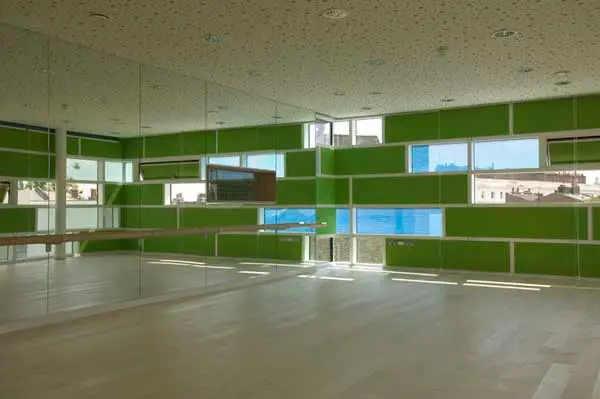
INTERIOR
The facade works doubly hard to define not only the exterior but also the interior. The vibrant coloured glass panels of the exterior are upholstered on the inside allowing opportunities for the display and presentation of pupils’ work. In contrast to a classic criticism of glass walls, staff are actively encouraged to adorn these walls with student work. The dynamic quality of the triple aspect classrooms is further heightened by the composition of the views. Solid, fritted and clear panels at varying heights create amazing compositions of the urban landscape whilst being inclusive of all ages and heights.
Environmental requirements for acoustic absorption, lighting and mechanical ventilation offer further opportunities for expression with ceilings composed as random arrangements of circular holes, circular lights and circular diffusers. The seamless cushioned floor allows teachers to shift from table to floor work for larger projects.
The atrium space that links the new and the old is a dynamic triple height space interspersed by walkways and stairs that criss-cross between different levels. The requirement for a quiet circulation space is achieved by acoustic plywood panels that follow the line of the façade, with cut-outs to mirror the acoustic ceiling. A glazed lift rises between two concrete vertical fin wall, its mechanism fully exposed as an educational delight for pupils to behold.
Clapham Manor Primary School – Building Information
Project name: Clapham Manor Primary School
Location: London, UK
Architect: dRMM team: Philip Marsh, Satoshi Isono, Michael Spooner, Mirko Immendoefer, Junko Yanagisawa, Jonas Lencer, Russ Edwards
Client: London Borough of Lambeth
Structural Engineer: Michael Hadi Associates
Environmental Engineer: Fulcrum Consulting
QS and CDM Coordinator: Appleyard & Trew
Acoustic: Fleming & Barron
Contractor: The Construction Partnership
Clapham Manor Primary School Photos © Jonas Lencer
About Clapham Manor Primary School
Clapham Manor Primary School is a ‘community school’ meaning their running costs are met from public funds, mainly through the local council, London Borough of Lambeth, and they operate within a framework which is set by the council. Clapham Manor Primary School admits boys and girls from the age of 3 to 11 years, from the local vicinity and is located in Clapham Old Town, close to the main High Street and Clapham Common tube station. Brian Hazell is the headteacher and Nigel Haselden is the Chair of Governors. During their last Ofsted Inspection in 2007 both Clapham Manor Primary School and the Children’s Centre were giving ‘Outstanding’ reports. In 2006 they were given the Basic Skills Quality Mark, the Active Mark for Sport and the Healthy School Award. In 2008 they were awarded School Green Flag Status and the Arts Council England Gold Award.
Clapham Manor Primary School images / information from dRMM
dRMM architects
Location: Clapham, London SW4 0BZ,, England, UK
Clapham Buildings
Clapham Buildings on e-architect
MEATliquor and Shed
Architecture: Shed

photo : Shed
MEATliquor X Shed, Clapham
Clapham House
Design: atmos, Architects
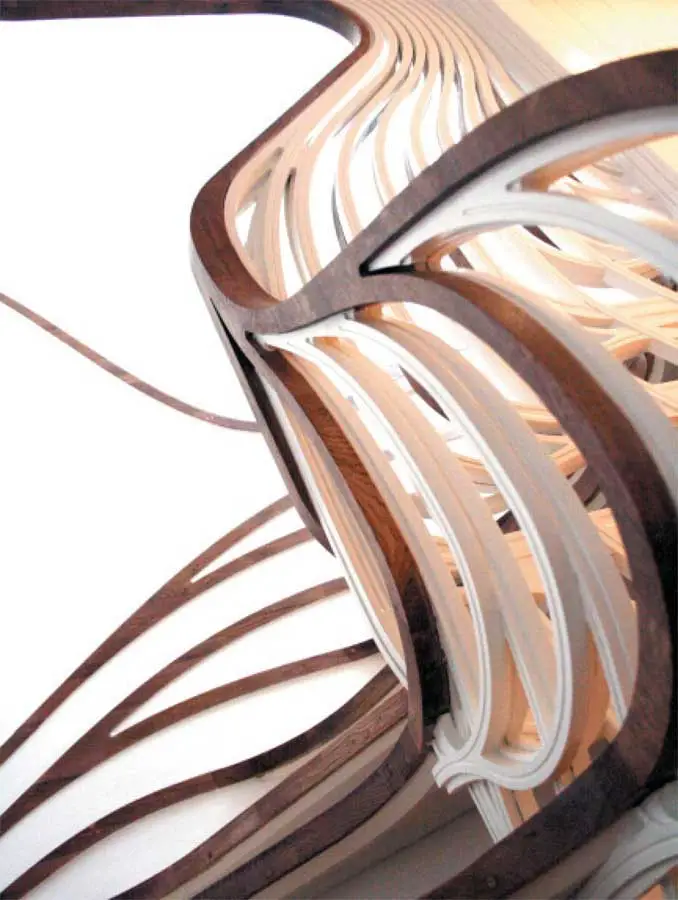
photo from architect studio
Clapham House
Cedars Road Pavilion
Design: Peter Barber Architects
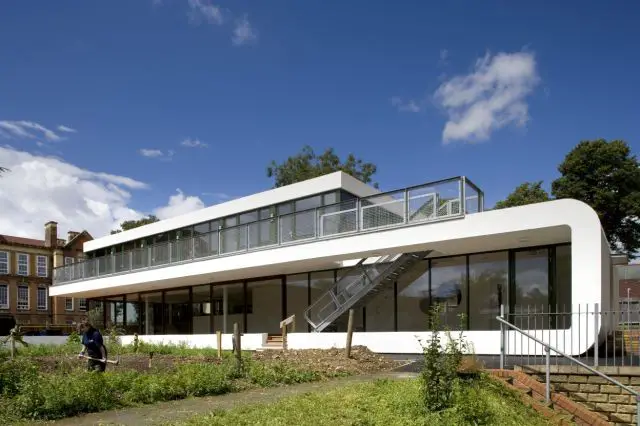
photo © Morley von Sternberg
Cedars Road Pavilion
Future Clapham
Future Clapham
Clapham Architects : Mangera Yvars Architects studio based on Clapham High St
London Buildings
Contemporary London Architecture
London Architecture Designs – chronological list
London Architecture Walking Tours by e-architect
London School Buildings
London School Buildings – Selection
Westminster Academy – Naim Dangoor Centre, 225 Harrow Road, W2
Allford Hall Monaghan Morris
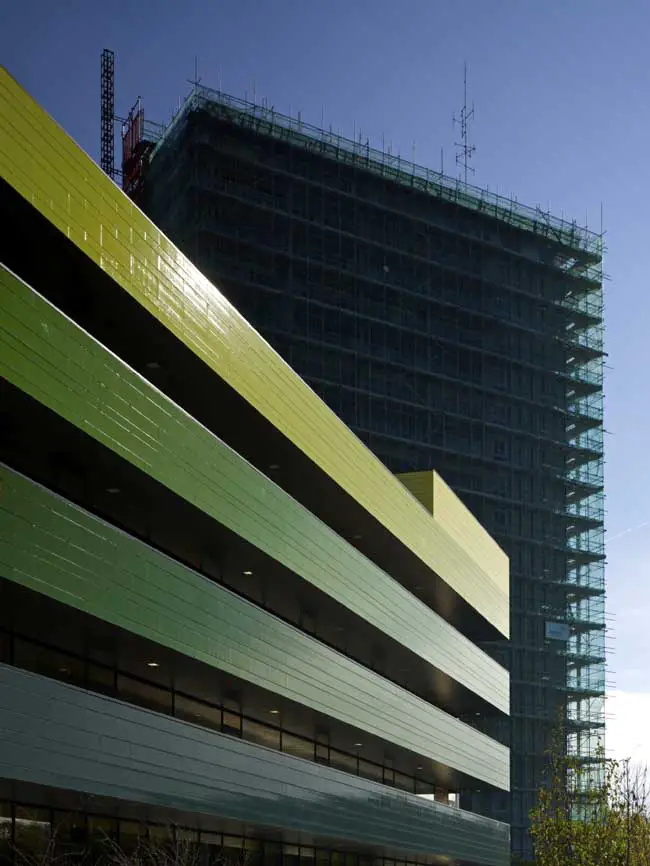
photo © Tim Soar
Westminster Academy
Bridge Academy, Hackney, east London
BDP Architects
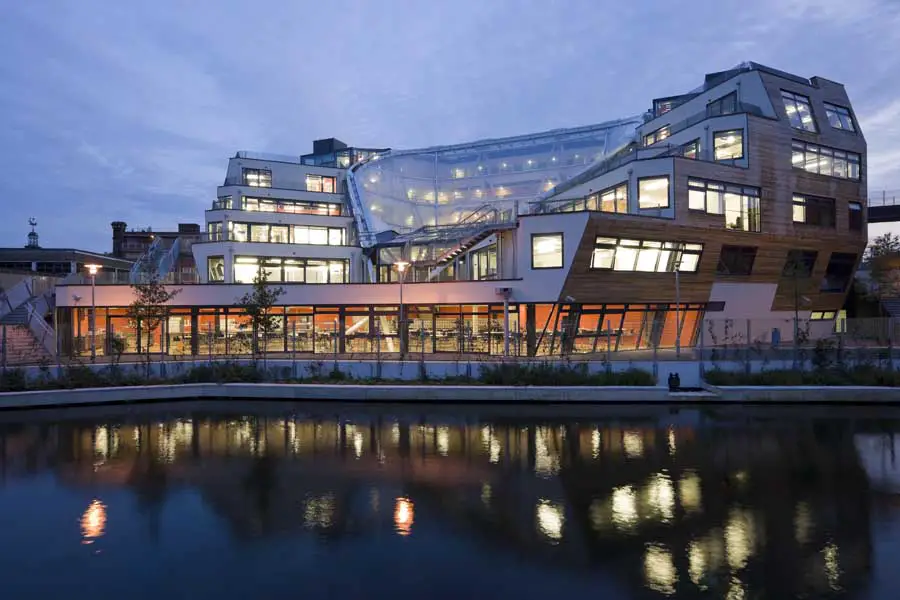
image © Martine Hamilton Knight
Bridge Academy London
St Mary Magdalene Academy, Islington, north London
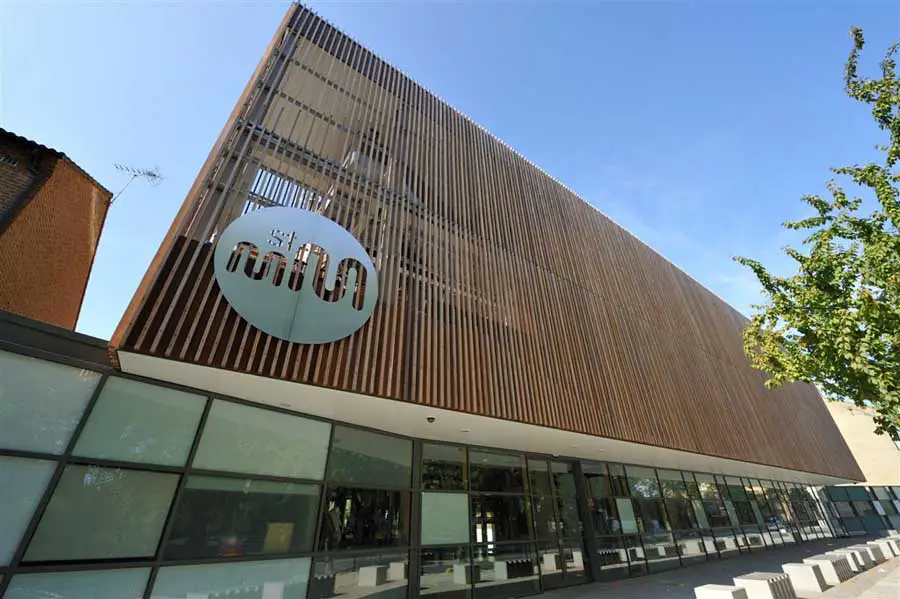
photo © Nick Weall
St Mary Magdalene Academy
Comments / photos for the Clapham Manor Primary School London Architecture page welcome
Website: www.claphammanor.childrencentre.org
