
Thomond Park, Irish Stadium Building, Limerick Redevelopment Project Photo, Arena Design
Thomond Park Redevelopment : Irish Stadium
Irish Sports Project, Limerick building design by Murray O’Laoire Architects, Ireland
18 Jun 2009
Thomond Park Redevelopment
Date built: 2008
Design: Murray O’ Laoire Architects / AFL Architects
Thomond Park stadium in context:
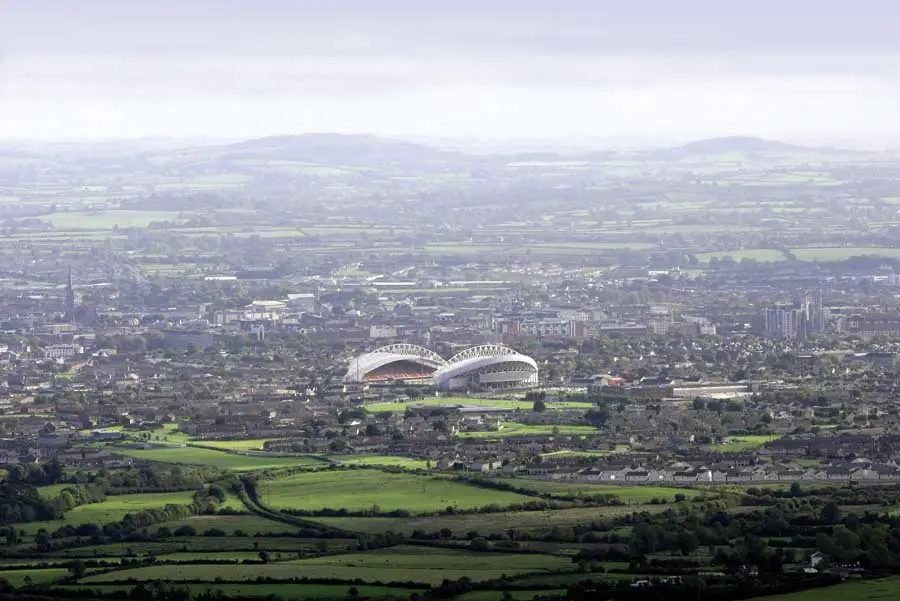
photo : Press 22
Thomond Park Stadium
The design process related to the redevelopment of Thomond Park extends back to 2003 with a request to examine significantly increasing the existing 11,091 capacity stadium. This study examined the options of developing within the existing boundaries of Thomond Park and expanding the site to the east into an area occupied by Limerick City Council and private residences.
A following study examined three alternative sites on the outskirts of the city. Based on these studies the decision was taken to retain the rugby stadium in its existing city centre location. While city centre stadiums present challenges in relation to event management these issues are outweighed by the vibrancy and atmosphere generated in the city on the day of a big match.
Construction photograph of the east truss:
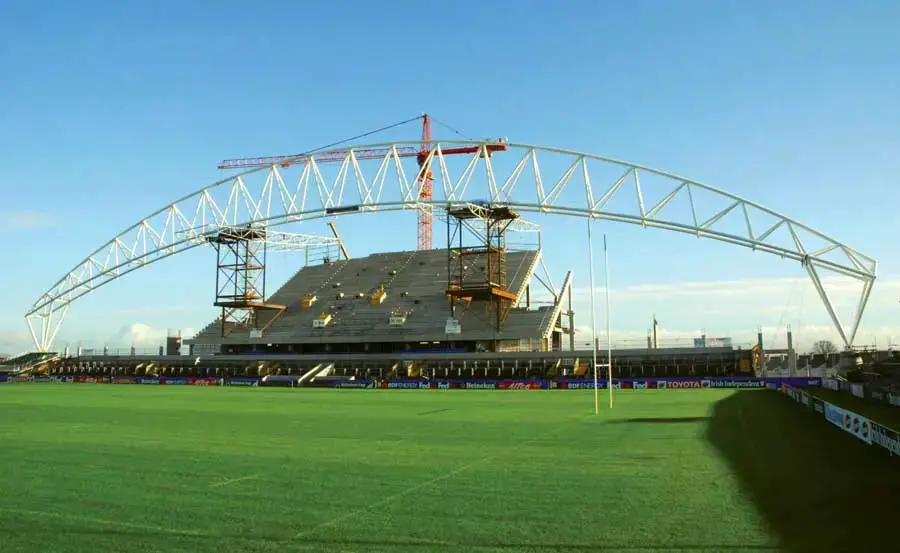
photograph : Michael Punch and Partners
Maintaining the atmosphere and close relationship between players and spectators was key requirement of the brief. The required capacity was 26,000, with 15,000 seated and 11,000 standing positions. Site constraints included the retention of both the main and practice pitches, the Shannon RFC clubhouse and north, east and south terraces. Following successful negotiations with Limerick City Council and the property owners on the east side the development area extended to Knockalisheen road.
View from north east:
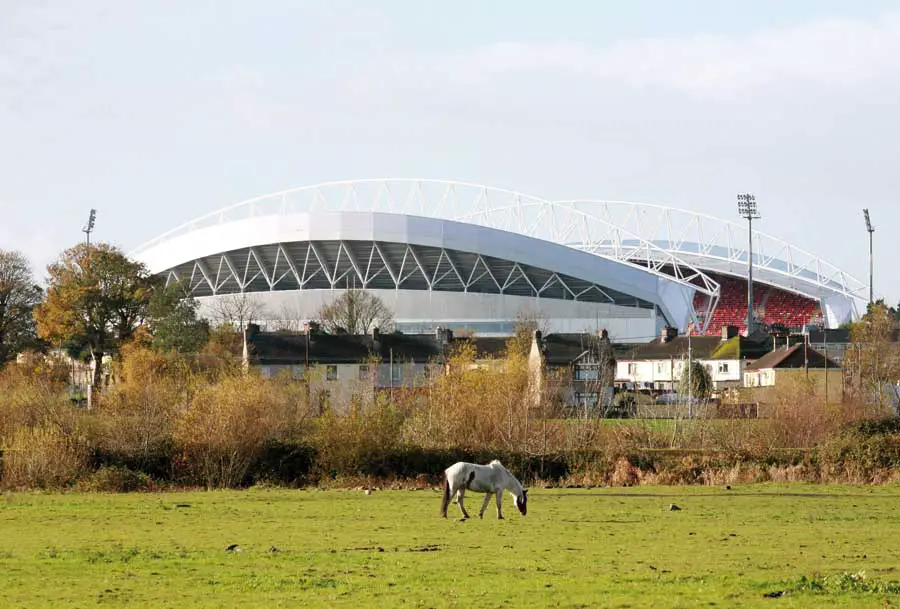
photo : Press 22
The key design aspirations, in addition to fulfilling the requirements of the brief, were as follows.
– To ensure that a stadium of the scale required had a positive impact on the cityscape and skyline, given its elevated site in relation to the surrounding city.
– The building should integrate with its immediate context. The scale of existing structures in the area is predominantly two-storey with residences located directly to the north and south of the existing stadium. The design challenge to incorporate a large structure in these surroundings was significant.
– The new home for Munster rugby should befit their status as the best supported and leading rugby club in Europe.
Night view from south east:
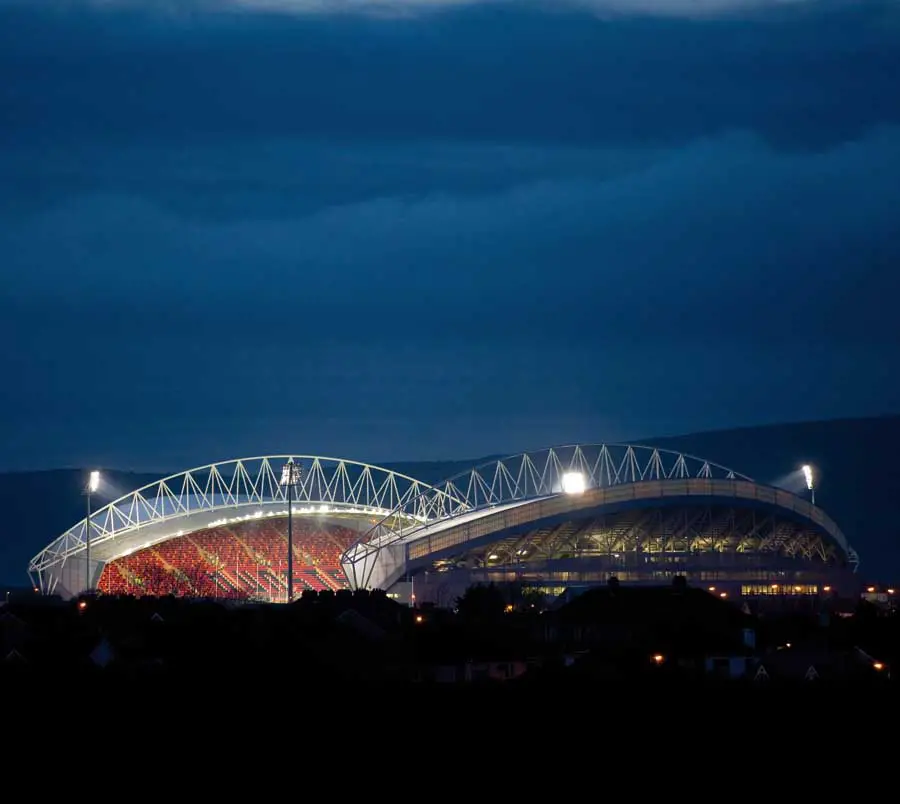
picture : Anew McKnight
These aspirations were set against the backdrop of an extremely challenging project budget where every design decision needed to be justifiable economically.
The three-dimensional form of the stands is a direct product of achieving optimum viewing for all spectators. The optimum functional layout of a rugby or soccer stadium is generated by accommodating all spectators within 90 metres of the centre of the pitch and within 150 metres of all four corners of the playing surface. This generates an “orange segment” profile where the maximum number of spectators is concentrated on the centreline.
The fact that Thomond Park is not enclosed on all four sides is important so that views into and out of the stadium are maintained. A “bowl” type stadium would eliminate the visual and acoustic connection with the city. The barking dogs of Ballynanty and the hum of traffic on Cratloe Road add to the atmosphere when silence descends on the stadium prior to goal kicks. These small but important aspects are an important part of the distinctive character of the stadium.
Detail of truss termination:
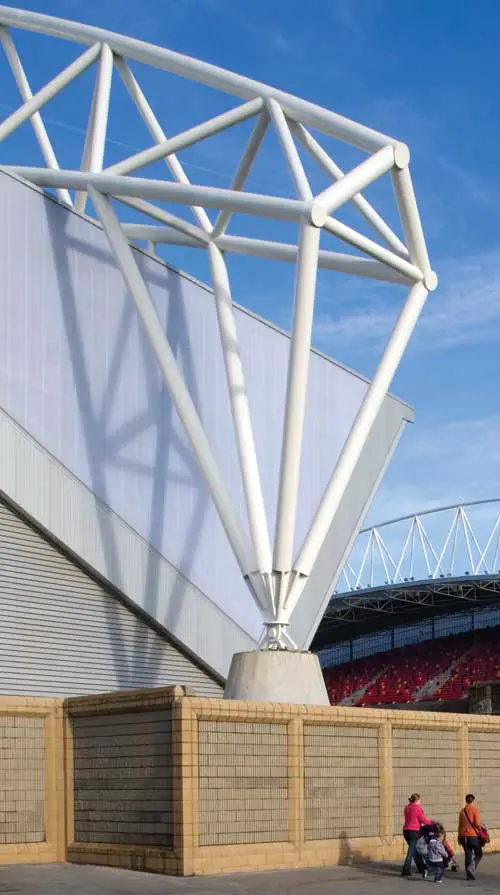
picture : Anew McKnight
The long arch or rainbow truss solution adopted to support the roof is central to the architectural expression of the building, with the trusses being visible from many parts of the city and on its approach routes. The external rainbow trusses overhead leads to extremely light trusses under the roof contributing to the overall visual lightness of the structure internally. Local press reports have commented that “the trusses that sweep across both stands shine like tiaras”.
Aerial view of completed project:
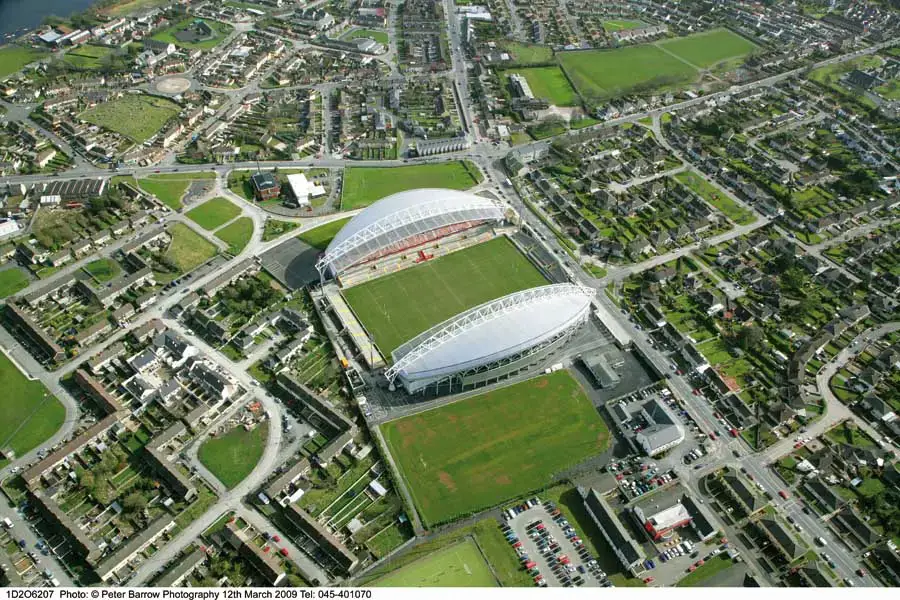
image : Peter Barrow
While the visual impact of the overall form and “rainbow” trusses have the most striking impact at the level of the cityscape, as one approaches the stadium another layer of detail and complexity becomes apparent. The seating bowl is made up of a combination of concrete raker beams with seating units between.
The raker beams are supported by inclined steel tubes which, together with the supporting column beneath, form a “tree” structure with “trunk” and “branches” which produces a dynamic fan-like pattern on the elevation. This is enhanced by the decrease in the slope of the “branches” from the maximum angle at the centre to the lowest angle at each end. The other elements of the building such as the cladding materials and fenestration play a background role and are designed to be neutral in expression.
Internal view of west stand seating bowl:
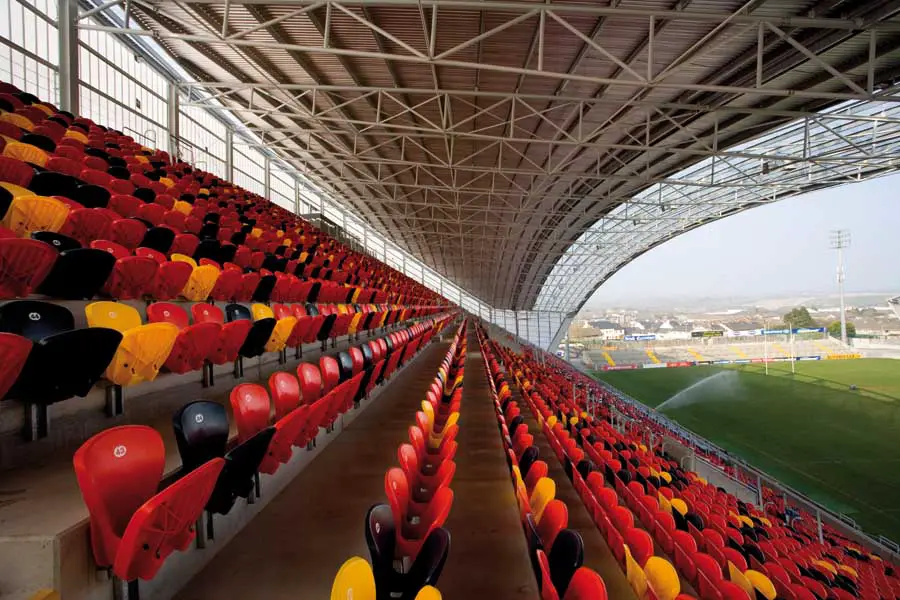
picture : Anew McKnight
The key materials used vary from solid to translucent and transparent. Translucent materials are used on the front section of the roof slope and rear and end walls of the seating bowl. This polycarbonate material changes in its appearance with different natural and artificial lighting conditions. The curved perforated anodised aluminium screen used to the rear of each stand on the open concourses also changes appearance from solid to transparent when back-lit.
This transforms the appearance of the building from non-match day to match day when the stadium is illuminated and inhabited. The mix of vibrant seat colours in the ratio 60% red, 30% navy and 10% gold corresponds with the colour mix in the Munster logo. This avoids the monotonous effect of a single colour seat. When the seating bowl is not at full capacity the optical illusion generated by the random seating mix makes the stadium appear full.
Aerial photograph prior to redevelopment:
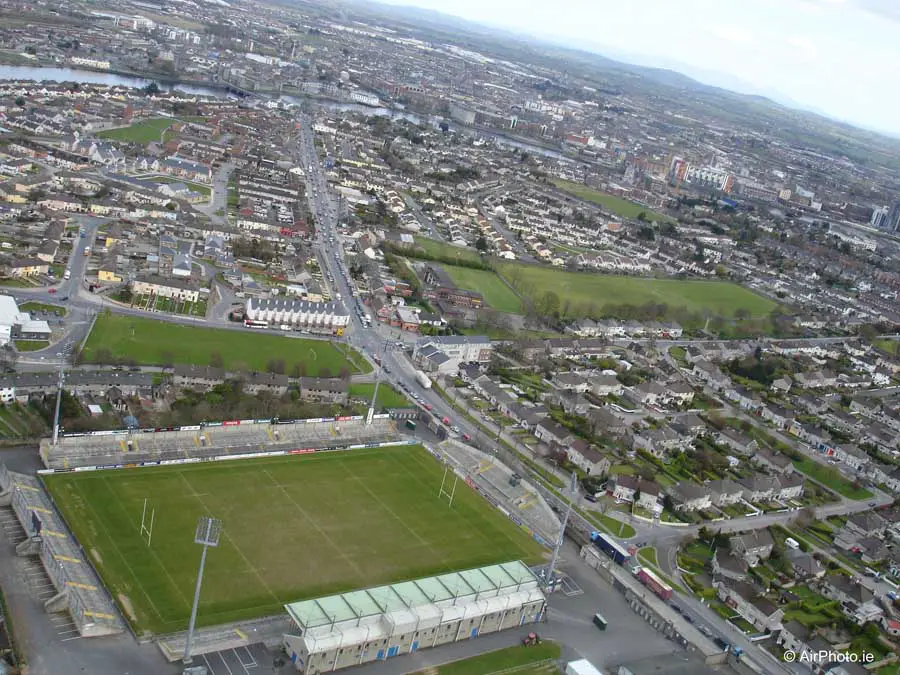
image : Airphoto
Thomond Park is now a fitting theatre for the many great occasions yet to come. Many new stadiums experience a “bedding in” period in the first season when players and supporters alike adapt to the new surroundings. However, the All Blacks rematch has demonstrated that the redeveloped Thomond Park can be as intimidating, intense and overwhelming as the more modest venue that it replaced.
Internal view from south terrace:
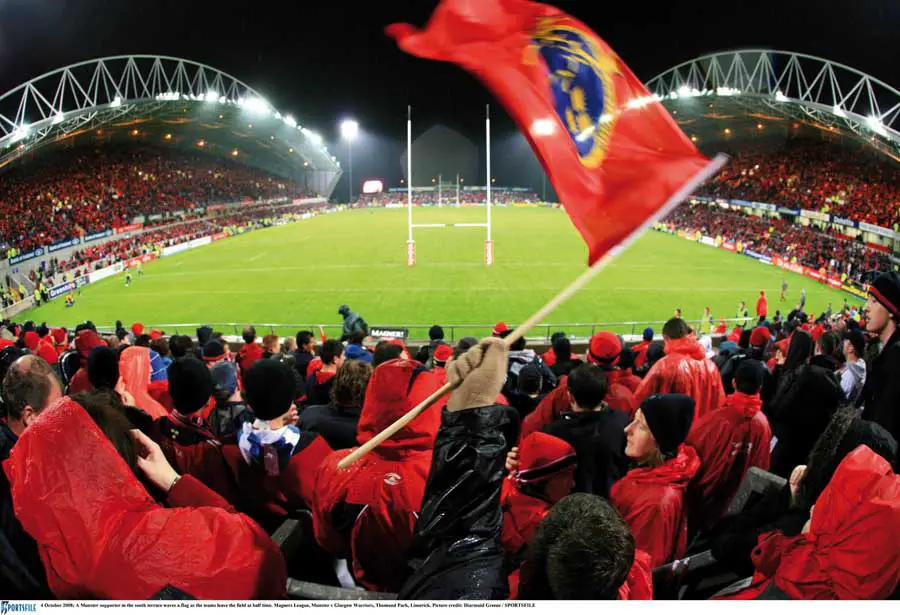
photograph : Sportslife
Murray Ó Laoire designers of the Thomond Park Stadium building
AFL co-designers of the Thomond Park Stadium building
Location: Thomond Park, Limerick, Ireland
Irish Architecture Designs
Contemporary Architecture in Ireland
Irish Architectural Designs – chronological list
Contemporary Dublin Architecture Designs Selection
House on Mount Anville, Dublin
Design: Aughey O’Flaherty Architects
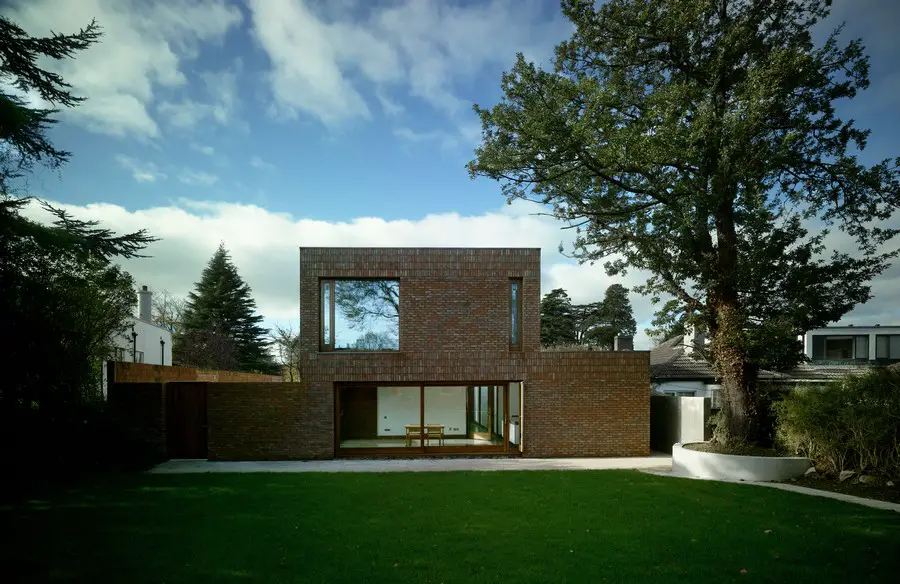
photographs © Louise Halpenny
House on Mount Anville
Spencer Dock Bridge, Dublin
Design: Amanda Levete Architects
Spencer Dock Bridge
Irish Architect – design office listings
Irish Architecture – Selection
RIAI Awards 2009 : Shortlist
Comments / photos for the Thomond Park Redevelopment Irish Architecture page welcome
