
Theatre Agora, Lelystad, Netherlands, Architect, Holland, Images, Design, Project
Theatre Agora, Holland
Dutch Theatre building – design by UNStudio Architects
22 May 2014
Theater Lelystad
Location: Lelystad, The Netherlands
Dates built: 2002-05
Design: UNStudio
Images added 22 May 2014
The design for the new theatre in Lelystad is part of the Master plan for the city center of Lelystad, designed by West 8. The theatre plays an important role during the day as well as during the night in this area of the city. The clustering of cultural and social activities in this new quarter will give Lelystad an outspoken cultural face.
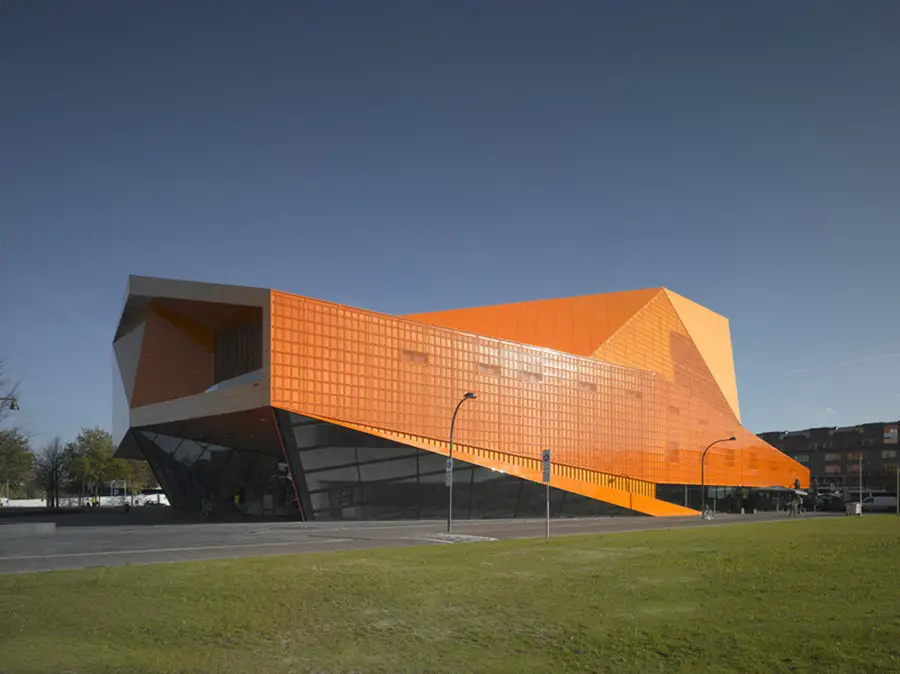
In this context the design for the theatre forms an important orientation point with a forthright architectonical look. Walking from the central station the theatre-tower forms a striking accent in the diagonal view. At night the volume illuminates, and is easily traceable from the different parking facilities.
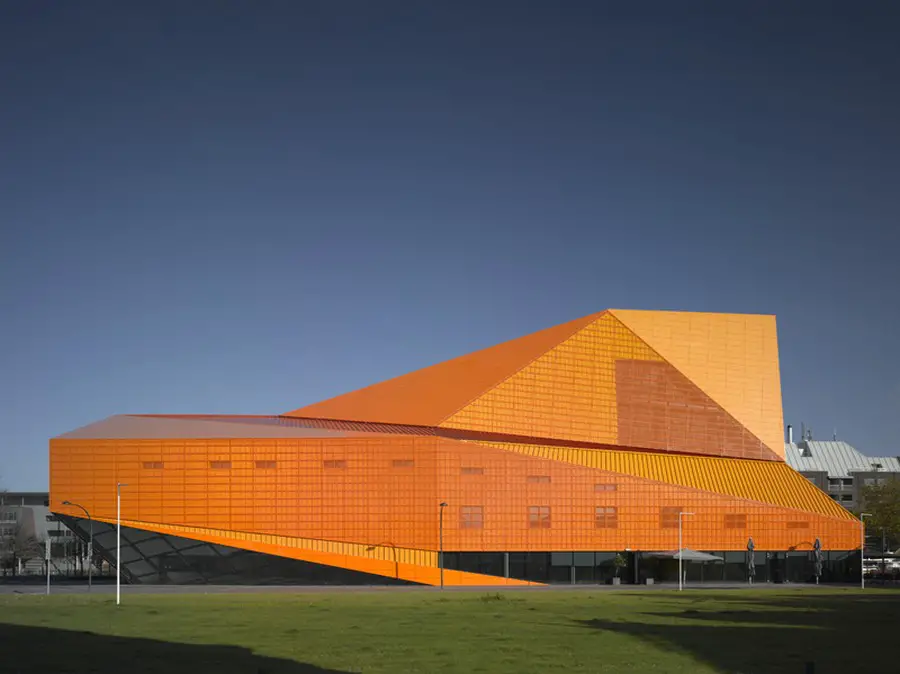
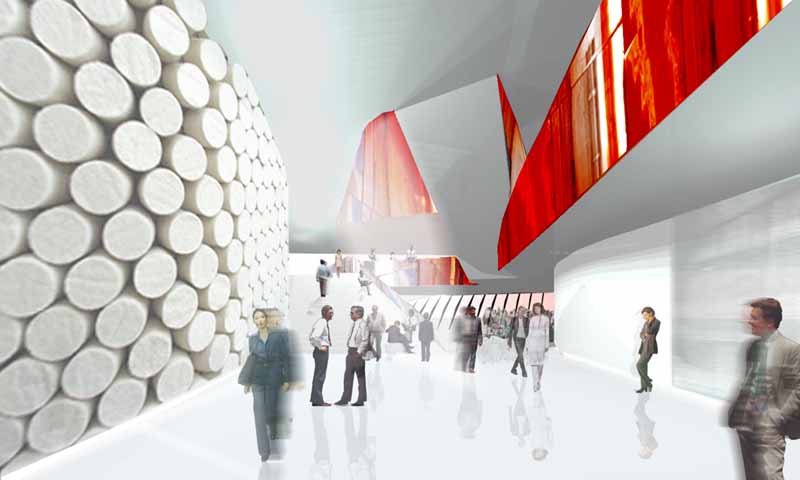
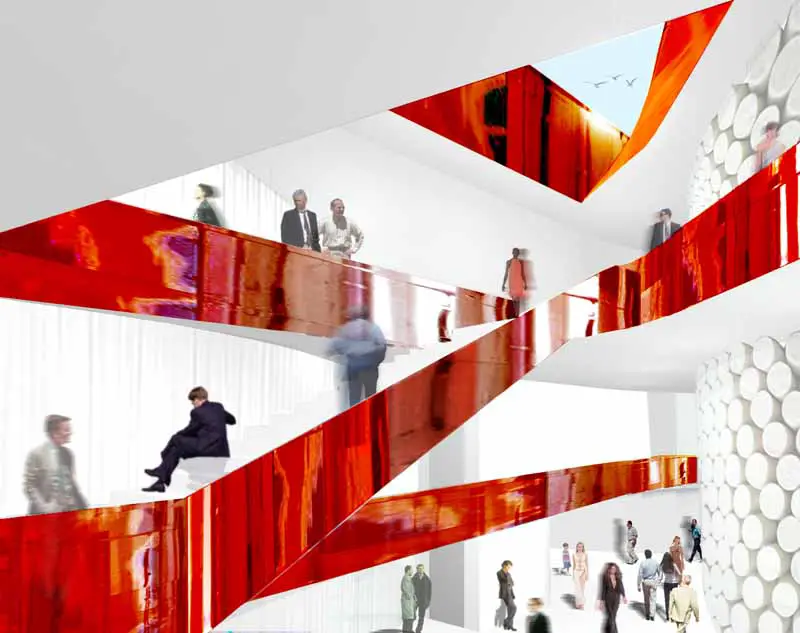
In daytime the shape of the theatre has a sculptural effect. The grand café, also open during the day, connects to the evening square. From the different lobbies of the entrance of the theatre a beautiful view of the Green Care is presented. The vertical foyer, which swings through the entire building, connects different theatre and congress halls on the different floors.
The typology of the theatre has become more and more complex during the years. UN Studio strived to bring the complexity of a multifunctional theatre back into a flexible, transparent and intelligent design. The clear and open organization of the design will serve as a cultural icon for Lelystad.
UN Studio has worked on different projects where theatre art and new media were important aspects in the program. The interaction between different art disciplines should be integrated in the design process of these buildings. UN Studio’s expertise lies in the analytical approach of the design requirements. During the research process, before the design process, questions regarding special organization and the multifunctional use of the theatre obtain an important role.
Theatre Lelystad building: text / images authorised by UNStudio Architects 270407
Theatre Agora Lelystad : UNStudio
Kaleidoscopic experience
Agora Theatre, Lelystad
The Agora Theatre is an extremely colourful, determinedly upbeat place. The building is part of the masterplan for Lelystad by Adriaan Geuze, which aims to revitalize the pragmatic, sober town centre. The theatre responds to the ongoing mission of reviving and recovering the post-war Dutch new towns by focusing on the archetypal function of a theatre: that of creating a world of artifice and enchantment. Both inside and outside walls are faceted to reconstruct the kaleidoscopic experience of the world of the stage, where you can never be sure of what is real and what is not. In the Agora theatre drama and performance are not restricted to the stage and to the evening, but are extended to the urban experience and to daytime.
The typology of the theatre is fascinating in itself, but Ben van Berkel, who has a special interest in how buildings communicate with people, aims to exploit the performance element of the theatre and of architecture in general far beyond its conventional functioning. As he recently stated: “The product of architecture can at least partly be understood as an endless live performance. As the architectural project transforms, becomes abstracted, concentrated and expanded, becomes diverse and evermore scaleless, all of this happens in interaction with a massive, live audience.
Today, more than ever, we feel that the specificity of architecture is not itself contained in any aspect of the object. The true nature of architecture is found in the interaction between the architect, the object and the public. The generative, proliferating, unfolding effect of the architectural project continues beyond its development in the design studio in its subsequent public use.” (Ben van Berkel and Caroline Bos, Design Models, Thames & Hudson, 2006)
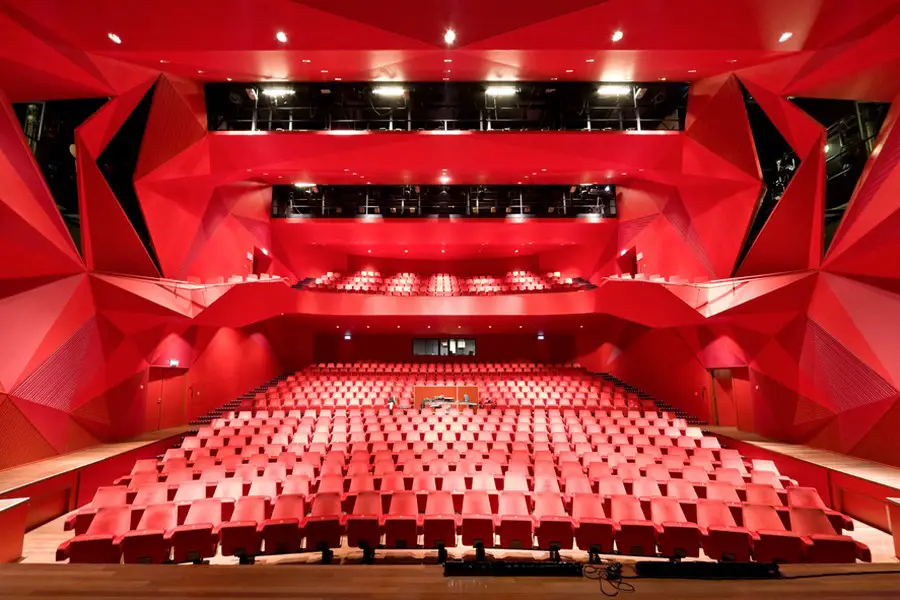
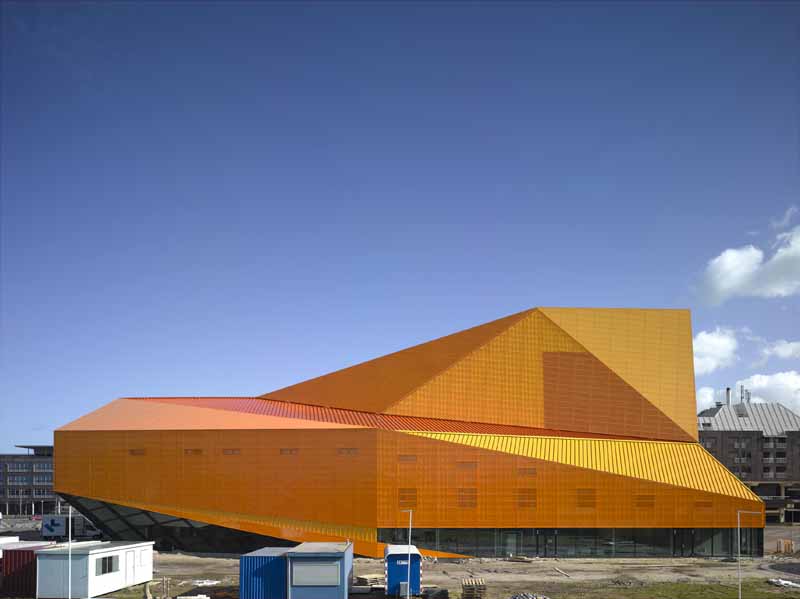
The facetted outlines of the theatre have a long history in the work of UNStudio and Van Berkel & Bos Architectuurbureau before that. In this case, the envelope is generated in part by the necessity to place the two auditoriums as far apart from each other as possible for acoustic reasons. Thus, a larger and a smaller theatrical space, a stage tower, several interlinked and separate foyers, numerous dressing rooms, multifunctional rooms, a café and a restaurant are all brought together within one volume that protrudes dramatically in various directions.
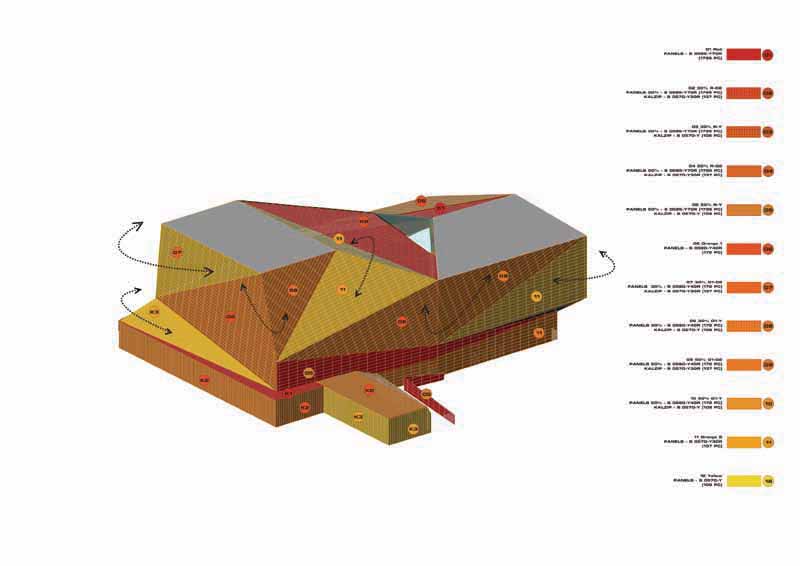
This facetted envelope also results in a more even silhouette; the raised technical block containing the stage machinery, which could otherwise have been a visual obstacle in the town, is now smoothly incorporated. All of the facades have sharp angles and jutting planes, which are covered by steel plates and glass, often layered, in shades of yellow and orange. These protrusions afford places where the spectacle of display is continued off-stage and the roles of performer and viewer may be reversed. The artists’s foyer, for instance, is above the entrance, enabling the artists to watch the audience approaching the theatre from a large, inclined window.
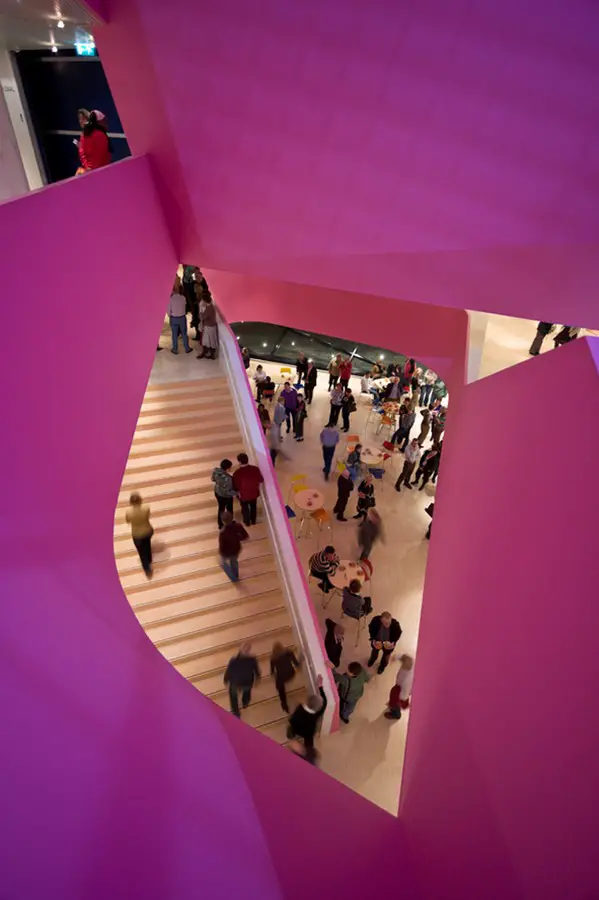
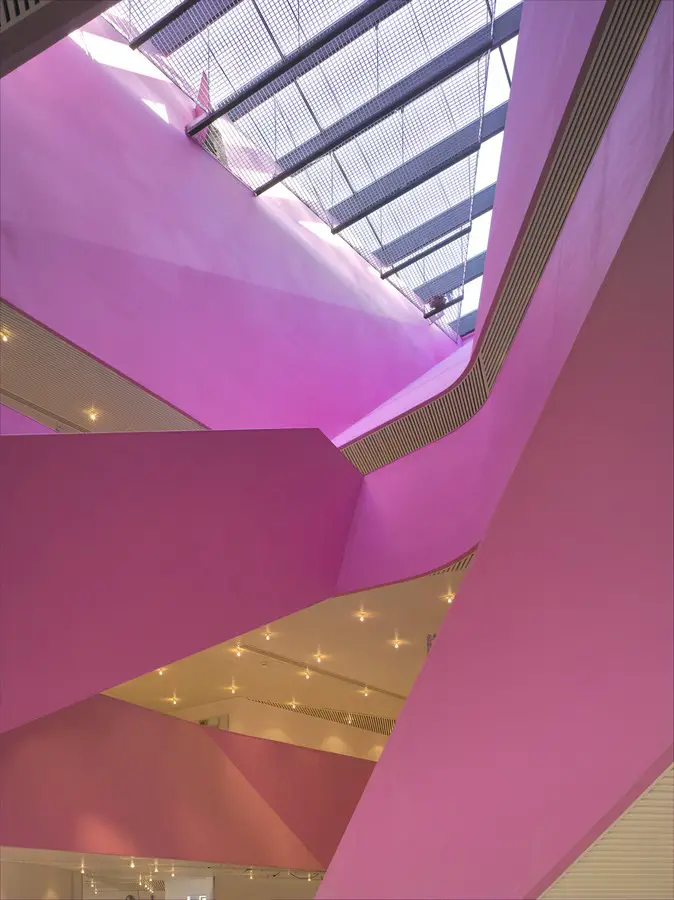
Inside, the colourfulness of the outside increases in intensity; a handrail executed as a snaking pink ribbon cascades down the main staircase, winds itself all around the void at the centre of the large, open foyer space on the first floor and then extends up the wall towards the roof, optically changing colour all the while from violet, crimson and cherry to almost white.
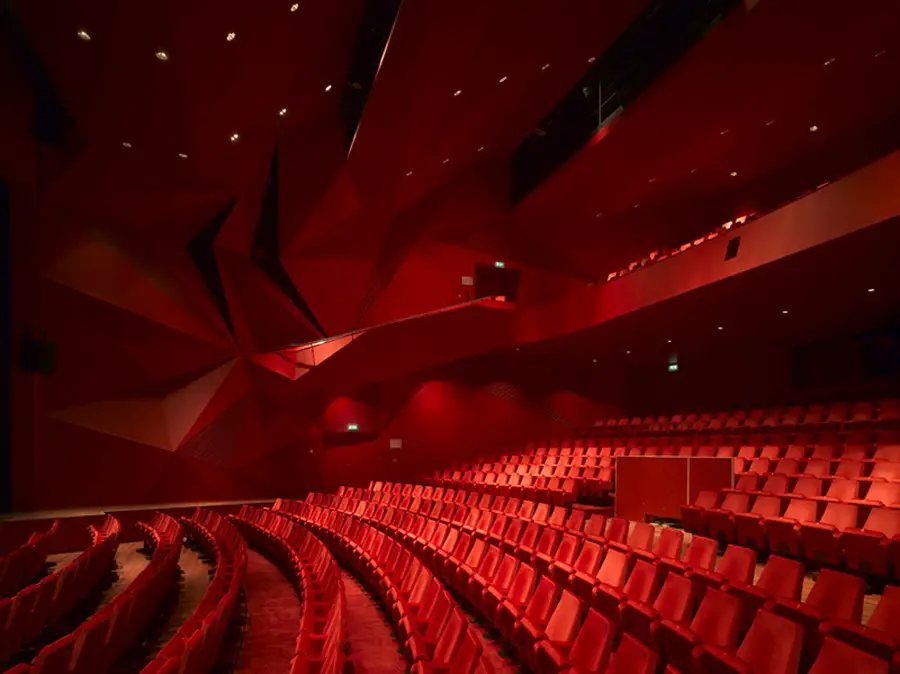
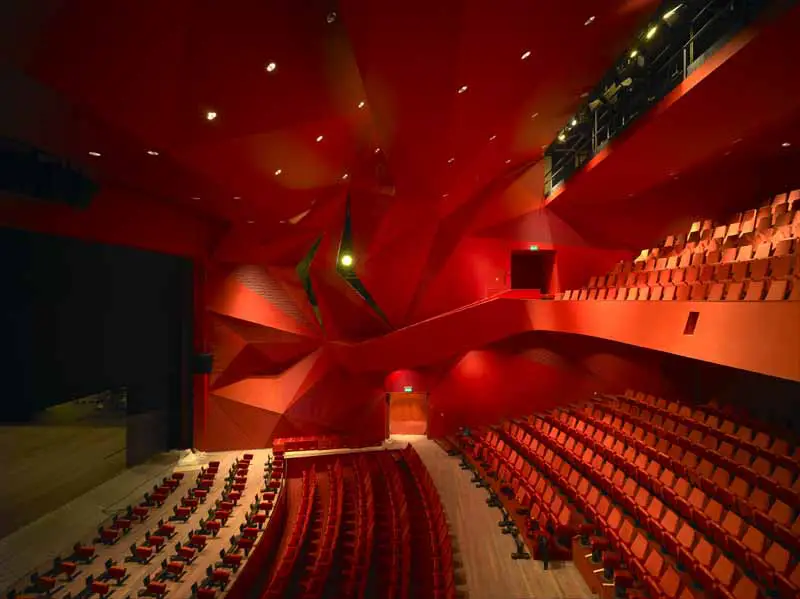
The main theatre is all in red. Unusually for a town of this size, the stage is very big, enabling the staging of large, international productions. The intimate dimensions of the auditorium itself are emphasized by the horse-shoe shaped balcony and by the vibrant forms and shades of the acoustic paneling.
The theatre is the most recent culmination of the interest Ben van Berkel has often expressed in exploring attractiveness, as this quotation from a recent publication shows: “The aim of our architecture is to intensify the gaze, to inspire thoughts and images and thus make it attractive for people to stay longer and return to the places we make for them. Keeping it light and almost scientific is our policy; the ploys invented to intensify the gaze are directly related to the traditional ingredients of architecture: construction, light, circulation, and so on.” (Ben van Berkel and Caroline Bos, After Image, 2006). The architect considers the Agora Theatre one of the most challenging projects he has undertaken, resulting in unusual and highly creative inventions, such as the handrail.
Theater Lelystad, 2005: images © Christian Richters, from UNStudio

Theater Lelystad, 2005, UNStudio
Theater Lelystad – Building Information
Design: UNStudio
Location: Lelystad, the Netherlands
Program: Regional theatre
Building surface: 5890m2 bvo
Seats: large theatre hall 725
Small theatre hall: 200
Volume: 30.000m³
Building site: 2925 m² and expedition area
Photographs
Theatre Agora, Lelystad 1-4 © Christian Richters
Holland Agora Theatre 1-2 © Iwan Baan
Architect: UNStudio – Team:
UNStudio: Ben van Berkel with Gerard Loozekoot, Jacques van Wijk, Job Mouwen, Holger Hoffmann, Khoi Tran, Christian Veddeler, Christian Bergmann, Sabine Habicht, Ramon Hernandez, Ron Roos, Rene Wysk, Claudia Dorner, Markus Berger, Markus Jacobi, Ken Okonkwo, Jorgen Grahl-Madsen
Executive architect: B+M, Den Haag
Theatre Agora, Lelystad – Credits
Client: Gemeente Lelystad
Architecture
UNStudio, Amsterdam
Ben van Berkel and Gerard Loozekoot with Jacques van Wijk, Job Mouwen en Holger Hoffmann, Khoi Tran, Christian Veddeler, Christian Bergmann, Sabine Habicht, Ramon Hernandez, Ron Roos, Rene Wysk, Claudia Dorner, Markus Berger, Markus Jacobi, Ken Okonkwo, Jörgen Grahl-Madse, Hanka Drdlova
Realization
UNStudio in collaboration with B + M, Den Haag
Advisors
Construction management: BBN, Houten
Engineering: Pieters bouwtechniek, Haarlem
Theatre technique: Prinssen en Bus Raadgevende Ingenieurs bv., Uden
Acoustics / Fire strategy: DGMR, Arnhem
Installations: Valstar Simones, Apeldoorn
Lighting advise: Arup, Amsterdam


Theater Lelystad, 2005, UNStudio
Contractor
Contractor: Jorritsma Bouw, Almere
W Installations: GTI, Roden
Electrical installations: Kempkens Brands, Veenendaal
Stage installations: Stakebrand, Heeze
Paintwork: Lansink, Lelystad
Suppliers
Aluminium cladding: Hafkon, Maassluis
Finishing: Gerko, Witmarsum
Signposting: Dehullu, Ochten
Facades: Van Dool Geveltechniek, De Lier
Interior prints: Vertical Vision, Weesp
Lifts: ThyssenKrupp, Krimpen aan de IJssel
Seating main hall: Fibroseat, Marke (B)
Seating small hall: Stol Nederland, Oldenzaal
Hall Information
Capacity main hall 753 seats
Capacity small hall 207 seats
Capacity ochestra pit 60 people
Backstade area main hall 500 m2
Stage main hall 195 m2
Backstage area small hall 135 m2
Stage small hall 81 m2
Party area small hall 225 m2
Height stage tower 19 meter
UNStudio Architects, NL
Location: Lelystad, Netherlands, northern Europe
Architecture in Lelystad
Lely Hotel
Design: Allard Architecture
Lelystad hotel
Zilverparkkade, Lelystad
Design: René van Zuuk Architekten
Zilverparkkade Lelystad
Architecture in The Netherlands
Contemporary Dutch Architecture
Netherlands Architecture Designs – chronological list
Amsterdam Architecture Tours by e-architect
Dutch Architecture – Selection
Borneo Sporenburg : Houses
Design: various architects including MVRDV
Borneo Houses
Almere Masterplan
Design: Rem Koolhaas / OMA
Almere Masterplan
Comments / photos for this Theatre Agora Lelystad page welcome
