
Pôle Sud Skating Rink, France, Architect, Building, Photos, Design
Pôle Sud – Grenoble Skating Rink
French Ice Rink Architecture – design by Hérault Arnod Architectes
9 Dec 2008
“Pôle Sud” Skating Rink – Grenoble
Date built: 2001
Design: Hérault Arnod Architectes
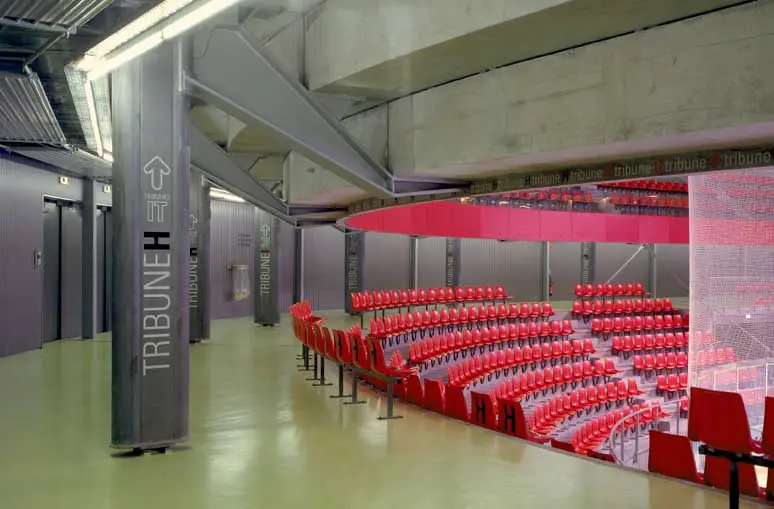
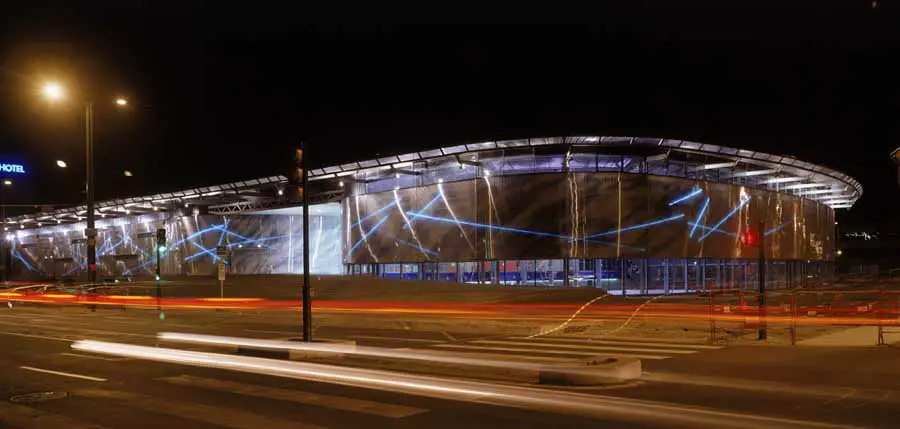

As an extension of the spirit of the 1968 Olympic Winter Games, the skating rink is a defining project for Grenoble. Nevertheless, the client was keen that it should also be an economical building. The response is a “high-density” project, a synthetic architecture that is both optimised and generous, compact, friendly and lively.
The skating rink is situated in the south of Grenoble, in a 1970s neighbourhood where the focus of urban planning was on economic efficiency and on cars, in the detriment of pedestrians. The public space is distended, undifferentiated and confused. The project forms a rectangle, running along Avenue d’Innsbrück, which is one of Grenoble’s southern entries. The structure is designed to be simple and distinctive, and to tighten the layout of the avenue that signifies entrance in the city.
The programme comprises two skating rinks, one 3500 seater stadium for competition, and the other for public use. The building’s shape is generated by the layout of the ice rinks, which determined the floor plan and the contour of the facades in a way that combines compactness and fluidity. Around the main rink, the seating is arranged to form an arena close to the ice, with the entrance hall forming a concentric ring that follows the external outlines of the building. The two ice rinks are positioned along a single axis, and all the elements of the programme are combined under a continuous roof structure. This forms a horizontal roofline at its edges, a marquee that holds the whole composition together. This governing plane twists into a convex shell covering the competition rink, and increases its height into a concave shell over the recreational rink. The roof forms a fifth facade, a relief-plan covered with inset aluminium strips. Inside, the raw materials of the structure – concrete seating, galvanised steel roof – contrast with the vivid colour range of the floors, stairways, seats and painted walls: aniseed green, fuchsia, dark orange, turquoise blue, ultramarine.
The conceptual principle of the skating rink is semiotic minimalism, its image is one of understated significance, in poetic connection with the raw material of skating: ice. The facades are like a vertical sheet of ice which unfurls in a flexible ribbon around the building, evoking the movement of the skaters, the fluidity and continuity of gliding. The ribbon moulds to the contours of the building, like a stocking stretched over a contracting muscle. The “ice” effect is produced by the depth, the transparency, the and vibration of matter. This effect is achieved by means of a double facade, which will consist of one efficient, technical, industrial type surface, spray-painted on its outer side with blue-and-white graphics, forming a 375 meter long fresco bearing a gestural and swift expression. In the front, a translucent polycarbonate ornamental skin is clad. Between the two layers, lines of light-diffusing optical fibres are fixed. This skin, which will react to the weather and to the environment, takes on very different aspects according to where one stands to look at it and metamorphoses completely during the night. The mixing and the superposition of the city lights’ reflection with the optic fibre blue lines create a disturbing feeling.
The interior roof structure of the main rink is a very light latticework, made up of 6 m long tubular steel sections, intersecting to form a shell supported by posts, themselves linked by tie-rods. Together, the resulting vertical trapeziums form a sort of spatial “cushion”, spanning a space measuring twenty four metres by fifty metres. The “cushion” is supported along its edges by oblong posts formed of two circular tubes connected by an HEA section. The posts are on rocker bearings, in other words jointed at the top and bottom to prevent motion being transmitted from the roof to the concrete podium block. In order to optimise the number of spectator seats and the view, the upper seating levels, which are made of prefabricated concrete and form a ring around the stadium, are supported by metal consoles grafted onto the pillars.
The inner roof structure of the smaller ice rink is made of radiating triangulated beams that support the convex roof. To compensate the predominance of the metal materials in this space, the entire surface of the rink has been painted red between two layers of ice. This unusual pink ice surface is reflected on the aluminium roof and radically modifies the atmosphere of the room.
“Pôle Sud” Skating Rink – Grenoble – Building Information
Location
· Avenue d’Innsbruck – Grenoble
Client
· Grenoble Alpes Métropole
· Territoire 38, client representative
Project management
· Hérault Arnod Architectes, lead architect
Project team : Eric Alfiéri, project manager
· Michel Forgue, economics
· Alto, structure
· Nicolas, fluids / refrigeration
· Thermibel, acoustics
Area
· 11,850 m2 total floor area
Cost
· €9.45 million excluding VAT
Timetable
· Work began December 1999
· Building delivered April 2001
Programme
· Competition track 60 x 30 m and additional sports areas with 3500 seats
· Recreational rink 56 x 26 m and additional spaces
· Restaurant
· Communal premises and shops
· Total building capacity: 4999 people at one time
Photos © André Morin
Pôle Sud Skating Rink, France images / information from Hérault Arnod Architectes Dec 2008
Location:Grenoble, France
New Buildings in France
French Architectural Projects
French Architecture Design – chronological list
French Architect Offices – design firm listings
Paris Architecture Tours by e-architect
French Architecture – Selection
Zenith Music Hall, Amiens
Massimiliano Fuksas Architecture
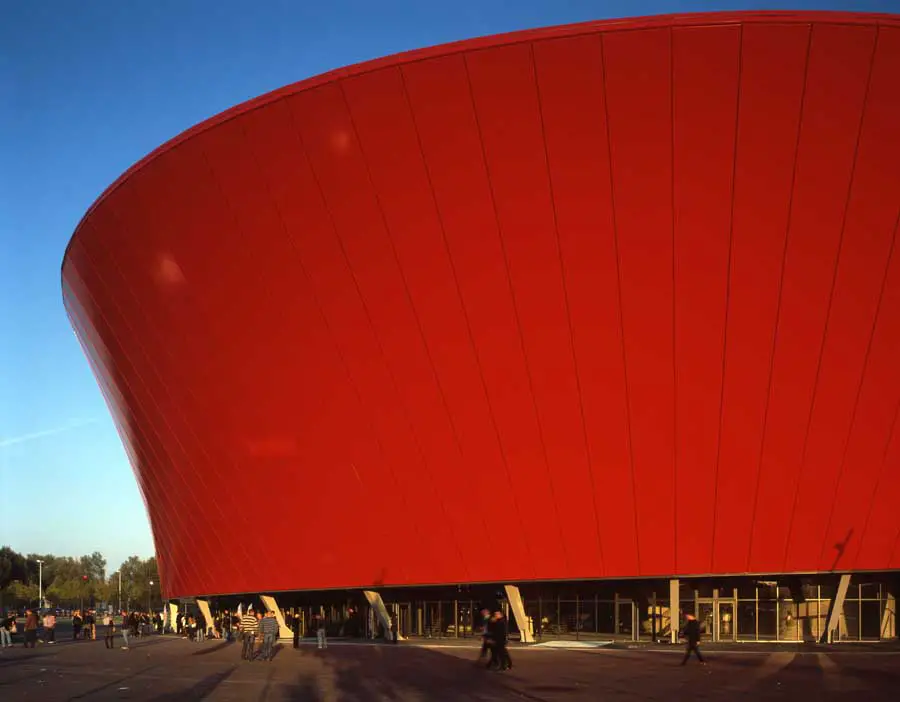
photo : Philippe Ruault
Limoges concert hall
Design: Bernard Tschumi Architects
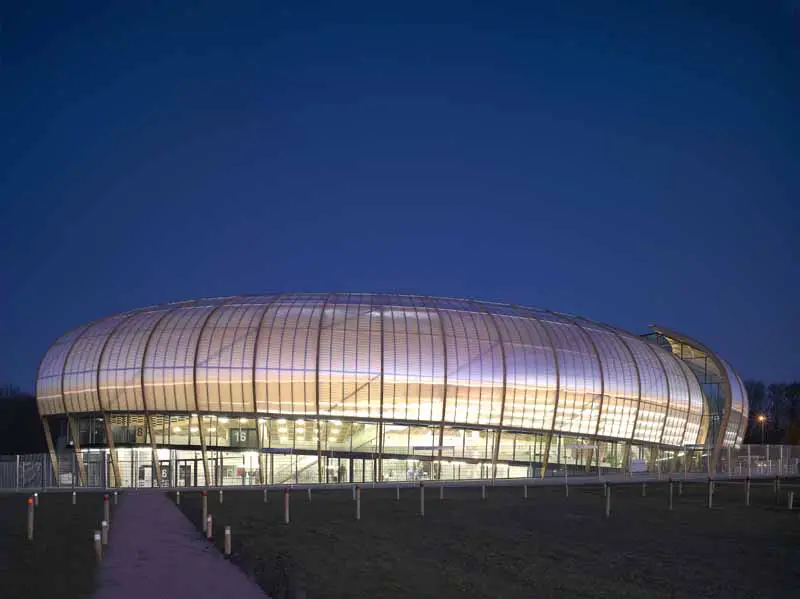
photo : Christian Richters
Comments / photos for the Pôle Sud Skating Rink France page welcome
Pôle Sud Skating Rink Grenoble