
Living Steel Recife Architecture, Sustainable Brazil Homes, Architect, Pictures, Design Proposal News
Living Steel Competition : Recife Housing, Pernambuco
Brazil Architecture Competition: Sustainable Housing, Recife, by Andrade Morettin Arquitetos, South America
8 Sep 2008
Living Steel – Sustainable Housing Recife
2nd International Architecture Competition for Sustainable Housing
Recife, Pernambuco, Brazil
Architects: Andrade Morettin Arquitetos
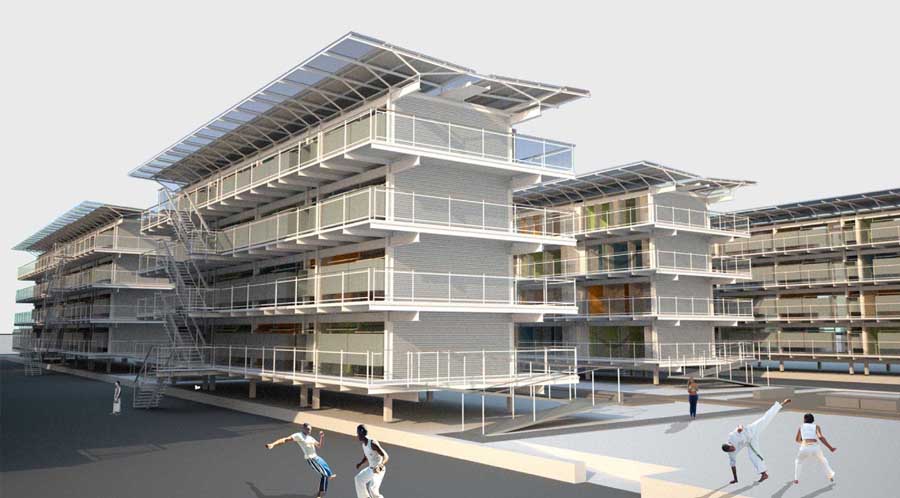
Andrade Morettin Arquitetos believe that the objective of the Living Steel Competitionn is not limited to proposing a design for a specific lot in Recife, the objective is rather to point out solutions for a major housing problem within a macro-region that is defined not by its geopolitical limits, but by its bioclimatic characteristics.
This macro-region is the humid tropical zone, which occupies almost 50% of the inter-tropic region of the planet. It is characterized by intense solar radiation, high rainfall index, high temperatures with little fluctuation, and high humidity.
Besides the climatic properties, some common socio-cultural factors can be distinguished. For example, the economic condition in the global scenario – many “developing” countries are established in this region; the growing urbanization of their societies and the lack of housing in the context of pressure by demographic growth.
Within this region local architectural typologies can be identified with characteristics that are repeated, which can provide a number of basic elements for the building’s adaptation.
The urban context of Recife – Pernambuco
Within this macro-region, Recife is part of the Tropical Atlantic region. With a notable hydrographic network the costal sub-region presents an unstable relation between soil and water, while the tendency is to occupy low, periodically flooded wetlands.
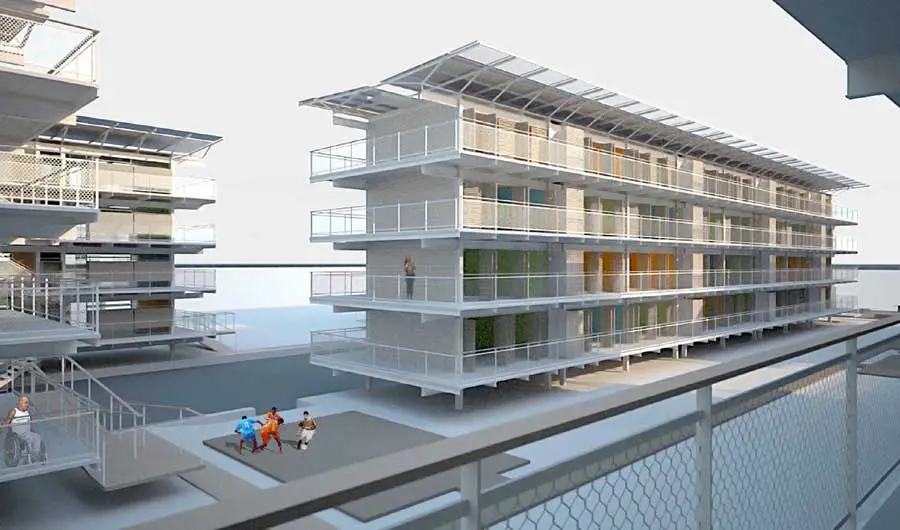
To adapt the design to this context Andrade Morettin Arquitetos thought of elevated buildings, on columns, with light structures that do not exceed the load-bearing capacity of the soil.
In the specific case of the proposed housing project with four floors the architects guarantee the desired density in a healthy manner, furthermore the architecture studio avoid the necessity of mechanization of the vertical circulation, respecting the severe financial restrictions.
APPROACH
Andrade Morettin Arquitetos believe that the consciousness, with regard to Global Warming – and the adoption of measures resulting from it – configures a new world order.
Consequently the architects understand that the problem proposed by the competition demands a broad approach, capable of defining what is to be the role of architecture in this new context and to which parameters it should refer.
Andrade Morettin Arquitetos sought to develop an architectural model whose essence consists in responding directly and economically to these parameters. In other words, a model not only adapted to ecological and social sustainability issues, but rather one that originates from and is restricted to these parameters: “Essential Architecture”.
Andrade Morettin Arquitetos established seven parameters that are fundamental to the solution the architects proposed for this competition. The architecture is rooted in its context in such a way that it cannot be understood without it. Only exposed to these parameters this architecture reveals its beauty.
The Seven Parameters
1 Land Use
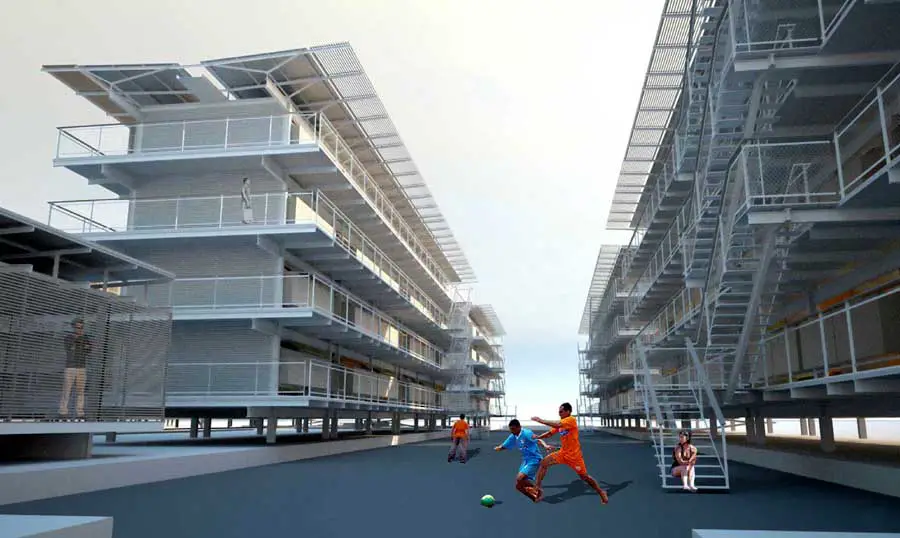
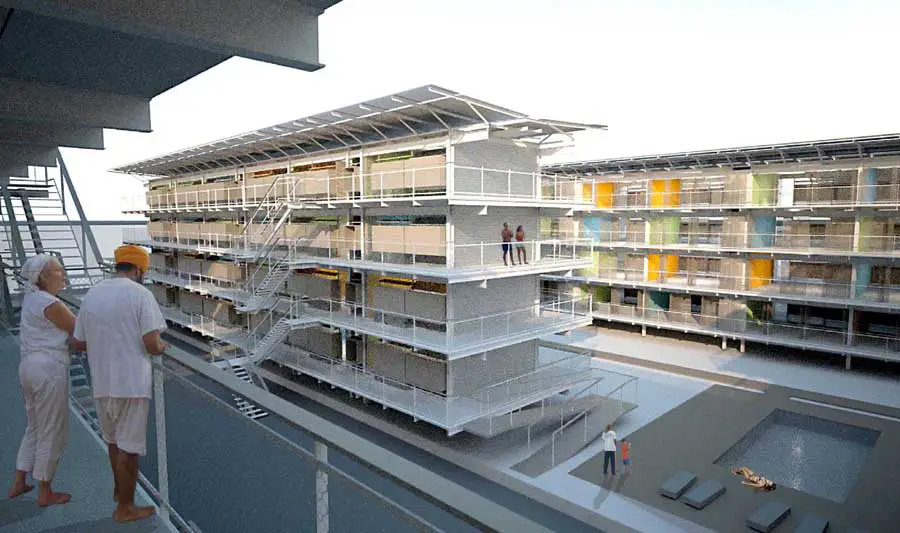
Considering that the quality of the urban environment in the humid tropical region depends mainly on good ventilation for thermal comfort and hygiene, the proposed model foresees not only “permeable” buildings, but also the implementation of isolated housing blocks, distributed in such a manner to allow the air to flow permanently between the buildings.
The increase in density – considering the extremely low density of the predominant settlements – conducts a more productive model for occupation of the territory, absorbing the population growth and containing urban sprawl.
The buildings were thought as a system that can assume different dimensions. The number of floors is a result of the load-bearing capacity of the soil and the possibility to equip the buildings with elevators.
The landscaping must be conceived fully in accordance to the native species, discarding use of extra maintenance and water.
2 Bioclimatic Performance
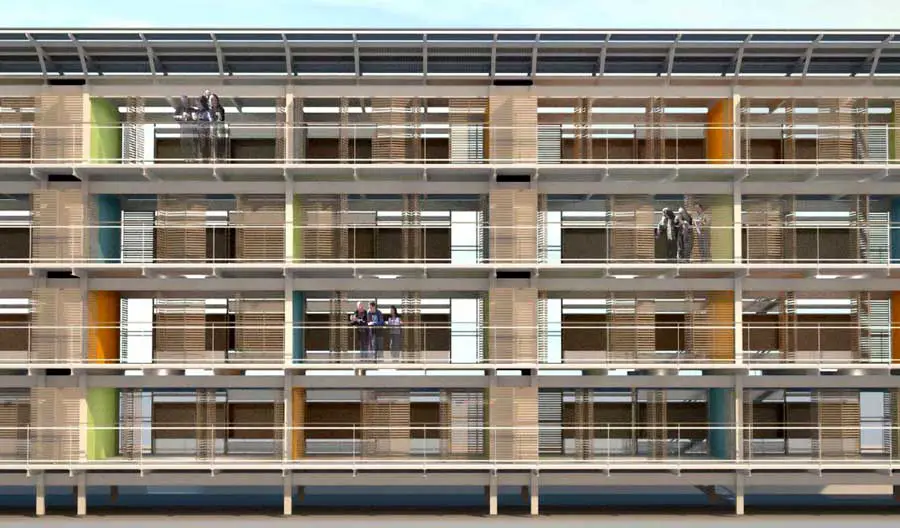
Shade and ventilation are understood as essential strategic resources, discarding the mechanized solutions for climate control. For this reason the spaces are “exploded”, there are voids. As there does not exist a cold season in this region, the use of glass in the facades was discarded: “Glass Free”.
Ventilation cools down the spaces and the buildings, maintains the atmosphere free of floating particles and prevents the condensation of moisture on the surfaces as well as the resulting formation of fungus.
The balconies and the roof – being an umbrella with big cantilevers – besides providing shade, guarantee good protection against the rain, however without blocking the ventilation. The building is elevated from the soil, on columns, like a pier.
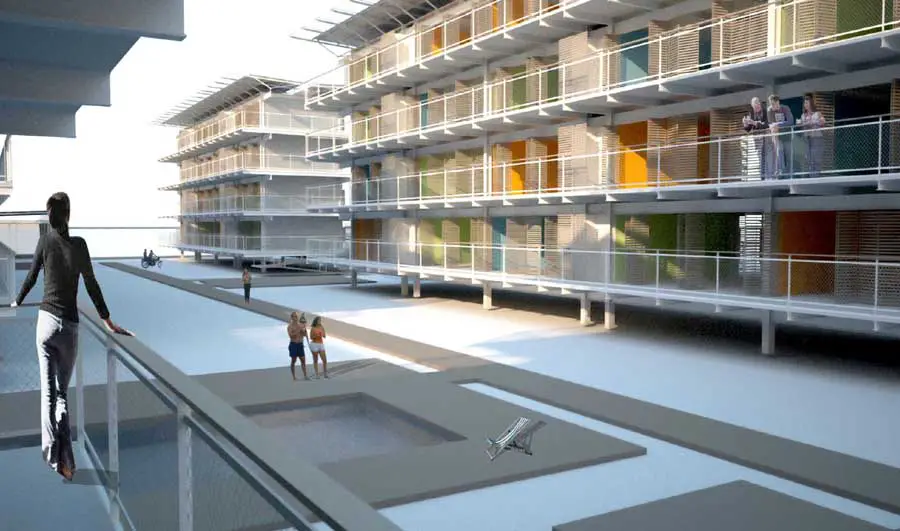
The cross ventilation is guaranteed by open interiors; room dividers of medium height and the shutters, designed to block the intense light of the sun, while admitting free air circulation at all times. The adjustment of the shutters allows the user to control the air velocity inside the apartment, as well as to block the solar rays of the rising and setting sun.
Materials with a small mass or thermal inertia were used, avoiding the accumulation of heat during the day, since the nights are equally hot. The use of bright colors also minimizes the absorption of solar radiation.
3 Construction and Operation
The construction method is basic, composed of few elements, components: “Essential”.
Through the typical cross section the building is conceived as an “extrudable” machine, a reproducible system. Prefabricated components are to be assembled easily at the site, guaranteeing a clean and rational process, a dry construction site.
Composed of standard profiles, the steel superstructure will be fully bolted in place, discarding the activity of welding on-site. The use of prefabricated flooring slabs discards the use of scoring or temporary structures.
The use of finished industrial components discards the use of painting and other treatment of surfaces, minimizing the maintenance activities. The residues generated during the construction or operation of the building must be separated and distributed for recycling, involving the local organizations in this production process.
The use of passive resources for the main functioning minimizes the costs and complexity of the building’s operation: “Energetic Efficiency” – less Watts per square meter.
4 Materials and Resources – Environmental Performance
The project seeks to respond to the global crisis basically by means of reduction. The idea of “essential” architecture foresees a basic construction; minimal, with economical use of materials: “Lightness”.
Its functioning based on passive solutions, the building demands a minimal consumption of energy for operation and maintenance.
The possibility of generation of clean energy on the site, however, is not abandoned. According to the financial situation and the region’s energy supply system, the project may carry photovoltaic panels on the roof.
The adopted principles for the materials? specification are: ecological certification with accessible cost – compatibility with the planning of social housing projects; maintaining a balance between industrial components of global impact and local materials, such as Eucalypto citriodora – a local reforestation product.
Some central systems, of basic functioning and maintenance, must be installed in each building, such as a solar heating system for hot water and reuse of rain water. Due to the region’s high index of rainfall the reuse of gray water can be discarded.
5 Flexibility and Reproducibility
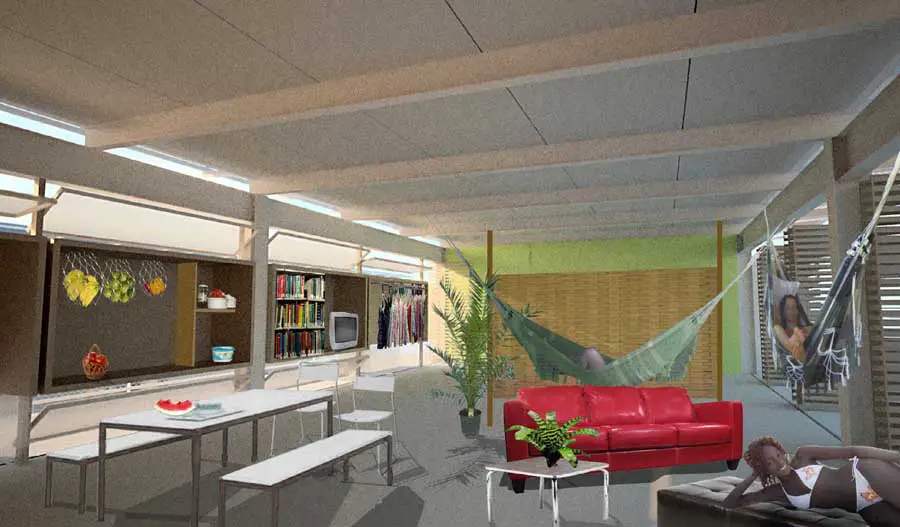
The idea of essential architecture as infrastructure took us to the conception of a flexible system, based on providing open and shaded floors, which offer as platforms – referring to the region’s river ships – a support, an open space to be appropriated.
The building, assembled from prefabricated components and industrial elements, is naturally focused on its reproducibility.
Designed as an adequate system for the entire humid tropical region, the building has a great capacity for absorbing the heterogeneity and mutability of use and allowing its reproduction in varying contexts with different dimensions.
6 Socio-cultural Factors
The unpredictability and velocity with which the family organization changes – influenced by religion, work division, symbolic values etcetera – induced us to think in flexible housing units with open floor plans.
The intervention in the space by the user is not only allowed, but in fact encouraged: The participation in the definition of the space stimulates the feeling of belonging, which besides adding to the well-being of the community also improves the involvement and responsibility regarding the preservation of the place – a fundamental factor for the sustainability of the complex.
Balconies and horizontal circulation are at the same time the places of shade, protection from the solar radiation, and the space for meetings and daily life. These common spaces are the spine of the building’s dynamics and may become the backbone of the community as well.
The use of certified industrialized materials contributes to the development of a productive organized society, while the incorporation of local techniques and traditions brings cultural identity into the complex.
7 Cost
The essential architecture is by definition economical: be it through industrialization of its production, be it by the rational use of materials.
The predominant use of natural resources, such as natural ventilation and lighting, reduces considerably the necessity of equipments and, therefore, the amount of energy and capital for the construction and operation of the buildings.
The industrialization of the construction provokes the economy of mass production, besides the reduction of construction time and waste of materials on the site.
Living Steel Competition – Further Information
PROJECT
2nd International Competition Living Steel for Sustainable Housing
LOCATION
Recife, Pernambuco
YEAR
2007
ARCHITECTS
Vinicius Andrade, Marcelo Morettin
PROJECT TEAM
Marcelo Maia Rosa, Marcio Tanaka, Marina Mermelstein, Merten Nefs, Renata Andrulis, Thiago Natal
CONSULTANTS
Stec do Brasil (structure); Ambiental (bioclimatic performance); Ecocasa – Tecnologias Ambientais (Environment); Tr?de – Servi?s T?nicos (Budgeting).
AWARD
1st Prize in the 2nd International Competition Living Steel
PUBLICATIONS
_The Architectural Review, 12/2007. Emap Communications, UK
_MORAR – Revista da Folha, 10/2007. Folha de S? Paulo, Brazil
_METALICA – www.metalica.com.br
Living Steel Competition images / information from Andrade Morettin Arquitetos 090908
Location: Recife, Pernambuco, Brazil
Brazil Architecture
American Architecture Walking Tours : city walks by e-architect
Brazil Architecture Design – chronological list
Cidade da Musica Rio de Janeiro
Comments / photos for the Living Steel Competition Brazil page welcome
