
Perth Zoo Orang-utan Enclosure, Zoological Gardens Australia, Exhibit Design, Picture
Perth Zoo Development
Orang-utan Enclosure Project Western Australia design by Iredale Pedersen Hook Architects
2 Sep 2009
Location : Western Australia
Design: Iredale Pedersen Hook Architects
Perth Zoo Orang-utan Enclosure
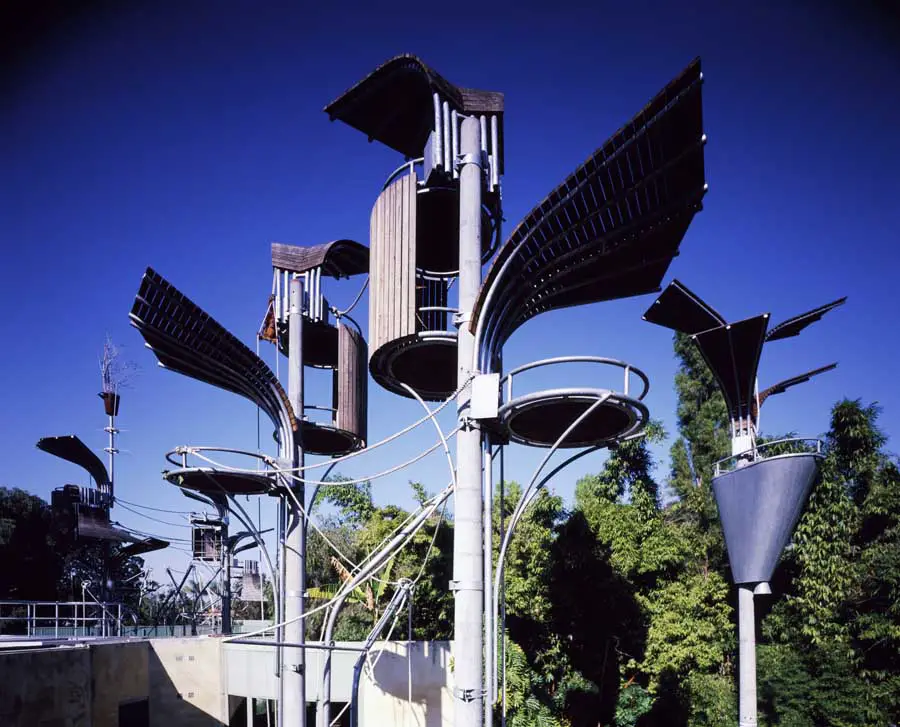
photo © Shannon McGrath
Perth Zoological Gardens Orang-utan Enclosure
The Perth Zoo’s Orang-utan Exhibit upgrade is our utopian project. It has combined many of our interests in the one project and proved to be a challenging and stimulating design task.
Iredale Pedersen Hook Architects were engaged as the Perth Zoo’s Architect and have designed upgrades to the Front Entry of the Zoo and the Australian Bushwalk Exhibit and, most importantly, developed a master plan and design for a major redevelopment of the Zoo’s Orang-utan Exhibit.
Sumatran Orang-utans are critically endangered and are facing extinction in the wild within the next five to ten years. Perth Zoo is regarded as a world leader in captive breeding of the Sumatran Orang-utan with 26 orang-utans born at the Zoo since 1970.
Orang-utans are highly intelligent, tree dwelling great apes and are one of our closest biological relatives. . They have the intelligence of a 6 year old child, and are very inquisitive, so creating a stimulating home for them is of critical importance.
photos © Shannon McGrath
The task involved detailed consultation with Zoo staff, studies of other animal enclosures and developing an understanding from the Zoo keepers of the ways of the orang-utans.
Our Brief was to retain the existing Service Building containing the animal night quarters and re-design the exhibit spaces to improve the exhibit for the orangutans and the people viewing them.
A Master Plan was developed based on a staged redevelopment that allowed the Zoo to move the upgrade the existing five exhibits and add two more. The first exhibit was a prototype that allowed the Zoo to trial the exhibit furniture and modify it based on the results of the observed behavior of the Orangutan who trialed the exhibit.
The first Orangutan to try the exhibit in 2002 was studied for a control period before being let into the new exhibit, then studies for the same period and season after release. This “post occupancy evaluation” provided the result that the physical indicators of animal welfare all improved, proving the success of the exhibit.
The last Orang released into the new exhibit last year was Hsing Hsing, the old male of the colony who has type-2 diabetes. After living in the exhibit for some weeks he became more active and his diabetic activity improved considerably.
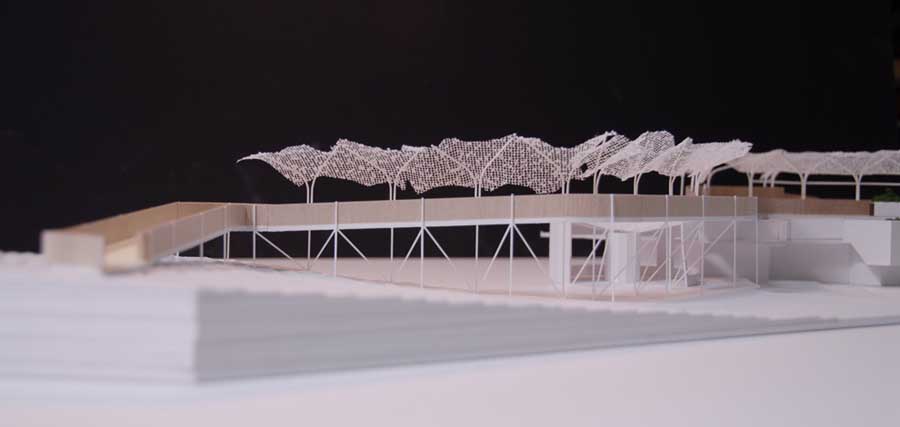
The last stage of the redevelopment includes plans to improve visitor viewing with a walk trail and viewing platforms within the rainforest canopy where visitors experience the “immersion effect” of viewing the orang-utans within an Asian rainforest.
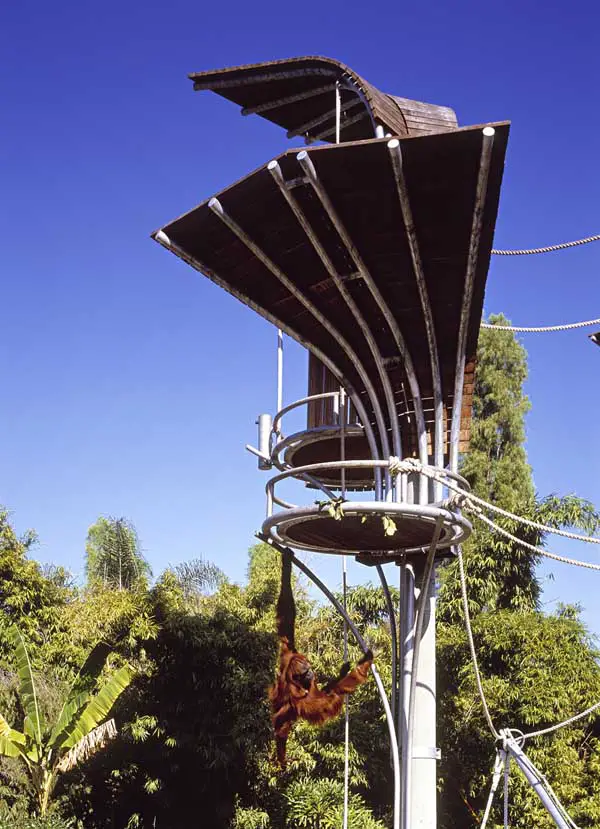
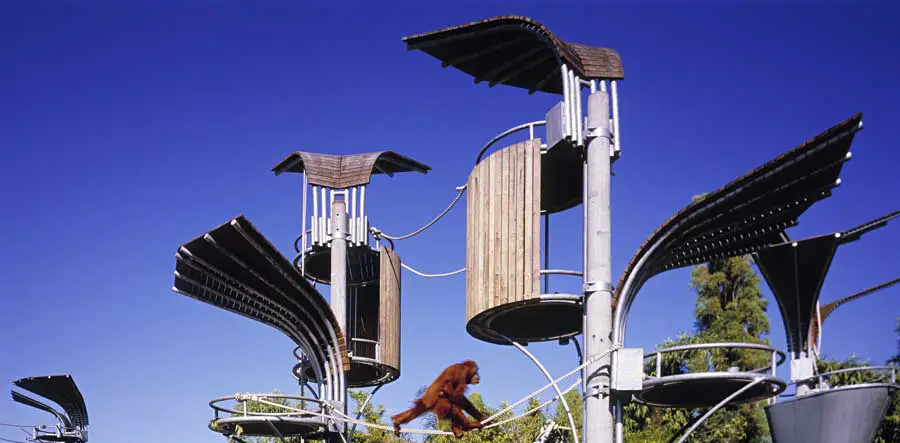
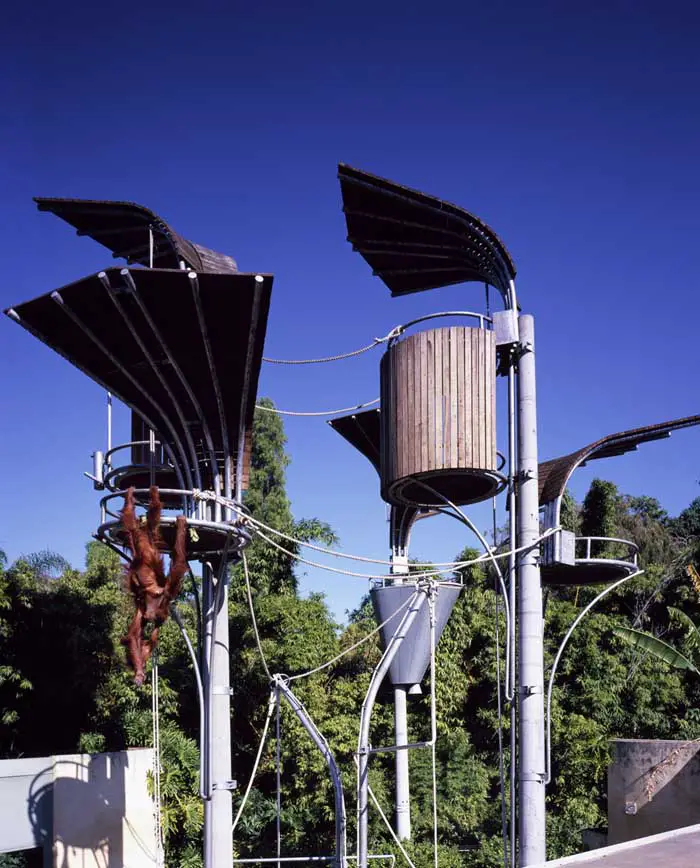
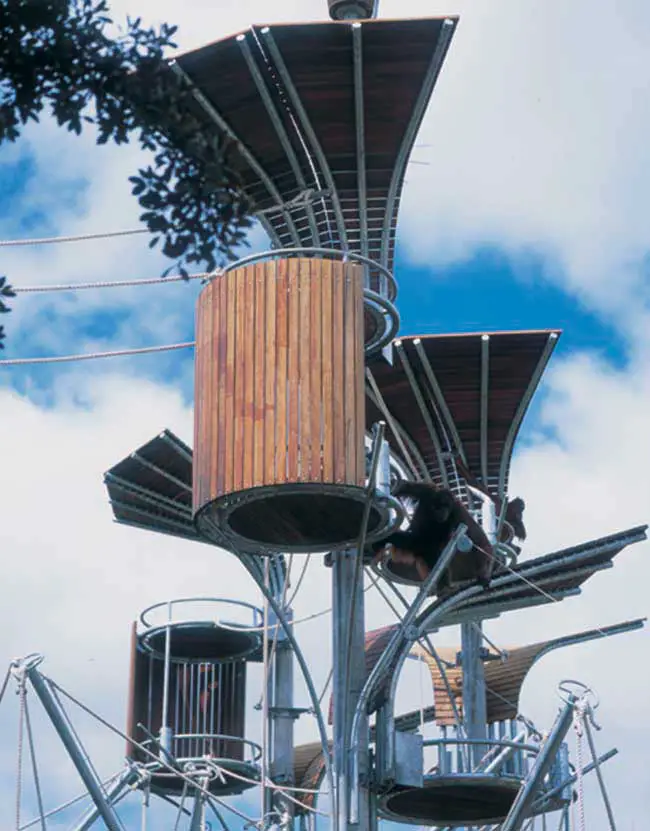
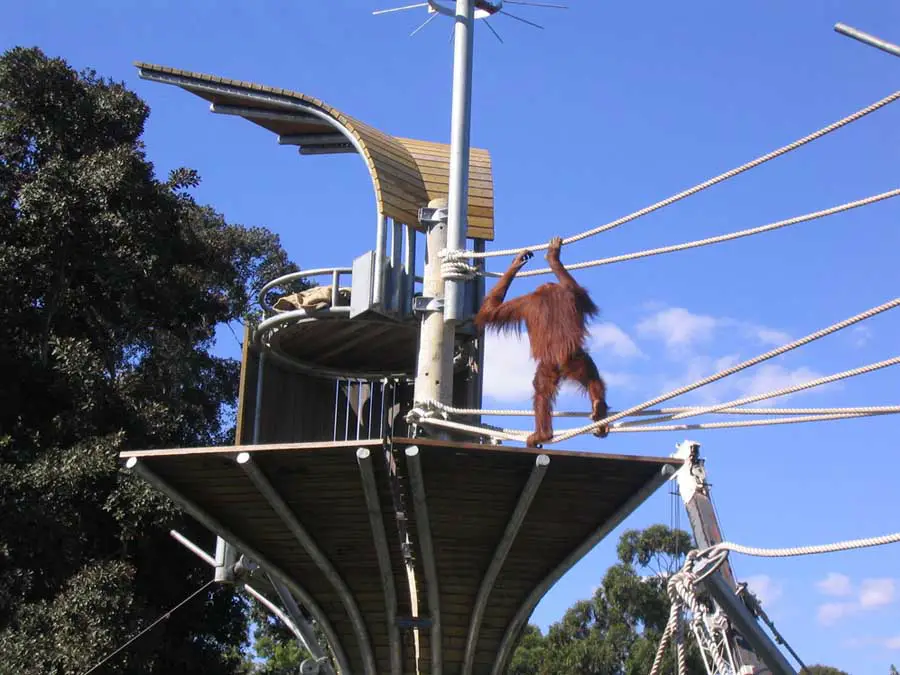
Real trees could not be used inside the new enclosure as the extremely strong orang-utans would destroy them very quickly, so the climbing apparatus is in effect a “tunable” steel forest. The steel branches and ropes can be adjusted by the keepers to suit different sized orang-utans.
The shorter steel mast poles support adjustable branches and rope “vines” and sway in a similar manner to small trees while the 12 to 14m tall concrete pole supports nesting platforms and shading devices from recycled jarrah joists. The re-cycled concrete power poles act as “tree trunks” and were donated by Western Power.
The nesting platforms are critical as orang-utans build nests in their natural habitat and need to be able to do the same at their home at the Perth Zoo. The nesting platforms also support drinking points and water canons that the orang-utans can spray each other with as a behavioral enrichment activity.
The bases of the poles support cordial and jam dip tubes providing further stimulation for the orang-utans as they make tools to remove the food from the tubes.
Other works included the industrial design of a system of Pneumatic sliding doors that can close in 3 seconds but not crush a banana (or injure an Orang-utan) and not be defeated by the animals who are 6 to 10 times stronger than an adult human.
photos © Iredale Pedersen Hook Architects
Perth Zoo Orang-utan Enclosure Keeper Notes
Status and Threats
Orangutans live on the Indonesian islands of Sumatra and Borneo. There are two species of orangutan; Sumatran and Bornean. The Sumatran orangutans are classified as a critically endangered species with only 7500 left in the wild.
They face extinction within 10 years if the huge amount of forest destruction does not cease in Indonesia. Bornean orangutans are endangered with approximately 40,000 in the wild but facing the same environmental devastation as the Sumatran orangutan. Forests are being logged to make way for massive palm oil plantations. Palm oil is used in hundreds of supermarket products including toothpaste and cosmetics.
There is a huge demand for palm oil from Western countries. Forests are also cleared to provide wood for the expanding timber industry and to make room for living and agricultural space. Forest fires are also responsible for much of the orangutan habitat being lost. Please be aware of the products you buy and try to avoid products that have contributed to the destruction of Indonesian rainforests.
The illegal pet trade also has a devastating impact on the orangutan population. Baby orangutans can be sold for large amounts of money on the illegal pet trade. In order to obtain a baby orangutan, the mother is usually shot and killed. The babies are then smuggled to illegal markets in Indonesia or sent to countries such as Bangkok, Taiwan and Hong Kong.
Many of the babies don’t survive that journey, so every pet baby orangutan that is for sale, probably represents another 4 mothers and infants that have been killed. That has a huge impact on a population where a female would normally only have 3-4 babies in her lifetime. Because of the many roads that have been built into the forest for logging trucks, many more hunters are now entering the forest to hunt the orangutans.
This is the largest group of Sumatran orangutans in Australasia. Perth Zoo is famous throughout the world for its extremely successful captive breeding programme of the critically endangered Sumatran orangutan.
Education and Conservation
Zoos throughout the world cooperate to breed and study orangutans and to educate people about them. However, there is no way that zoos can save orangutans on their own. We don’t have the space or the money or any of the other resources that we would need.
The only way that the two species of orangutan will survive is if their habitat in Sumatra and Borneo is protected. It is vital that zoos maintain a genetically diverse group of orangutans and maintain as many natural behaviours as possible including tool use, nest building and mothering skills. Educating the public and offering ways for them to help are also important factors in helping the orangutans.
The Australian Orangutan Project is a non-profit, volunteer run organisation that was started in Perth. AOP’s mission is to ensure the survival of both the critically endangered Sumatran and the endangered Bornean orangutan species in their natural habitat and promote the welfare of all orangutans. AOP raises funds to assist in-situ (in the wild) orangutan projects in their conservation and welfare work including:
– Providing medicines and equipment to care and rescue centres
– Anti-logging patrols in National Parks
– Establishing protected release sites for ex-captive orangutans
– Rainforest rehabilitation
– Community education programmes
The Australian Orangutan Project has been extremely successful over the last 2 years, raising well over half a million dollars for orangutan conservation. Numerous primate keepers are involved with this organisation. If you are interested in orangutan conservation then please visit the website: www.orangutan.org.au. You could become a member of AOP, adopt an infant at one of the care centres or make a donation. Perth Zoo has been supportive of AOP’s work and has provided donations to assist with our conservation projects.
Exhibits
Our new style exhibits have proven to be very successful with our orangutan colony. The exhibits contain a range of flexible, moveable equipment that is more complex and stimulating than the older style climbing frames. The large poles with nesting platforms are 12m high and give the orangutans a great view of the zoo. A range of new behavioural enrichment has been incorporated into the new structures including water canons, food hoists and a range of dip tubes. Our orangutans are also more active and playful in the new exhibits.
Perth Zoo Orang-utan Enclosure – Building Information
Architects: Iredale pedersen hook architects
Project Team: Finn Pedersen, Adrian Iredale, Martyn Hook, Rebecca Angus, Jemma van Dongen, Peter Weiss, Ross Brewin, John Belviso, Mike Moore.
Client: Department of Housing and Works Government of Western Australia
Project Timeframe: 1999+
Perth Zoological Gardens Orang-utan Enclosure images / information from Iredale Pedersen Hook Architects
Perth Zoo Enclosure design : Iredale Pedersen Hook Architects
Address: 20 Labouchere Rd, South Perth WA 6151, Australia
Phone: +61 8 9474 0444
Opened: 1898
Location: Perth Zoological Gardens, Labouchere Rd, South Perth, Australia
Zoo Building Designs
Adelaide Zoo Entrance Precinct, Australia
Design: HASSELL
Adelaide Zoo Building
Australian Zoo Building : Giant Panda Forest
Islands at Chester Zoo Building, England
Design: AECOM, Architects
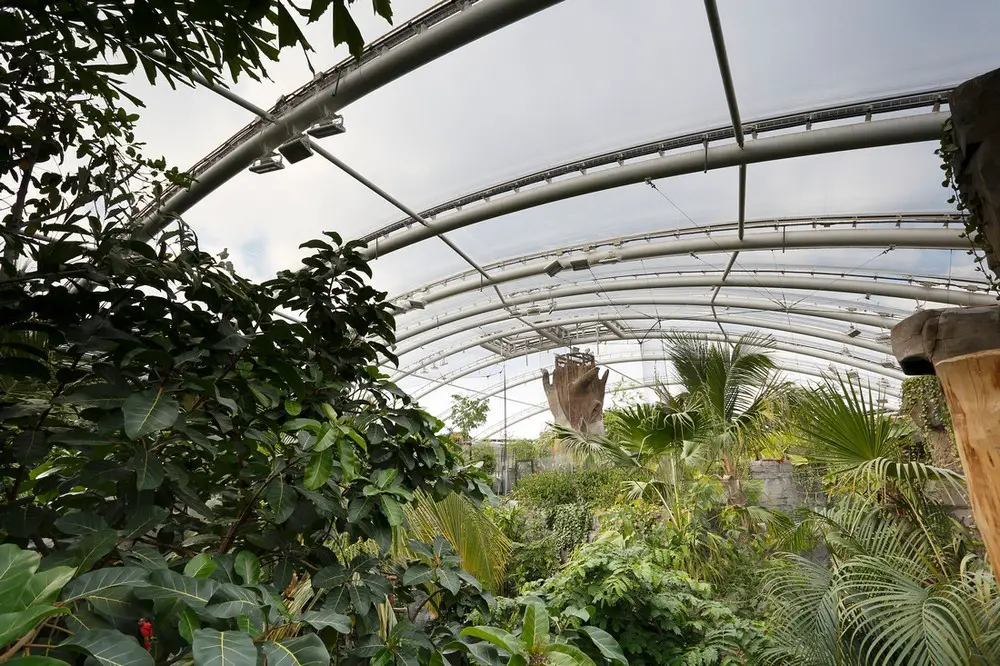
photo courtesy Novum Structures UK
Islands at Chester Zoo Building
Architecture in Australia
Comments / photos for the Perth Zoo Orang-utan Enclosure Australian Architecture page welcome
Website: Perth Zoo, Western Australia
