
Vivaldi Tower Amsterdam, Zuidas Offices, Architect, ING Project, Design
Vivaldi Tower Amsterdam
Ernst & Young Building, Zuidas, Holland design by Foster + Partners Architects
11 Jun 2008
Ernst & Young Headquarters Building, Vivaldi-park
Vivaldi Tower Project, Zuidas district, Amsterdam
2002-08
Design: Foster + Partners
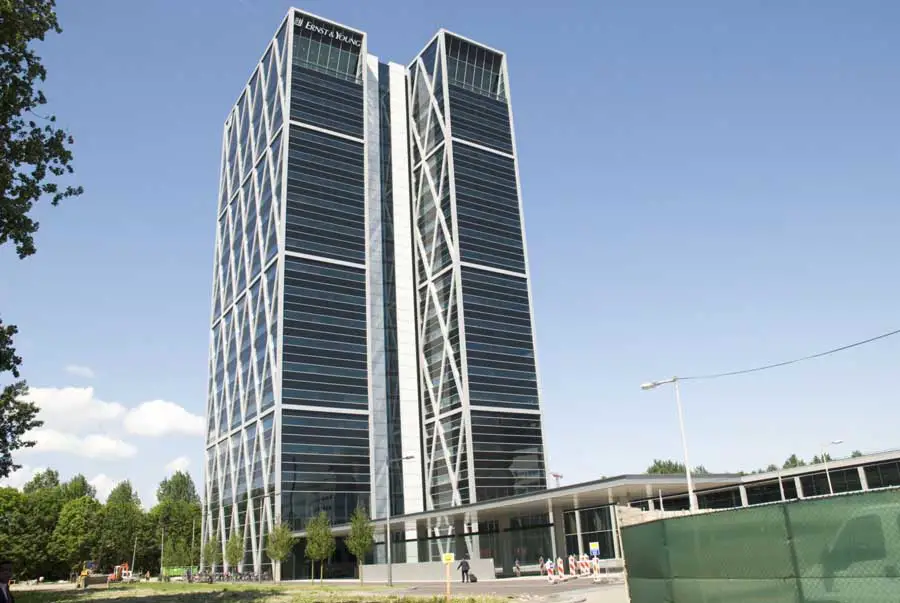
Foster + Partners has completed a headquarters building for Ernst & Young at the gateway to the Vivaldi-park area of the new Zuidas district, south of Amsterdam. Commissioned by ING, the tower establishes a landmark on the route into the city with its diagrid façade. Ten per cent more efficient than the target Dutch environmental standards, the building also extends the public realm with a water court at its base.
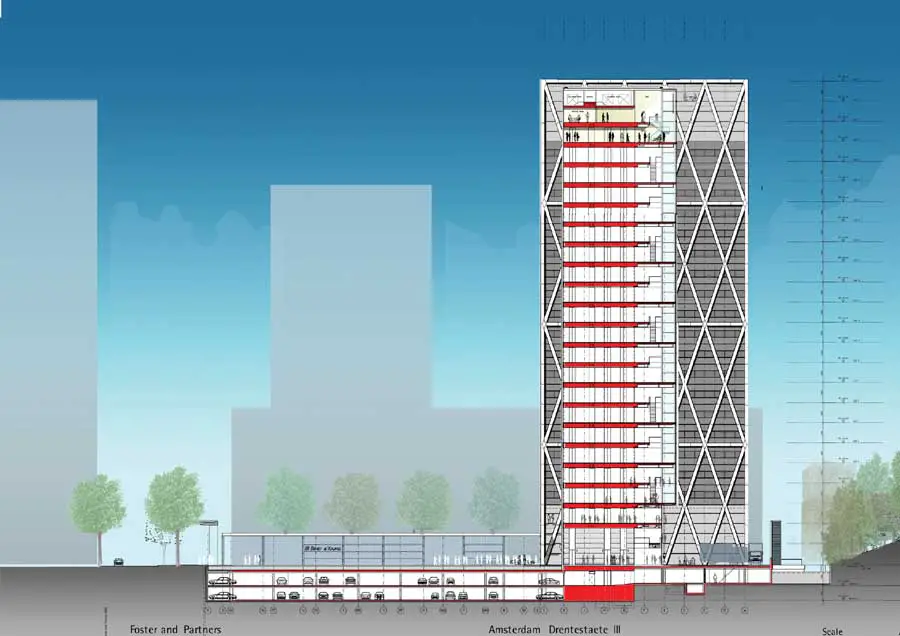
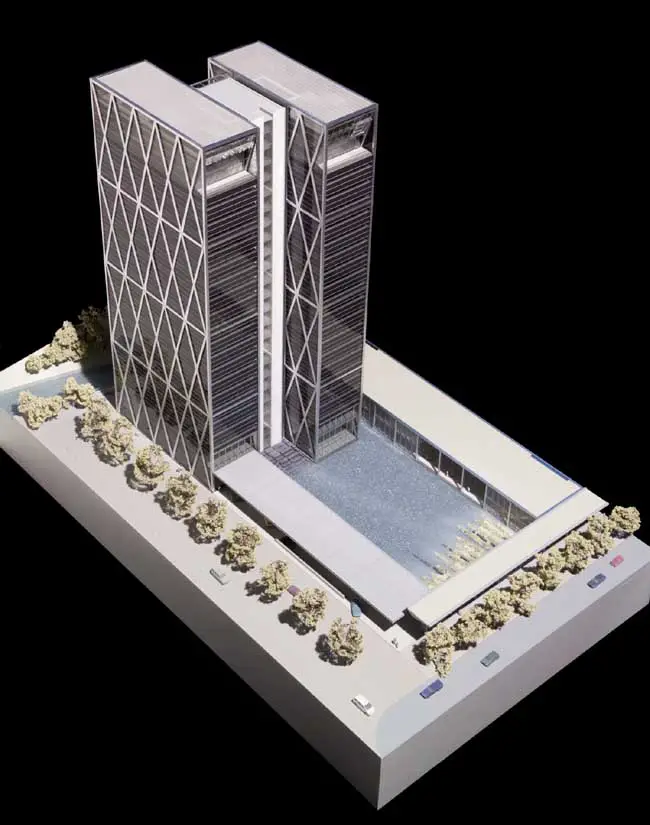
The 24-storey building is divided into two twelve metre-wide column free towers with open, flexible floor plates. The blocks are staggered in plan to admit as much natural light as possible and to make the most of the northerly city views. The northern façade is fully glazed, while partial thirty per cent glazing to the east, west and south limits solar gain. Combined with ground water storage to further save on energy for cooling, the overall environmental strategy is highly efficient.
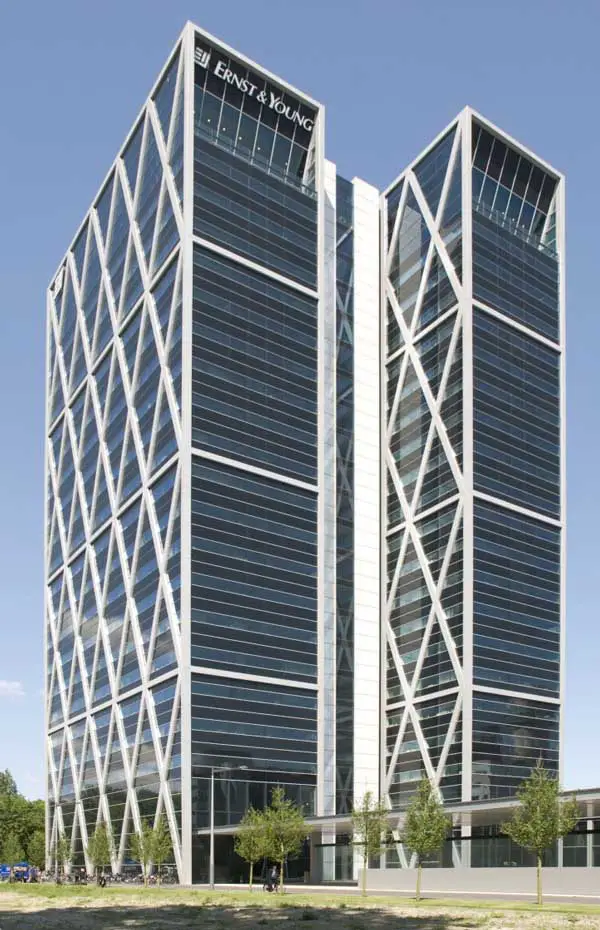
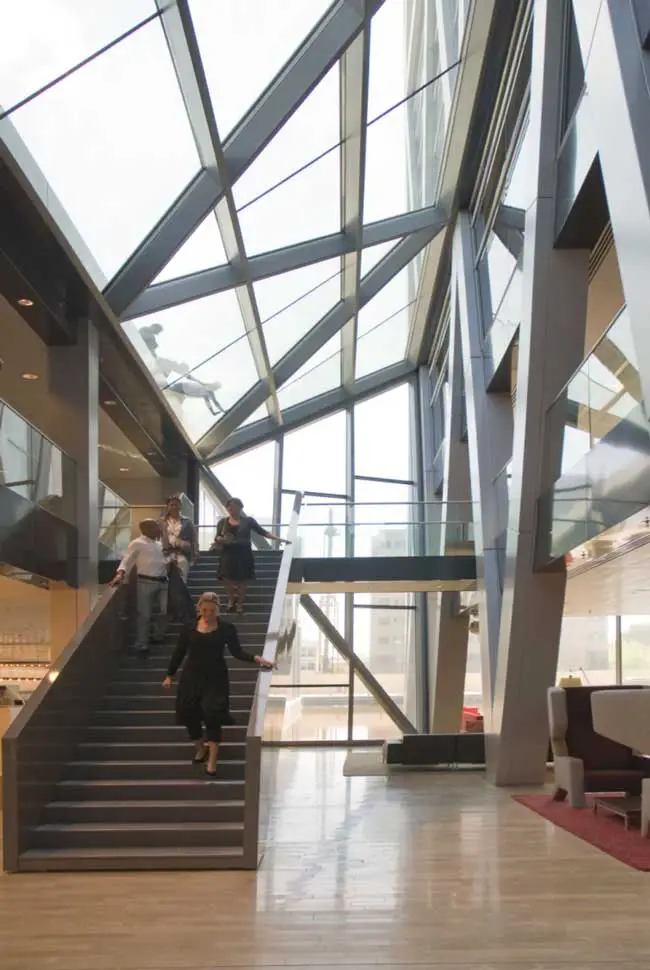
Linked by a shared transparent core, the offices are serviced by double-height meeting spaces and light-filled social spaces allowing communication between different floors. The structural steel diagrid is clad in silver aluminium and is offset by opaque black panels, which reduce the definition of the individual floor levels.
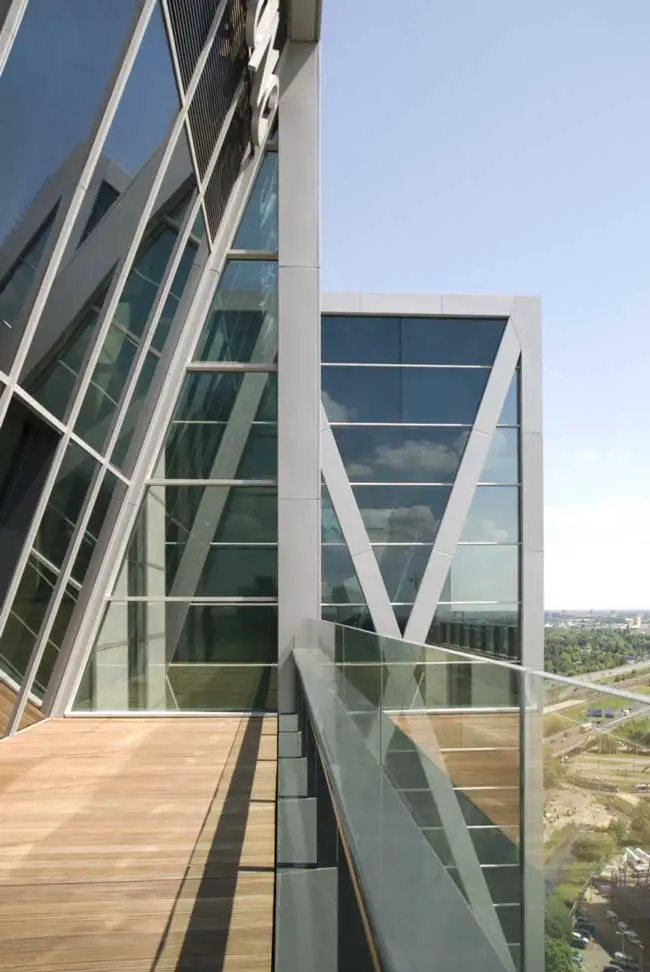
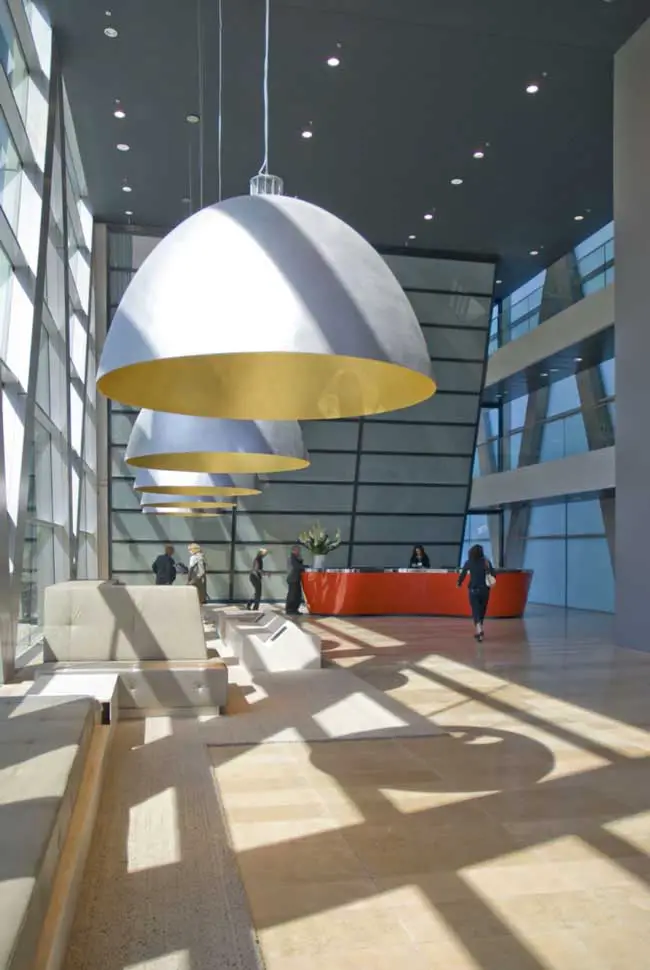
This lattice scales the entire 87-metre high facade and gives the building its identity. At the base of the building the height of the diagrid creates a triple-storey lobby space, while at the top of each tower north and south-facing terraces are set into the structure.
The towers are approached via a water-court with an ecological pond beneath an overhanging canopy. Defining the relationship between public and private, this space houses the social functions, such as staff restaurant, terrace, auditorium and bar, clustered around the water-court.
Coupled with a green roof on the restaurant building, the pond has an important environmental contribution. 65 per cent of rainwater is retained on site while the run-off feeds into the Amsterdam canal system to control water levels following peak rainfall. The pond is naturally cleansed by a planted biotope of reeds, water lilies and grasses.
David Nelson, Senior Executive and joint Head of Design at Foster + Partners said: “Our first building in Amsterdam not only exceeds Dutch environmental regulations by ten per cent, but provides a striking marker for the Vivaldi park area, a high quality, flexible working environment for tenants Ernst & Young and a lively public water-court with a working ecological pond at its base.”
Vivaldi Tower Project – Building Information
Images : Foster + Partners
Client: ING Real Estate Development NL
Tenant: Ernst & Young
Architect: Foster and Partners:
Norman Foster, David Nelson, Paul Kalkhoven, Reinhard Joecks, Gaby Schneider, Ben Dobbin, Lesley Epking, Simone Gauss, Luke Fox, Brian Ditchburn, Scott Beaver, Rafael Schmidt
M&E: Hiensch Engineering BV
Structural Engineers: Aronsohn Raadgevende Ingenieurs BV
Cost Consultant: Basalt Bouwadvies BV
Collaborating Architect: Bureau Bouwkunde Rotterdam bv
Environment and Façade Consultant: DGMR Consulting Engineers
Fit out: Merkx + Girod
Tenant Advisor: Kraan Consulting bv
Previously:
Vivaldi Tower Amsterdam – Groundbreaking Ceremony
A groundbreaking ceremony was held today to mark the beginning of construction on Foster and Partners twin towers in the Vivaldi urban quarter of Amsterdam. The 87m-high 24-storey tower was commissioned by ING Real Estate in 2002 – with Ernst & Young as the principal tenants.
It is one of several office buildings located at the eastern gateway to the mixed-use Zuidas development, south of Amsterdam. The towers rise above the elevated motorway to the north, and are linked to each other by a transparent core that accommodates shared service functions. The appearance of the building is determined by a distinctive ‘diagrid’ that ensures the tower is readily-identifiable on the drive into Amsterdam.
The structural steel diagrid is clad in silver aluminium and offset against the dark glazed cladding panels, which reduce the definition of the individual floor levels. This creates an elegant and arresting lattice that scales the entire facade. Set back from the street, the towers are approached along a south-facing water-court under an overhanging canopy, which defines the relationship between public and private. The social and communal functions, such as staff restaurant, ‘living room,’ and entrance hall, are clustered around this water-court, and the canopy – when joined to those of the adjacent developments – will provide sheltered access to nearby transport links.
The office accommodation is divided into two 12.6m-wide column free blocks with equal floor plates of 600m2 each, allowing for multi-tenant occupation if required. The blocks are staggered in plan to admit as much natural light as possible and to make the most of the northerly city views. The central circulation core incorporates six lifts, escape stairs and toilet facilities.
On the upper levels, the lift lobbies open onto double-height meeting spaces that are located between the two office wings. With the insertion of stairs between connecting floors, these spaces can serve four separate office floorplates by enabling horizontal and vertical connections. Executive facilities are located on the uppermost floors, and car-parking for 240 vehicles is provided underground. Access for all service traffic is at the rear of the building, via a dedicated service route that will ultimately connect all the towers on the Vivaldi site.
The scheme includes a series of environmentally progressive measures and is 10% more energy efficient than current Dutch requirements requires. Local legislation also stipulates that a large percentage of rainwater must be retained on site, before being released to the surface drainage system of this polder area. To achieve this goal, the lower plinth buildings have green roofs and the courtyard pond acts as buffer storage, with a biological filter of self-cleaning water plants. Any additional rainwater is directed into the building’s service water.
Vivaldi Tower design : Foster + Partners
Location: Zuidas, Amsterdam
Architecture in Amsterdam
Contemporary Architecture in Amsterdam
Amsterdam Architecture – contemporary building information
Amsterdam Buildings – historic building information
Vivaldi Tower architects : Foster + Partners
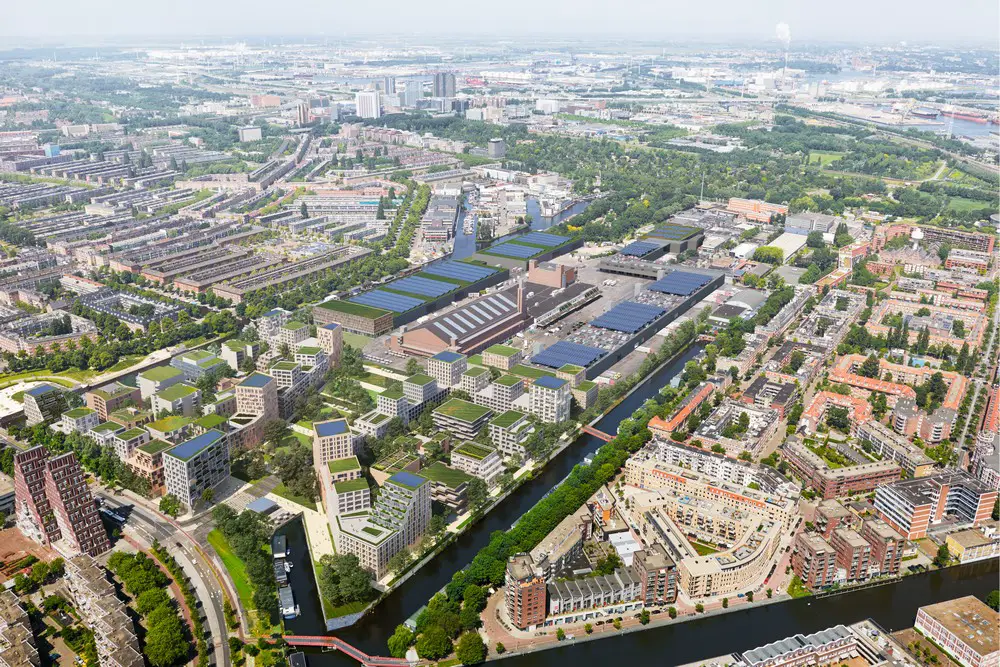
Masterplan Marktkwartier, Amsterdam, North-Holland, The Netherlands
Architects: Mecanoo
images : GVd Werff, Bank Amsterdam and Mecanoo
Masterplan Marktkwartier Amsterdam
Comments / photos for the Vivaldi Tower Amsterdam page welcome
